
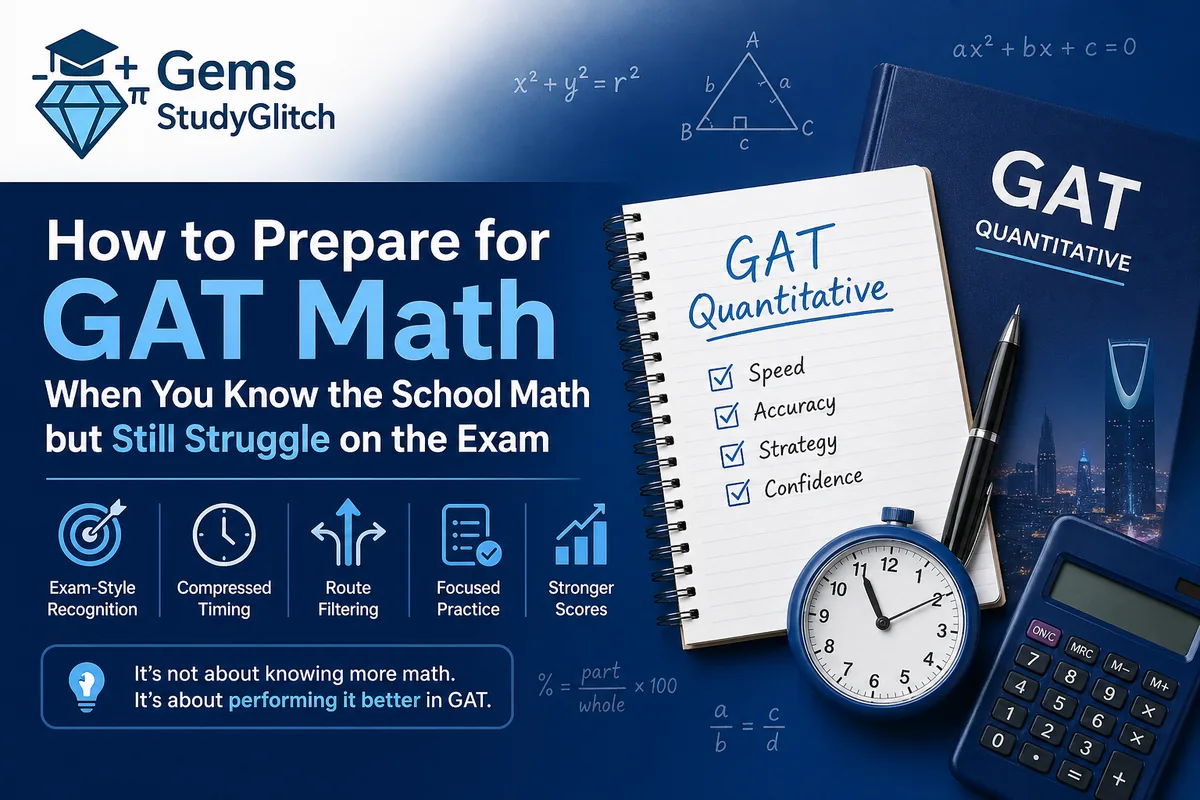
Many Saudi students face a confusing problem:
They are not weak in school math, but they still struggle in GAT Quantitative.
This can feel frustrating because the student may understand the formulas, pass school exams, follow classroom explanations, and still lose control when facing Qudurat-style math questions. Parents may also feel confused because the student appears capable in normal math but does not show the same ability in the GAT exam.
The problem is not always missing content.
In many cases, the problem is that GAT Quantitative asks for a different type of performance. It uses familiar math ideas, but it tests them through compressed timing, fast recognition, route selection, and pressure-heavy question forms.
That difference matters.
School math often rewards learning the lesson, following a method, showing steps, and applying a known rule. GAT math often rewards recognizing the shortcut, filtering the route quickly, avoiding traps, and making decisions under time pressure.
So when a student says, “I know the math, but I still struggle in GAT,” they may be telling the truth.
They may not need to restart math from zero. They may need to learn how to turn familiar math into exam-ready execution.
Why school math familiarity does not always transfer to GAT
School math and GAT Quantitative overlap, but they do not feel the same.
In school, students often learn one chapter at a time. They know the topic of the lesson before solving the question. If the class is about percentages, the student expects percentage questions. If the class is about geometry, the student expects geometry questions. The surrounding context helps the student choose the method.
GAT does not always give that comfort.
In GAT Quantitative, the student may face ratios, percentages, geometry, algebra, sequences, number sense, and word problems mixed together. The topic is not always announced clearly. The student has to recognize the structure quickly.
That is where many students lose time.
They may know the rule, but they do not identify fast enough that this is the rule needed now. Or they may recognize the topic but choose a long method that works in class but wastes time in the exam.
This is why the question is not only “Do I know the math?”
It is also:
- Can I recognize the question type quickly?
- Can I choose the shortest reasonable route?
- Can I solve without overthinking?
- Can I stay accurate under timing pressure?
- Can I move on before one question damages the whole section?
That is the real difference between classroom familiarity and GAT performance.
GAT math is not totally different math
It is important to be clear: GAT Quantitative is not completely separate from school math.
The exam still depends on familiar math foundations. Students need number sense, arithmetic control, percentages, ratios, equations, geometry, patterns, and problem-solving ability. Weak foundations will still hurt performance.
But GAT changes the way those foundations are tested.
A student may understand percentages in a school lesson but struggle when the percentage appears inside a fast word problem. A student may know geometry rules but freeze when the diagram is compressed or the solution requires noticing a relationship quickly. A student may understand ratios but choose a slow setup when mental comparison would be faster.
So the goal is not to reject school math.
The goal is to adapt it.
GAT preparation should take what the student already knows and train it into faster, clearer, more exam-shaped behavior.
This is why the StudyGlitch GAT Quantitative page focuses on structured preparation, not random question collection. Students need the bridge between math knowledge and Qudurat execution.
The real issue is recognition
One of the biggest reasons students struggle in GAT math is slow recognition.
Recognition means the student can quickly identify what kind of problem they are facing and what route is likely to work.
Without recognition, the student starts every question from zero.
They reread. They hesitate. They try one method, then switch. They wonder if there is a trick. They lose confidence. Even if they eventually solve the question, the time cost may be too high.
Strong GAT performance depends on faster recognition patterns.
For example, the student should start noticing:
- When a ratio question is really asking for comparison.
- When a percentage question can be solved by scaling.
- When a geometry question depends on one hidden relationship.
- When a word problem should be translated into a simple equation.
- When answer choices can guide the solution.
- When estimation is enough.
- When a full calculation is unnecessary.
This is not magic. It comes from targeted practice and review.
The student needs to stop asking only “What is the answer?” and start asking “What made this question recognizable?”
That question builds exam skill.
Timing pressure changes everything
Many students can solve GAT-style questions when there is no timer.
Then the exam starts, and everything feels different.
Timing pressure changes how the brain behaves. A student may rush simple arithmetic, misread a word, forget an easy relationship, or become stuck on one question for too long. The math did not disappear. The execution became unstable.
This is why GAT Quantitative can feel harder than the student’s actual math level.
The issue is not always intelligence or effort. It is often timing behavior.
Under time pressure, students need to make faster decisions:
- Is this question worth solving fully?
- Is there a shortcut?
- Can I eliminate choices?
- Am I using a method that is too long?
- Should I skip and return?
- Did I spend too much time rereading?
A student who does not train timing will often feel surprised by the exam. They may know the math, but they are not ready for the pace.
This is why GAT preparation should include timed practice after the student has repaired key weaknesses. Untimed practice helps build understanding, but timed practice reveals whether that understanding survives the exam.
Route filtering is a major GAT skill
Route filtering means choosing the most efficient solution path.
In school math, a longer method may still be acceptable because the goal is often to show understanding. In GAT, a correct method that takes too long can still damage the final score.
This does not mean students should only memorize shortcuts.
It means they should learn to compare routes.
For many GAT questions, there may be more than one possible way to solve. One route may use algebra. Another may use substitution. Another may use answer choices. Another may use estimation or number sense.
The best route is not always the most formal route. It is the route that is accurate, efficient, and realistic under exam pressure.
Students should review questions by asking:
- Was my method correct but too slow?
- Did the answer choices offer a faster path?
- Could I have simplified before calculating?
- Did I use a school-style setup when a GAT-style route was better?
- Did I overcomplicate a simple relationship?
This is one of the biggest shifts from classroom math to Qudurat preparation.
The student is not only learning math. The student is learning how to choose.
Simplified questions can still be difficult
Some students underestimate GAT Quantitative because the math may look simple at first.
Then they discover that simple-looking questions can still be difficult under pressure.
A question does not need advanced mathematics to be challenging. It can be challenging because it is compressed, mixed, fast, or designed to punish hesitation. A basic percentage question can become difficult if the wording is tight. A simple geometry relationship can be missed if the student does not recognize the diagram quickly. A ratio question can consume too much time if the student chooses the wrong setup.
This is why GAT math can feel strange.
It is not always hard because the content is advanced. It is often hard because the exam demands quick judgment.
That is also why strong school students can struggle.
They may be used to understanding lessons deeply, but not used to making fast decisions across mixed question types. They may expect the question to look like the classroom example. When it appears in a different form, they hesitate.
GAT preparation must train flexibility.
The student should see the same idea in different forms until recognition becomes faster and more stable.
What to do if you know the math but struggle in GAT
If you already know many school math topics but still struggle in GAT Quantitative, do not restart blindly.
Start by diagnosing the gap.
The gap may be:
- A topic gap.
- A recognition gap.
- A timing gap.
- A route-selection gap.
- A review gap.
- A confidence gap under pressure.
Each gap needs a different response.
If the gap is topic knowledge, review the foundation. If the gap is recognition, practice mixed question types. If the gap is timing, use timed sets. If the gap is route selection, compare solution methods after each question. If the gap is review, classify mistakes instead of only checking answers.
A GAT/Qudurat diagnostic test can help separate these problems. Without diagnosis, students often waste time doing more questions without knowing what those questions are supposed to fix.
The goal is not just to practice more.
The goal is to practice the right thing.
Build a GAT preparation routine
A strong GAT math preparation routine should include four parts.
First, repair weak foundations.
This includes the topics that repeatedly cause mistakes, such as ratios, percentages, equations, geometry, sequences, averages, and number operations. Students should not ignore foundations because GAT rewards fast use of basic skills.
Second, train recognition.
Do mixed practice where the topic is not announced. After solving, label the question type and write what clue should have helped you identify it faster.
Third, train route filtering.
For each missed or slow question, compare your method with a shorter method. Do not only ask why the correct answer is correct. Ask why the faster route was available.
Fourth, train timing.
Use short timed sets. Do not immediately jump into long practice if timing causes panic. Start with controlled sets, review deeply, then increase pressure.
The StudyGlitch materials library can support this type of routine because students need guided review, topic repair, and structured practice rather than random scrolling through disconnected resources.
Good preparation is not just more work. It is better sequencing.
How to review GAT mistakes properly
Review is where many students lose the chance to improve.
After a wrong answer, they look at the solution, understand it, and move on. But understanding the solution is not always enough.
A stronger review asks:
- Why did I choose my original method?
- What clue did I miss?
- Was this a topic error or a recognition error?
- Did timing pressure change my decision?
- Was there a faster route?
- Can I solve a similar question tomorrow without help?
- Can I solve it under time?
This kind of review turns mistakes into patterns.
Patterns are what help students improve. If every mistake feels random, the student cannot build a plan. But if the student starts seeing repeated categories, preparation becomes clearer.
For example:
- “I keep missing ratio comparison questions.”
- “I know percentages but waste time setting them up.”
- “I understand geometry rules but miss hidden angle relationships.”
- “I lose accuracy when I rush arithmetic.”
- “I spend too long checking because I do not trust my first route.”
These are fixable problems.
But they only become fixable when they are named.
Why random question practice is not enough
Random practice can help, but only after the student has a system.
Many students prepare for Qudurat math by collecting questions from different places and solving as many as possible. This can feel productive, but it may not repair the actual performance issue.
If a student solves randomly without tracking mistakes, they may repeat the same weaknesses for weeks.
Random practice also hides the difference between:
- A question the student got right confidently.
- A question the student guessed correctly.
- A question solved with a method that was too slow.
- A question solved only because the topic was already familiar.
- A question that would fail under exam pressure.
These differences matter.
GAT preparation should turn practice into information. Every set should tell the student something: which topic is weak, which route is slow, which question type causes hesitation, and which skill is becoming stronger.
That is why structured study is more powerful than volume alone.
This connects closely to the idea in Prepare for GAT (Qudurat) Math in Saudi Arabia: students need a preparation system shaped around the actual exam, not just more exposure.
GAT is different from SAT and AP, but the lesson is useful
Students sometimes compare GAT with SAT or AP because all of them involve math performance.
But GAT Quantitative has its own personality.
It is especially sensitive to speed, recognition, and decision-making. SAT Math has its own structure and digital module behavior. AP Calculus AB tests calculus understanding and application. GAT is not simply a smaller SAT or an easier AP. It is a Saudi exam with its own pressure and preparation needs.
Still, one lesson is shared across all exams: knowing content is not the same as performing well.
That idea is also discussed in SAT vs GAT (Qudurat) Math: Key Differences Students in Saudi Arabia Should Know, but for this article, the main point is simple:
GAT students should prepare for GAT behavior.
That means fast recognition, route filtering, timing control, and pressure practice.
What strong students should understand
Strong students can struggle in GAT Quantitative.
This is important to say clearly.
Struggling in GAT does not always mean the student is weak. It may mean the student’s classroom strengths have not yet been converted into exam behavior.
A strong student may be used to careful solving. GAT may require faster filtering.
A strong student may be used to knowing the chapter. GAT may mix topics without warning.
A strong student may be used to full written methods. GAT may reward estimation or answer-choice use.
A strong student may be used to enough time. GAT may punish slow starts.
This does not make the student less capable. It simply shows the next skill to build.
The gap is not always intelligence. Often, it is adaptation.
When should you start preparing?
Students should not wait until the final weeks to understand how GAT Quantitative feels.
The earlier a student experiences exam-style questions, the earlier they can identify the gap between school familiarity and GAT execution.
That does not mean panic preparation. It means smart exposure.
If students wait too long, they may discover late that their issue is not one topic but the whole way they handle mixed, timed questions. This is the problem discussed in GAT Quantitative — Too Early or Too Late?.
A good preparation timeline gives the student enough space to repair foundations, train recognition, improve timing, and stabilize performance.
Cramming may help with reminders, but it rarely builds stable exam behavior from scratch.
Frequently Asked Questions
Why do I know school math but still struggle in GAT? You may know the math but struggle with exam-style recognition, timing pressure, route selection, or mixed question formats. GAT Quantitative often tests familiar ideas in faster and more compressed ways than normal classroom practice.
Is GAT math different from school math? GAT math is not totally different from school math, but the exam demand is different. It uses many familiar foundations, but it expects faster recognition, efficient solving, and stronger performance under time pressure.
How should I prepare for Qudurat math in Saudi Arabia? Start with a diagnostic test, repair weak foundations, practice mixed question types, review mistakes by category, and train timing gradually. Preparation should be structured around Qudurat exam behavior, not only around school chapters.
Why does GAT feel harder than normal math class? GAT can feel harder because topics are mixed, time is compressed, and students must choose solution routes quickly. In class, the topic and method are often clearer. In GAT, the student must recognize both under pressure.
Can strong students still struggle in GAT Quantitative? Yes. Strong students can struggle if they are not used to GAT-style timing, shortcuts, mixed topics, or fast decision-making. This does not mean they lack ability. It means their math knowledge needs to be trained into exam execution.
Final thought
If you know school math but still struggle in GAT Quantitative, do not assume you are not capable.
The gap is often not a lack of intelligence, effort, or potential.
The gap is usually about exam behavior.
GAT asks you to recognize faster, filter routes better, manage time more calmly, and execute familiar math under pressure. Once preparation is built around those demands, school math knowledge can start turning into stronger Qudurat performance.