
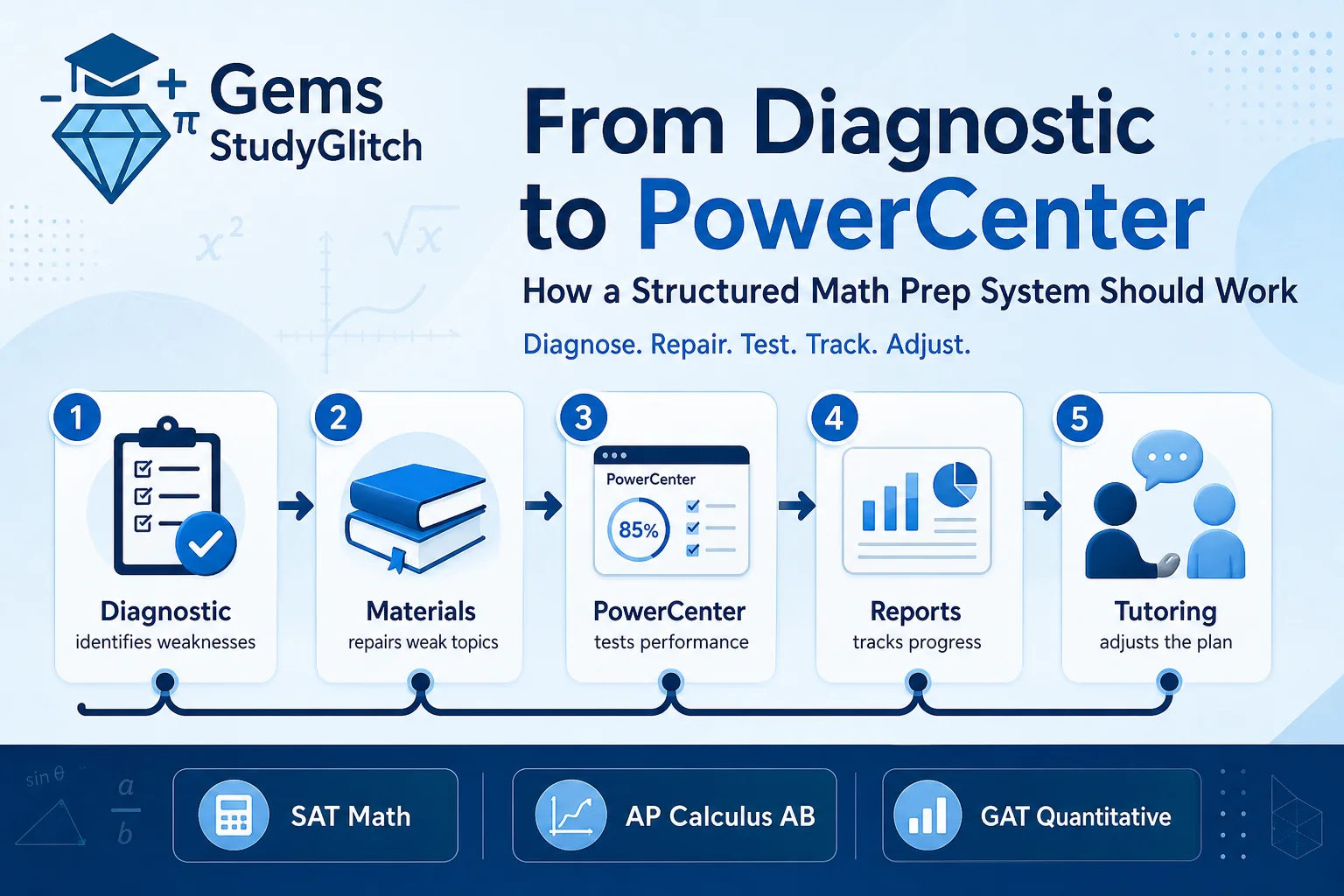
A strong math prep system should not begin with random practice.
For SAT Math, AP Calculus AB, and GAT Quantitative preparation, students need more than questions, worksheets, videos, and full-length tests. They need a system that shows where they stand, what they should fix, how they should practice, and whether their performance is actually changing.
That is why structured math preparation should move in a clear order:
- Diagnose the weakness
- Repair the topic
- Test the skill
- Track the result
- Adjust the next step
When these parts are disconnected, students often study harder without knowing whether they are studying correctly. When they are connected, preparation becomes easier to understand and easier to improve.
Why math prep needs a system
Many students prepare for math exams by collecting resources.
They take a practice test, open a PDF, watch a video, solve a worksheet, then move to another question set. This can create effort, but effort alone does not guarantee score improvement.
The problem is not that these resources are useless. The problem is that they are often used without order.
A student preparing for Digital SAT Math may keep practicing mixed questions while still missing basic algebra patterns. An AP Calculus AB student may review derivative formulas but still struggle with graph, table, and AP Calculus FRQ questions. A GAT Quantitative student may solve many short questions but repeat the same timing and reasoning mistakes.
A structured system helps prevent that.
It connects each step to the next one, so the student does not have to guess what to do after every result.
Step one: diagnostic testing identifies the starting point
The first step should be a diagnostic test.
A diagnostic test is not just a score. Its purpose is to identify the student’s starting point and expose the topics that need attention.
For SAT Math, a diagnostic can show whether the student is losing marks in algebra, advanced math, problem solving, geometry, or trigonometry. For AP Calculus AB, it can show whether the weakness is in limits, derivatives, applications of differentiation, integrals, accumulation, or AP-style reasoning. For GAT Quantitative, it can reveal problems in arithmetic, ratios, percentages, geometry, algebra, or quantitative reasoning.
Without diagnosis, students often choose practice based on feeling.
They may study what is familiar, avoid what is uncomfortable, or repeat topics they already understand. This makes preparation less efficient.
A good diagnostic should help answer:
- Which topics are weak?
- Which topics are strong?
- Which skills need repair first?
- Is the student struggling with accuracy, timing, or both?
- What should the next study step be?
This is why the StudyGlitch Diagnostic Test is the starting point of the preparation path. It helps turn a general study goal into a clearer plan.
Step two: materials repair the weak topics
After diagnosis, the next step should not always be another full test.
If the diagnostic shows that a student has weak foundations, the student needs targeted review before moving into heavy practice. This is where guided learning materials matter.
Materials should help repair the topics that the diagnostic exposed.
For example, if an SAT Math student is weak in linear equations, the next step should include focused review and practice for that area. If an AP Calculus AB student struggles with applications of derivatives, the materials should support that concept before the student moves into broader practice. If a GAT Quantitative student keeps missing ratio or percentage questions, the study path should point toward those skills.
This is different from random resource browsing.
A structured materials system should help the student know:
- Which topic to review
- Which skill the material supports
- How it connects to the exam
- Whether it should be used before or after practice
- What to do next after finishing it
The StudyGlitch Materials page supports this part of the process by giving students learning resources that can connect to exam preparation instead of leaving them with scattered files and no direction.
Step three: PowerCenter tests performance under exam conditions
After the student repairs weak topics, the next step is to test performance.
This is where practice tests matter.
A topic may feel clear during review, but the real test is whether the student can apply it in mixed questions, under time pressure, and across unfamiliar wording. That is why practice tests should come after targeted repair, not always before it.
The StudyGlitch PowerCenter is where students can move from topic review into performance testing.
For SAT Math, this can help students check whether repaired topics hold up in practice test conditions. For AP Calculus AB, it can help students test concept application across multiple question formats. For GAT Quantitative, it can help students measure speed, accuracy, and reasoning under pressure.
A strong practice system should show:
- Whether the student improved after review
- Which topics still break in mixed practice
- Whether timing is stable
- Whether mistakes repeat
- Whether the student can repeat a strong score
This is important because studying a topic and performing well on a test are not the same thing.
PowerCenter should not be used only as a place to take tests. It should be used as a checkpoint in the study cycle.
Step four: reports track what changed
After a student practices, the system should show what changed.
This is where progress reporting becomes important.
A score is useful, but it is not enough. A student needs to know whether the same weak topics are still appearing, whether timing improved, whether accuracy became more consistent, and whether the preparation plan should change.
A good report should help students and parents understand:
- Which topics improved
- Which topics are still weak
- Whether timing is better or worse
- Whether scores are becoming more consistent
- Whether the next step should be review, practice, or tutoring
This matters because improvement should be measured over time, not only by one test.
One strong score can happen by chance. One weak score can happen on a difficult day. But repeated data shows whether preparation is becoming more stable.
For schools, parents, and students, this kind of reporting makes math preparation easier to evaluate. It turns practice into evidence.
Step five: tutoring adjusts the plan when support is needed
Some students can use diagnostic results, materials, practice tests, and reports independently.
Others need guided support.
Tutoring becomes more effective when it is connected to data. Instead of starting with a vague statement like “I need help in math,” the tutor can see which topics are weak, which mistakes repeat, and whether the issue is content, timing, or consistency.
This helps tutoring become more targeted.
A student preparing for SAT Math may need help repairing algebra foundations. An AP Calculus AB student may need support with FRQ reasoning, graph interpretation, or applications of integration. A GAT Quantitative student may need faster strategies for ratios, percentages, and geometry under time pressure.
The StudyGlitch Booking page supports this final layer when students need structured tutoring after identifying where support is needed.
Tutoring should not replace diagnosis. It should respond to it.
Why the order matters
The order of the system matters because each step answers a different question.
A diagnostic asks: where is the weakness?
Materials ask: how do we repair it?
PowerCenter asks: can the student perform now?
Reports ask: what changed?
Tutoring asks: what adjustment is needed?
When students skip this order, preparation becomes less clear.
If a student jumps straight into full practice tests, they may collect scores without repairing the causes. If a student only watches lessons, they may understand topics but not know whether they can perform under pressure. If a student only takes tutoring sessions without measurement, it may be hard to know whether the support is producing consistent improvement.
A structured system keeps the process connected.
How this helps students
For students, the biggest benefit is clarity.
Instead of asking, “What should I study today?” the student can follow a more logical path.
First, identify the weakness. Then repair it. Then test it. Then review the result. Then adjust.
This reduces wasted effort because the student is not constantly guessing.
It also helps with motivation. Students often lose confidence when they work hard but do not understand why scores are not improving. A structured system gives them more specific feedback, which makes the next step easier to see.
How this helps parents
Parents often see the score first.
But a score alone does not explain whether the student is improving, stuck, or preparing in the wrong way. A structured system gives parents a clearer picture of the preparation process.
Parents can better understand:
- What the student is weak in
- Whether the student is practicing the right topics
- Whether performance is improving over time
- Whether the student needs tutoring
- Whether the study plan is becoming more focused
This makes decisions easier.
Instead of only asking whether the student studied, parents can ask whether the student studied the right thing.
How this helps schools and programs
Schools and learning programs need more than individual scores.
They need to understand patterns across students, topics, and levels. If many students struggle with the same SAT Math skill, AP Calculus AB concept, or GAT Quantitative topic, that information can guide instruction.
A structured system can support:
- Group-level topic analysis
- Student risk identification
- Practice assignment by weakness
- Better tutoring decisions
- Clearer performance tracking over time
This is why diagnostic-based preparation can support both individual learning and institutional reporting.
It gives schools and programs a clearer way to see what is happening academically.
What a connected study cycle looks like
A connected study cycle should feel simple from the student’s side.
The student starts with a diagnostic. The diagnostic identifies weak topics. The student uses materials to repair those topics. The student takes practice through PowerCenter. The report shows whether the weakness improved. If the same issue continues, tutoring or additional guided practice adjusts the plan.
That is the cycle.
It is not about adding more tools. It is about connecting the right tools in the right order.
StudyGlitch scales beyond individual prep and tutoring. It is an EdTech math prep platform that connects diagnostic testing, guided materials, PowerCenter practice, reporting, and tutoring support into one structured preparation path.
A strong math prep system should help students avoid random effort and move toward measurable preparation.
The goal is not just to practice more. The goal is to practice with direction.
Frequently Asked Questions
What is a structured math prep system? A structured math prep system connects diagnostic testing, topic review, practice tests, progress reports, and tutoring support so students know what to study, how to practice, and whether they are improving.
Why should students start with a diagnostic test? Students should start with a diagnostic test because it identifies weak topics, strong areas, timing issues, and the best next step before they spend time on random practice.
How does PowerCenter fit into math preparation? PowerCenter fits into math preparation as the testing and performance layer. After students review weak topics, they can use PowerCenter to check whether those skills hold up in practice test conditions.
Are materials enough without practice tests? Materials can help students repair weak topics, but practice tests are needed to measure whether those topics can be applied under exam-style conditions.
When should a student use tutoring? A student should use tutoring when weak topics keep repeating, timing does not improve, score movement stalls, or the student needs guided support to adjust the study plan.