
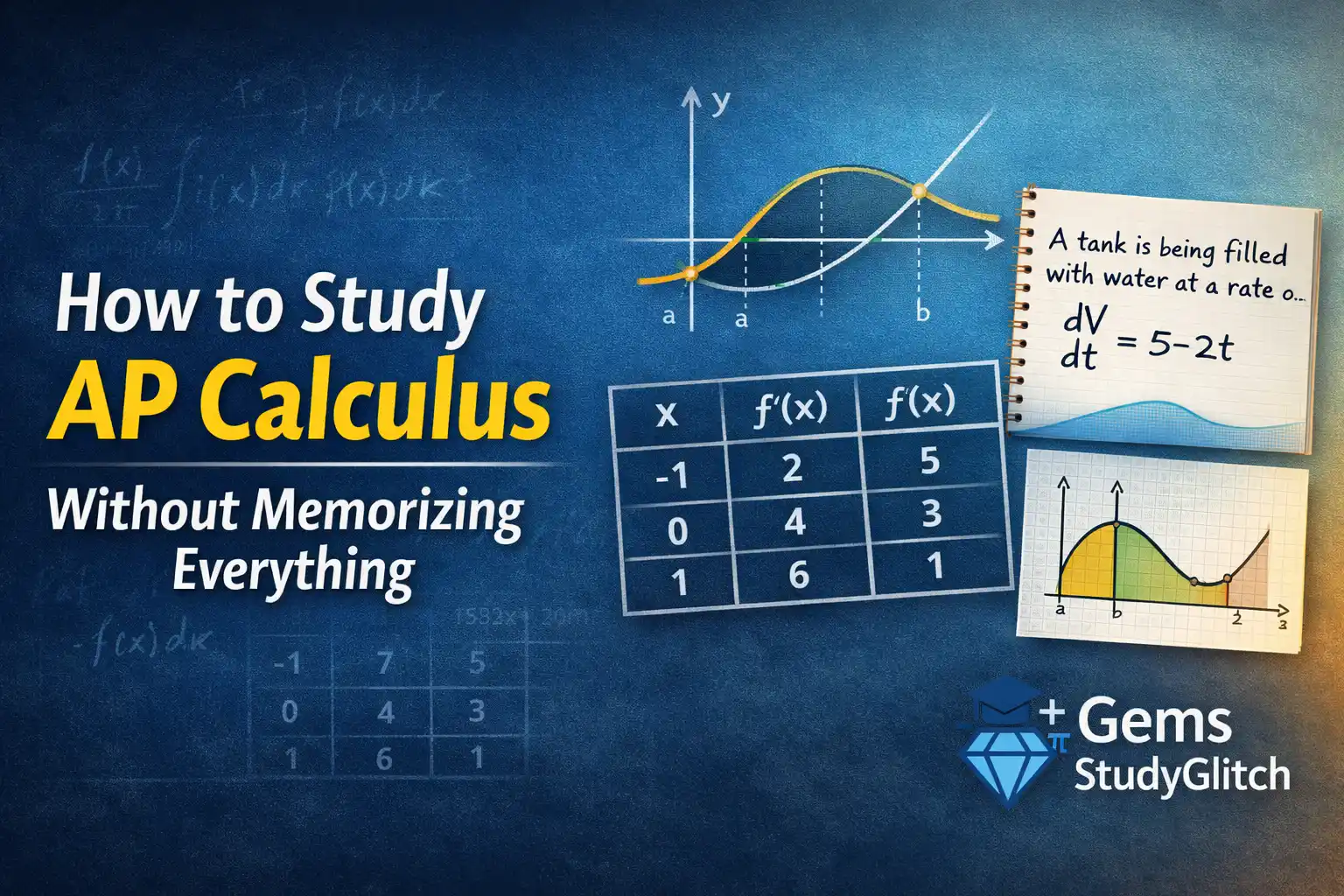
A lot of students walk into AP Calculus with the wrong survival plan.
They assume the course is mostly about memorizing derivative rules, integral patterns, theorem names, and standard procedures.
At first, that approach feels reasonable.
There are formulas to know. There are rules to remember. There are question types that repeat.
So students start building preparation around recall.
Memorize the rule. Memorize the pattern. Memorize the steps. Hope that is enough.
Sometimes it works for a little while.
Then AP Calculus does what it always does.
It changes the form of the question.
The derivative appears through a graph instead of an equation.
The integral appears through a table instead of a neat function.
The question asks for meaning, not just computation.
The free-response section demands setup, justification, and interpretation.
That is where many students realize something uncomfortable.
They did not actually know as much as they thought.
AP Calculus is not a course where memorization does nothing.
But it is absolutely a course where memorization alone starts breaking down fast.
Why Memorization Feels Helpful at First
Students are not wrong for feeling that memorization matters.
Some of it does.
You do need quick access to important derivative rules.
You do need comfort with basic integral forms.
You do need familiarity with recurring ideas like the Fundamental Theorem of Calculus, the chain rule, implicit differentiation, related rates structure, and common applications.
Without that kind of recall, every question feels heavier than it should.
So memorization can create early speed.
It can reduce friction.
It can make practice feel smoother.
That is why so many students become attached to it.
The problem is not that memorization helps.
The problem is that it helps just enough to create false confidence.
A student can become fast on familiar exercises without becoming flexible on unfamiliar ones.
That is where the illusion begins.
Where Memorization Starts Falling Apart
Memorization starts failing the moment AP Calculus stops asking the question in the exact form the student practiced.
That happens more often than students expect.
A question may give a graph and ask about the behavior of a function through its derivative.
A table may show values of a function and its rate of change, and the student has to interpret what is happening without seeing a full equation.
A context-based problem may ask what a derivative means in words, not just what its value is numerically.
A free-response question may combine setup, interpretation, and justification in the same problem.
This is where shallow preparation gets exposed.
Students who memorized steps often know how to begin only when the question looks familiar.
Once the representation changes, they hesitate.
Once they need to explain meaning, they get vague.
Once multiple concepts appear together, they lose the thread.
The issue is not always weak effort.
The issue is often that the preparation was built around recognition of surface patterns rather than understanding of relationships.
What AP Calculus Is Actually Testing
AP Calculus is not just testing whether you can perform procedures.
It is testing whether you can connect ideas.
That is the real center of the course.
You are expected to understand relationships between:
- a function and its derivative
- a derivative and rate of change
- a second derivative and concavity
- an integral and accumulation
- a graph and the meaning behind it
- a table and the behavior it implies
- a context and the mathematical structure inside it
That is why AP Calculus feels different from subjects where memorization carries more of the weight.
The exam keeps asking students to move between forms.
Sometimes you compute.
Sometimes you interpret.
Sometimes you justify.
Sometimes you estimate.
Sometimes you explain what the answer means in context.
A student who only memorizes procedures may survive the easiest version of a question.
But AP Calculus is designed to ask for more than that.
Why Graphs, Tables, and Context Matter So Much
Many students think they understand calculus until the equation disappears.
That is usually a warning sign.
If a student can differentiate a formula cleanly but freezes when given a graph of f′, that is not a small weakness.
If a student can integrate from an equation but feels lost when values come from a table, that is not a detail.
That means the understanding is too narrow.
AP Calculus loves changing representation.
The same idea can appear through:
- an equation
- a graph
- a table
- a written scenario
And students need to be stable across all four.
This is one of the biggest reasons memorization alone fails.
Memorization often ties understanding to one visible format.
Real AP readiness means the concept still makes sense when the format changes.
If the idea disappears the moment the equation disappears, then the idea was never fully secure.
What You Should Memorize — and What You Should Not
A strong AP Calculus student should not try to memorize everything.
That is inefficient and fragile.
But a strong student also should not pretend memorization has no role.
Some things should become automatic because they save time and mental energy.
These include:
- core derivative rules
- standard antiderivative patterns
- major theorem statements and when they apply
- common application structures
- calculator familiarity and section habits
- standard notation and interpretation language
That kind of memorization is useful because it supports thinking.
What students should not try to do is build their entire preparation around storing procedures without understanding why those procedures work.
You should not be memorizing your way through every problem type as if calculus were a script.
That approach collapses when the question changes shape.
The healthier model is simple.
Memorize the essentials.
Understand the relationships.
Practice using them in different forms.
Why FRQs Expose Weak Understanding Fast
The free-response section is where shallow preparation becomes visible almost immediately.
Multiple-choice can sometimes hide weak understanding.
Students can eliminate choices.
They can recognize familiar forms.
They can sometimes back into the right answer.
FRQs are harsher.
They ask students to build the solution.
They ask for setup.
They ask for reasons.
They ask for interpretation.
They often ask students to combine skills rather than isolate them.
That is why students who felt comfortable in routine practice sometimes feel suddenly exposed on FRQs.
The problem is not always that the material became harder.
The problem is that FRQs remove the support structure that memorization depends on.
Now the student has to think.
Now the student has to justify.
Now the student has to connect ideas without being led step by step.
That is why FRQ practice matters so much in AP Calculus.
Not because FRQs are mysterious.
But because they reveal whether understanding is actually durable.
The Patterns Students Should Learn to Recognize
One reason students feel overwhelmed in AP Calculus is that they often study chapter by chapter without noticing the recurring structures the exam keeps coming back to.
AP Calculus is not random.
Certain patterns show up again and again.
Students should become comfortable with ideas such as:
- rates in and rates out
- accumulation and net change
- graph behavior and what it implies
- interpreting a derivative from values or visuals
- motion and changing movement
- area and volume applications
- estimating from tables
- linking function behavior to derivative behavior
- justifying answers with correct reasoning, not just final values
That does not mean the exam becomes predictable in a cheap way.
It means that preparation becomes stronger when students stop seeing each question as isolated and start recognizing the deeper structure underneath it.
That is how confidence becomes real instead of fragile.
How to Study AP Calculus More Intelligently
A better AP Calculus plan starts by changing the goal.
The goal is not to memorize enough material to survive.
The goal is to become flexible enough to handle the same concept in more than one form.
A strong study sequence usually looks like this.
First, identify weak units clearly.
Do not study everything with equal energy.
You need to know which topics are actually unstable.
That is where a AP Calculus AB Diagnostic Test can help expose what is weak before you waste time reviewing everything the same way.
Second, learn the meaning before drilling the procedure.
Do not just ask how to solve it.
Ask what the derivative represents.
Ask what the integral is accumulating.
Ask what the graph is saying.
Ask what changes when the second derivative changes sign.
Third, practice one concept through multiple representations.
If you study optimization only from equations, that is too narrow.
If you study accumulation only from neat integrals, that is too narrow.
You need to see ideas through equations, graphs, tables, and words.
Fourth, use structured topic-based practice.
That is where StudyGlitch Materials can support preparation through focused resources, interactive PDFs, and question sets organized by topic.
Fifth, move into exam-style application.
After the concept becomes more stable, students need to apply it under more realistic conditions.
That is where AP Calculus AB practice tests becomes useful.
Students can work through exam-style sets, pause when needed to think more honestly, and then review topic and skill analysis afterward to see where understanding is still weak and where it is becoming stronger.
That kind of practice is much more useful than rushing through random questions just to feel productive.
Why Timed Practice Should Come Later, Not First
A lot of students panic early and start timing themselves before the concept is ready.
That usually makes things worse.
When a student is still weak conceptually, timing does not build mastery.
It builds stress.
The first stage should be clean understanding and stable recognition.
After that, timing begins to matter.
This order matters in AP Calculus because rushed confusion can easily become a habit.
If a student keeps practicing under pressure before understanding is solid, they often reinforce weak setup, incomplete reasoning, and careless interpretation.
Real speed in calculus comes from familiarity with structure, not from panic.
That is why untimed precision should come before mixed timed sets.
You build clarity first.
Then you compress time later.
What Real AP Calculus Readiness Looks Like
A student is not truly ready for AP Calculus just because they remember a lot.
A student is ready when they can stay calm even when the question looks unfamiliar.
They are ready when they can explain why, not just how.
They are ready when they can move between graph, table, equation, and context without feeling like each one is a different subject.
They are ready when they can choose the right tool without waiting for the problem to announce itself.
They are ready when FRQs stop feeling like a completely different language.
That is what actual mastery looks like.
Not total memorization.
Not endless note review.
Not blind repetition.
Connected understanding.
Flexible application.
Deliberate practice.
That is how students get stronger in AP Calculus without trying to memorize the entire course.
Frequently Asked Questions About Studying AP Calculus
Do I need to memorize formulas for AP Calculus? Yes, but not everything. Students should memorize core derivative rules, common integral forms, major theorem ideas, and key notation, but those should support understanding rather than replace it.
Why do students struggle in AP Calculus even after studying a lot? Many students study procedures without learning how ideas connect across equations, graphs, tables, and context. That works on familiar exercises but breaks down on mixed or interpretation-heavy questions.
Why are AP Calculus FRQs so hard? FRQs are hard because they expose whether a student can set up, justify, interpret, and connect ideas without relying on answer recognition or familiar formatting.
Is AP Calculus more about understanding or memorization? It requires both, but understanding carries more of the course. Memorization helps with speed, while understanding is what allows students to handle unfamiliar questions and changing representations.
What is the best way to study AP Calculus without rote memorization? Start by identifying weak topics, learn the meaning behind the concept, practice it through graphs, tables, equations, and words, then apply it in exam-style sets with careful review of mistakes.