
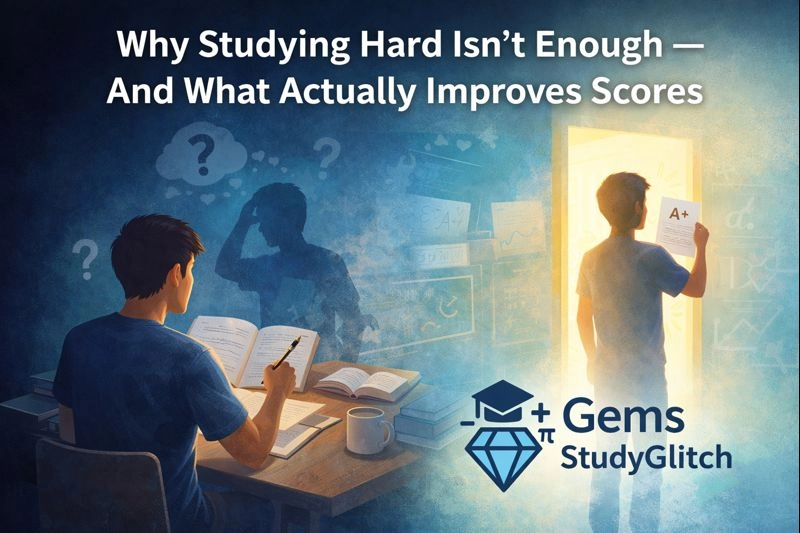
Most students who want better scores do not have a motivation problem.
They have a learning problem.
They study hard. They review notes, watch videos, solve practice questions, and spend long hours trying to improve. They stay disciplined. They care about the result. They put in real effort.
Yet many of them still feel stuck.
They leave a study session feeling productive, only to struggle when the next unfamiliar question appears. They recognize the topic. They remember seeing something similar. But when it is time to think independently, their confidence disappears.
That is what makes the experience so frustrating.
A student can work seriously, stay consistent, and still see very little progress.
This is not laziness.
It is not a lack of discipline.
It is usually a problem with the way the student is learning.
Many students study in a way that hides weaknesses instead of revealing them.
That is where the real problem begins.
The Illusion of Understanding
One of the biggest reasons students stay stuck is the illusion of understanding.
This happens when learning feels clear in the moment but does not hold up during independent performance.
A worked solution looks logical. A teacher explanation sounds simple. A video makes the method seem obvious. Everything appears to make sense while the student is watching or reviewing.
That creates confidence.
But confidence created by exposure is not the same as mastery.
Students often mistake familiarity for understanding. A concept feels recognizable, so they assume it is learned. Then the question changes slightly, the wording becomes less familiar, or the structure is less direct, and the understanding disappears.
That is the illusion.
The student did not truly learn too little.
The student simply never tested whether the idea could be applied independently.
This pattern appears constantly in SAT, AP, and GAT preparation. Students are exposed to methods, formulas, and explanations, but exposure alone does not guarantee strong performance.
Why Hard Work Alone Does Not Guarantee Better Scores
Hard work matters.
But hard work alone does not guarantee score improvement.
When students feel stuck, the usual response is to do more.
More examples. More notes. More videos. More practice problems. More hours.
The effort is real, but the direction is often wrong.
If a student does not know where understanding is breaking down, then doing more of the same usually produces more of the same result.
That is why students can feel busy for weeks and still not move forward.
They are not failing because they do not care enough.
They are failing because their study process is not exposing the real weakness clearly enough to fix it.
Improvement does not come from seeing more answers.
It comes from seeing weaknesses more accurately.
A student starts improving when practice reveals what is unstable, what is misunderstood, what is being guessed, and what still cannot be done under pressure without help.
Better scores are not created by effort alone.
They are created by effort guided in the right direction.
The Real Missing Skill: Metacognition
The missing skill for many students is metacognition.
Metacognition is the ability to judge your own understanding accurately.
It helps a student answer questions like these honestly:
Do I actually understand this topic, or does it only look familiar?
Can I solve this on my own, or do I only follow it after seeing the solution?
Do I know why I got this wrong, or am I just hoping I will do better next time?
Students with weak metacognition become confident too early. They confuse smooth review with real learning. They assume that because something made sense during studying, it will also make sense in a timed test.
That is why the same mistakes keep returning.
Without metacognition:
- students overestimate how much they truly understand
- weak areas stay hidden longer than they should
- mistakes repeat across similar question types
- study time feels productive without producing strong transfer
- progress becomes difficult to measure honestly
When metacognition improves:
- gaps become easier to identify
- practice becomes more targeted
- review becomes more honest
- mistakes become useful feedback
- score improvement becomes more measurable
This is one of the biggest differences between students who stay stuck and students who improve consistently.
The stronger student is not always the student doing more work.
Often, it is the student seeing their own learning more clearly.
Why More Practice Is Not Always the Answer
Students who are frustrated often assume they need more practice.
Sometimes they do.
But more practice is not the same as better practice.
A student can solve many questions and still keep the same weaknesses if those questions are being used in the wrong way.
When answers are checked too quickly, mistakes lose their value.
When students review solutions before thinking deeply, they borrow clarity instead of building it.
When practice is random, it becomes harder to notice patterns in what keeps going wrong.
That is why repetition alone often fails.
Practice becomes powerful when it creates diagnosis.
Students improve when practice reveals which topics are weak, which question types create hesitation, which mistakes are conceptual, and which errors come from rushed thinking or poor decision-making.
That is the point where studying changes from passive exposure into active correction.
The goal is not simply to do more work.
The goal is to make the work reveal something useful.
What Effective Learning Actually Looks Like
Effective learning feels different from comfortable learning.
It does not begin with reassurance. It begins with clarity.
Instead of hiding weak areas, it exposes them.
Instead of rewarding recognition, it demands independent thinking.
Instead of measuring progress by hours spent, it measures progress by what a student can now do correctly without help.
That distinction matters in every serious exam.
In the SAT, students must apply concepts under time pressure, often with wording or structure that feels unfamiliar.
In AP preparation, students need depth of understanding, not just surface recognition.
In GAT preparation, students need reasoning control, pattern awareness, and accurate thinking under pressure.
These exams do not reward the appearance of understanding.
They reward actual understanding.
Students who improve consistently are not always the ones who study the longest.
They are the ones whose study process is honest enough to reveal the truth about their performance.
That honesty is what turns effort into progress.
Why Diagnosis Changes Everything
Diagnosis is what turns studying into a real improvement process.
A student who knows exactly where performance breaks down is in a completely different position from a student who only knows that scores feel disappointing.
Diagnosis makes practice specific.
It shows whether the problem is concept weakness, question interpretation, time pressure, carelessness, pattern recognition, or inconsistent reasoning.
Once the weakness becomes visible, the next step becomes clearer.
That is why effective study systems do not rush students toward answers.
They create a structure where answers become useful only after thinking has already happened.
Students should attempt first.
They should struggle honestly.
They should notice where they hesitate.
Then they should review mistakes in a way that reveals patterns instead of treating each error like an isolated event.
This is why tools like the Diagnostic and the Materials section matter. They help students move from vague frustration to visible patterns, which is where real progress begins.
How This Applies to SAT, AP, and GAT Preparation
The details of each exam are different, but the learning trap is often the same.
In SAT preparation, many students feel comfortable during review and then lose control when a question changes structure or demands more independent reasoning than expected.
In AP preparation, students may follow examples well but struggle when they must build a full solution on their own without cues.
In GAT preparation, students often repeat the same reasoning mistakes because their practice is not organized in a way that makes those patterns visible.
The exam changes.
The trap stays the same.
Students think they are improving because they are active, engaged, and spending time.
But time spent is not the same as understanding gained.
What improves scores is a method that exposes weak thinking early enough to correct it.
That is what students need far more than another long, comfortable study session.
Why StudyGlitch Was Built Around This Problem
StudyGlitch was built around a simple idea.
Learning should make weaknesses visible.
Students do not need more confusion disguised as productivity. They need a clearer way to identify where they are struggling, why they are struggling, and what kind of practice should come next.
That is why StudyGlitch supports a more honest improvement process through:
- diagnostic testing
- structured materials
- PowerCenter for exam-style preparation
- strategy content on the Blog
- a broader learning environment through the Hub
The goal is not to create short-term confidence.
The goal is to help students build real understanding, see their patterns more clearly, and improve in a way that lasts.
That is the difference between a system that feels active and a system that actually moves scores.
Studying Hard vs. Studying Correctly
Studying hard still matters.
Effort matters. Discipline matters. Time matters.
But effort alone is not enough.
Students improve when effort is paired with diagnosis, awareness, and the willingness to see weak performance honestly.
Studying correctly means testing understanding instead of assuming it.
It means reviewing mistakes for patterns instead of treating them as random.
It means practicing by topic when needed, thinking independently before checking answers, and using feedback to adjust what happens next.
That is how confusion becomes clarity.
That is how repetition becomes correction.
That is how score improvement stops feeling mysterious.
The students who improve most are not always the students pushing the hardest.
They are the students whose study process teaches them how to think more clearly, respond more accurately, and learn from mistakes more intelligently.
That is what actually improves scores.
What Students Should Do Next
Students who feel stuck do not need more random studying.
They need a better feedback loop.
A stronger next step is to begin with diagnosis, identify where performance breaks down, and then practice in a way that turns mistakes into direction.
That process can start on StudyGlitch by using the Diagnostic, continuing into the Materials section, and building exam-focused preparation through PowerCenter.
The goal is not simply to study more.
The goal is to study in a way that finally leads somewhere.
Frequently Asked Questions
Why do students study hard but still not improve their scores? Many students work hard but study in a way that creates familiarity instead of mastery. They review, watch, and recognize ideas without fully testing whether they can apply them independently under pressure.
What is the illusion of understanding in studying? The illusion of understanding happens when something feels clear during review but falls apart during independent problem-solving. It creates false confidence because recognition is mistaken for real understanding.
What is metacognition and why does it matter? Metacognition is the ability to judge your own understanding accurately. It matters because students improve faster when they can identify what they truly know, what they do not know, and what kind of practice they need next.
Why doesn’t more practice always improve SAT, AP, or GAT scores? More practice only helps when it reveals real weaknesses and leads to targeted correction. Repeating questions without diagnosis often repeats the same weak patterns instead of fixing them.
How can students improve scores more effectively? Students improve more effectively when they begin with diagnosis, practice intentionally, review mistakes for patterns, and use structured learning to expose weak areas early.
How does StudyGlitch help students improve? StudyGlitch helps students improve through diagnostic testing, structured topic-based materials, exam-style preparation, and learning tools designed to make weaknesses visible and progress more measurable.
Explore Related articles: Why Diagnostic Tests Improve SAT, AP, and GAT Math Scores , Prepare for SAT Math in Saudi Arabia: A Structured Approach,SAT, GAT & AP Math Preparation in Saudi Arabia | Diagnostic-Based Strategy.