
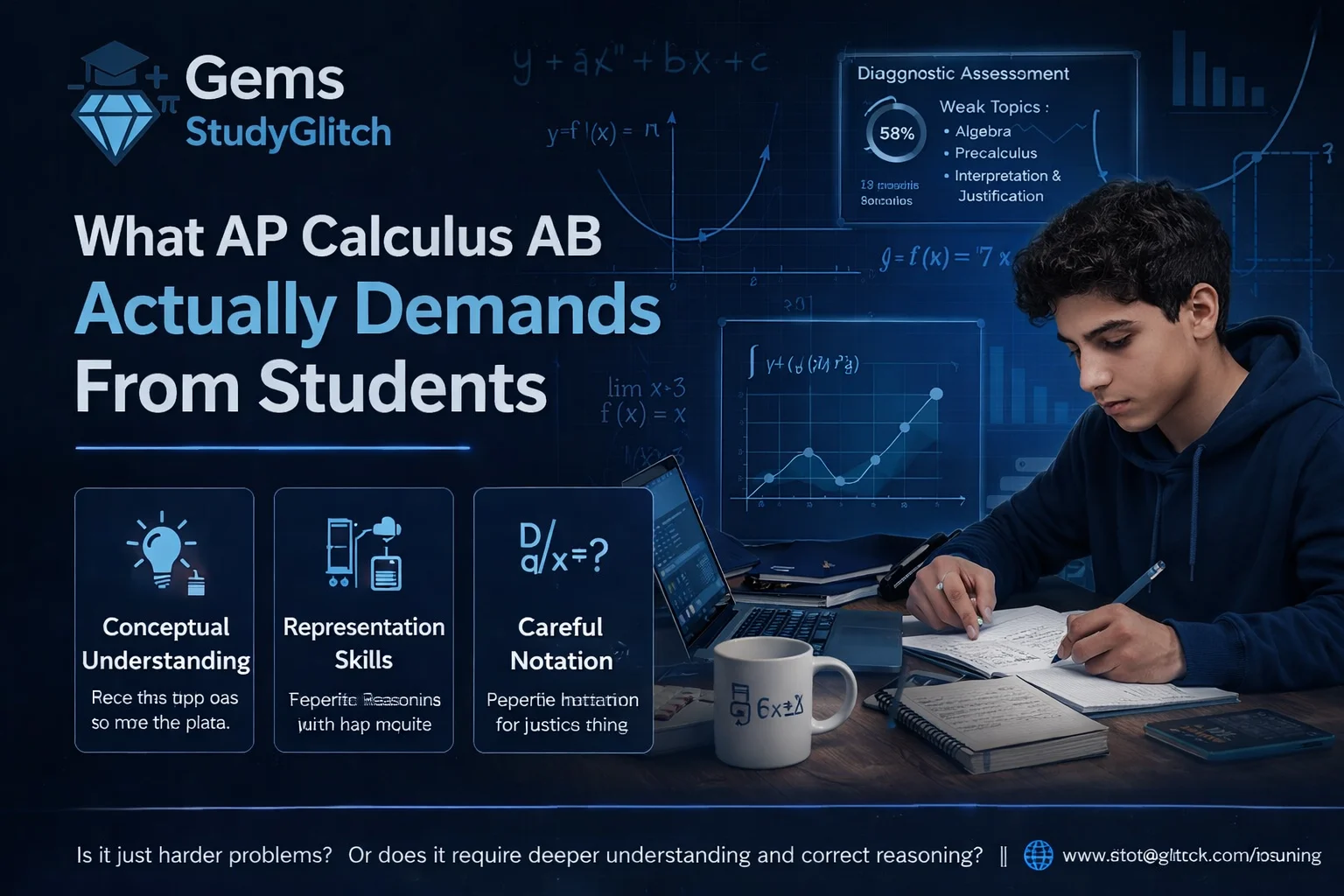
Students enter AP Calculus AB with the wrong expectation.
They assume the course is simply harder math.
More formulas.
More difficult questions.
More pressure.
That description is not completely wrong.
But it is incomplete.
AP Calculus AB does not only demand effort.
It demands a different level of mathematical thinking.
This is where many students get surprised.
A student may work hard, complete assignments, and still feel that the course keeps exposing something unstable underneath.
That hidden issue is often not calculus itself.
It is the kind of thinking the course requires.
Why AP Calculus AB Is Often Misunderstood
A lot of students treat AP Calculus AB as if it were mainly a procedural class.
Learn the derivative rules.
Practice the integral rules.
Memorize the common forms.
Apply the correct step.
Move on.
Procedure matters, of course.
But AP Calculus AB expects more than procedure.
Students are expected to understand what the mathematics means, not just what to write next.
They need to connect graphs, formulas, tables, and verbal descriptions.
They need to justify decisions.
They need to use notation carefully.
They need to interpret results in context.
That is why some students feel confident while practicing routine problems but become uncertain when the question changes form.
The exam is not only asking whether the student can perform a calculation.
It is asking whether the student truly understands the idea behind it.
What AP Calculus AB Actually Rewards
Strong AP Calculus AB performance usually comes from a combination of skills.
- procedural accuracy
- conceptual understanding
- interpretation of meaning
- flexibility across representations
- careful notation
- clear reasoning under pressure
This is what makes the course different from a simple chapter-by-chapter school routine.
A student may know how to compute a derivative and still lose points if they misread the context, misuse notation, or fail to explain what the derivative represents.
A student may know the integration process but still struggle if they cannot connect the result to area, accumulation, or rate of change.
That is why AP Calculus AB often feels difficult in a deeper way.
It asks students to think mathematically, not just mechanically.
Why Weak Foundations Show Up Later
One of the most frustrating experiences in AP Calculus AB is that a student may blame calculus for problems that actually began earlier.
The hidden issue is often weak algebra, weak function understanding, weak graph interpretation, or weak trigonometric control.
Calculus sits on top of earlier math.
So when a student struggles in AP Calculus AB, the breakdown is not always caused by the new idea itself.
Sometimes the breakdown comes from:
- weak manipulation of expressions
- fragile understanding of functions
- discomfort with graphs
- slow equation handling
- poor organization in multistep work
This is why some students understand the teacher’s explanation but still get stuck when solving alone.
The concept may not be the only problem.
The mathematical foundation underneath it may also be unstable.
That is important because students often respond the wrong way.
They try to solve more calculus questions without repairing the actual weakness.
That usually creates frustration instead of progress.
Why Representation Matters So Much
AP Calculus AB expects students to move between different forms of information.
A question may begin with a graph, then require interpretation using algebra.
Another may begin with a table and ask for a conclusion about rate of change.
Another may require verbal interpretation of a derivative or integral in context.
This is one of the clearest differences between shallow preparation and real AP readiness.
Some students are comfortable only when the question looks familiar.
But AP Calculus AB often rewards students who can translate ideas between forms.
That means understanding how the same concept can appear as:
- a graph
- an equation
- a table
- a written scenario
- a symbolic expression
When students cannot move between those forms confidently, their understanding remains narrow.
That narrowness becomes dangerous on the exam.
Why Notation Is More Important Than Students Expect
Students sometimes treat notation as a small detail.
In AP Calculus AB, it is not a small detail.
Correct notation helps show whether the student actually understands the idea being used.
This matters in derivatives, integrals, limits, and applied contexts.
A student may have the right instinct but still lose clarity if their notation is careless, incomplete, or logically messy.
That is one reason why AP Calculus AB feels stricter than ordinary school practice.
The exam is not only checking the final number.
It is checking whether the work reflects mathematical control.
That includes how the student writes, represents, and communicates the idea.
Why Memorizing Steps Stops Working
Many students try to survive AP Calculus AB by memorizing patterns.
This can help at the beginning.
It can even create short-term confidence.
But it stops working when the question shifts.
A student might memorize how to differentiate a certain form.
Then the question appears in a graph setting.
Or a table setting.
Or a word problem about motion or accumulation.
Suddenly the memorized route feels less useful.
That is when the difference between recognition and understanding becomes visible.
Recognition says:
I have seen something like this before.
Understanding says:
I know what this idea means, what the question is asking, and how to respond even if the form changes.
AP Calculus AB rewards the second one.
That is why random repetition without reflection often leaves students feeling busy but still unstable.
Why AP Students Need More Than More Practice
Practice matters.
But AP Calculus AB students usually do not improve just by increasing volume.
They improve when practice becomes more intentional.
That means asking stronger questions after each mistake.
- Was this a concept gap?
- Was this weak algebra underneath the calculus?
- Was the issue interpretation?
- Was notation the problem?
- Did I understand the meaning of the answer?
- Could I explain the idea in another form?
These questions turn practice into growth.
Without them, practice can become repetitive without becoming transformative.
That is why students often need a more structured system.
Not simply more pages.
Not simply more hours.
A better way of seeing what is actually breaking down.
What Better AP Calculus AB Preparation Looks Like
Stronger AP Calculus AB preparation usually includes a few clear elements.
First, the student needs honest diagnosis.
They need to know whether the real weakness is foundational algebra, representation, notation, conceptual understanding, or test pressure.
Students who want a clearer starting point can begin with the StudyGlitch AP Calculus AB diagnostic test.
Second, the student needs targeted work.
That means not treating all errors as the same.
A graph interpretation issue is not the same as a weak chain rule issue.
A notation issue is not the same as a conceptual misunderstanding of accumulation.
Third, the student needs guided review and structured support.
Students can explore the AP Calculus AB page for a more focused AP pathway.
Students who want live support can also explore booking.
When preparation becomes more structured, the course starts feeling more readable.
Not easy, but clearer.
And clarity changes performance.
To test whether a rule transfers beyond a familiar exercise, use AP Calculus AB questions with worked solutions by topic and justify the setup before reading the answer. Use full practice tests to assess the separate problem of mixed, timed performance.
Why AP Calculus AB Fits the StudyGlitch Philosophy
StudyGlitch is built around a simple academic principle.
Students improve faster when weaknesses become visible.
That matters especially in AP Calculus AB because this course exposes hidden instability quickly.
A student may appear fine in class but struggle in independent work.
They may understand the example but fail on variation.
They may know the procedure but not the meaning.
That is exactly why structured support matters.
The goal is not to bury the student in more practice.
The goal is to identify what kind of weakness is actually present and then build a cleaner path forward.
Students preparing across multiple exam systems can also explore SAT Math, Qudurat GAT, or visit the StudyGlitch blog for more math preparation guidance.
Final Thought
AP Calculus AB does not only demand harder math.
It demands stronger mathematical thinking.
Students need more than procedures.
They need interpretation, representation, notation, flexibility, and the ability to understand what the mathematics is actually saying.
That is why some students feel overwhelmed even when they are trying hard.
The course is not only asking for effort.
It is asking for a deeper kind of clarity.
Once students understand that, preparation becomes much healthier.
They stop chasing survival.
They start building real control.
Frequently Asked Questions
What makes AP Calculus AB difficult for many students AP Calculus AB is difficult because it expects more than procedural work. Students must understand concepts, interpret meaning, move between representations, and use notation carefully under pressure.
Do students need strong algebra before AP Calculus AB Yes. Many AP Calculus AB struggles actually come from weak algebra, weak function understanding, or poor graph interpretation underneath the calculus itself.
Is memorizing derivative and integral steps enough for AP Calculus AB No. Memorizing steps can help temporarily, but the exam rewards students who understand the idea behind the procedure and can apply it in different forms and contexts.
Why does notation matter so much in AP Calculus AB Notation matters because it reflects mathematical control. In AP Calculus AB, clear and correct notation helps show that the student understands what they are doing, not just the final answer.
How should students start preparing for AP Calculus AB more effectively Students usually prepare more effectively when they begin with diagnosis, identify whether the real weakness is conceptual or foundational, and then follow structured targeted support instead of relying only on random practice.