
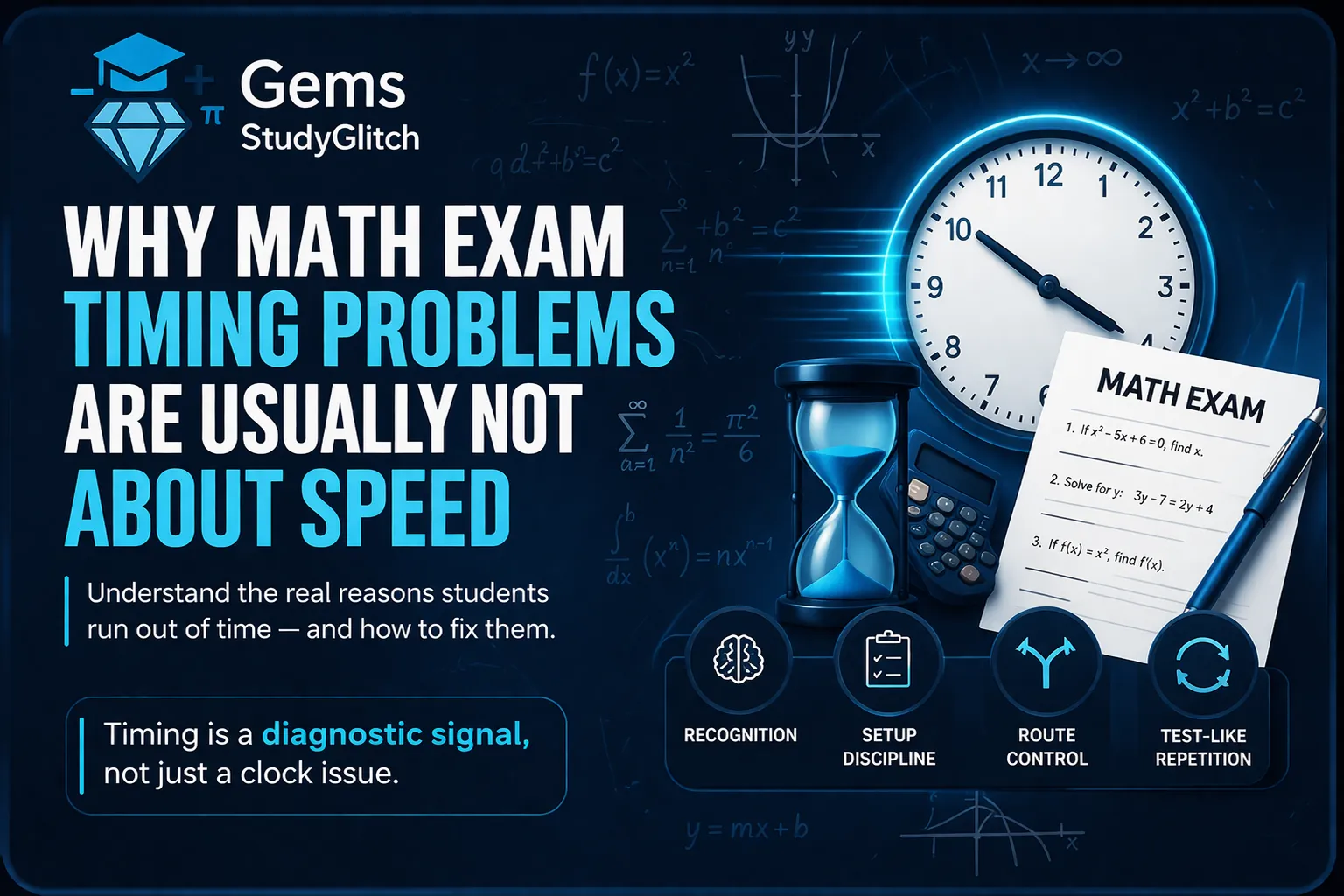
Many students think timing problems in math exams have one obvious cause: they are too slow.
That explanation feels simple, but it is usually incomplete.
In real exam settings, students often do not lose time because they physically solve too slowly. They lose time because they hesitate too long, recognize the structure too late, set up the work badly, choose inefficient solving routes, or lose control of their process under pressure. The result looks like a speed problem, but the actual cause is usually deeper than speed alone.
This matters because weak advice creates weak correction. When students are told to “just solve faster,” they often respond by rushing, forcing themselves to move quicker, and increasing pressure without fixing the real source of delay. That usually leads to more mistakes, more second-guessing, and even worse timing control.
A better way to understand timing is to treat it as a diagnostic signal. When a student keeps running out of time in math exams, the clock is often revealing friction inside recognition, setup, decision-making, and execution. The timing problem is real, but it is usually pointing to a structural weakness in the solving process rather than a simple speed deficiency.
That is especially important across exams like SAT Math, GAT Quantitative, and AP Calculus AB. All three involve time pressure, but they punish students differently. That means timing should not be trained through generic time management tips. It should be analyzed by exam type, solving demands, and the specific form of friction the student is experiencing.
Why “Just Solve Faster” Is Weak Advice
“Just solve faster” sounds practical, but it is poor diagnostic advice.
It tells students what outcome they want, but it does not explain why they are missing that outcome in the first place.
In math exams, time is often lost before efficient solving even begins. A student may stare at a question too long before recognizing its structure. They may choose the wrong approach and switch halfway through. They may start calculating without defining the target clearly. They may write too much, organize poorly, or check too early because confidence is unstable.
These are not pure speed problems.
They are process problems.
That distinction is important because two students can know the same content and still show very different timing performance. One student enters the problem cleanly, sees the structure early, and commits to a useful route. The other student hesitates, explores too many possibilities, or sets up inefficiently. The second student feels slow, but what is actually happening is that time is leaking through friction.
So when students say, “I need to get faster,” the smarter question is usually, “Where exactly is my process losing time?”
Timing Loss Often Starts Before Real Solving Begins
Students often imagine that time is mostly lost during calculation.
In reality, a major part of timing loss often happens earlier.
It starts with recognition.
Recognition is the ability to identify what kind of problem is in front of you, what it is really asking, and what route is likely to work best. When recognition is delayed, students spend time reading again, testing uncertain ideas, or sitting in indecision. The delay may only feel like a few seconds, but across an exam it becomes significant.
Then comes setup.
Setup is where many students silently lose time. A student may understand the concept but still create delay by organizing the work badly. They may define variables in an awkward way, rewrite too much information, begin solving before identifying the target, or create clutter that makes later steps harder to manage.
This is why timing should not be reduced to quickness of hand or mental speed alone. Good timing usually reflects clean entry into the problem. Students who improve recognition and setup often improve timing before they ever try to “move faster.”
Why Students Who Know the Content Still Waste Time
One of the most frustrating things in exam prep is knowing the math and still feeling too slow.
This happens more often than students realize.
Content knowledge is not the same as timed performance. A student may understand algebra, functions, percentages, graph behavior, derivatives, rates, or limits, but still lose time because access to that knowledge is not stable enough under pressure.
Sometimes the knowledge is there, but recall is not automatic enough for timed work.
Sometimes the concept is understood in lessons or homework, but recognition becomes slower when the exam presents it in a different form.
Sometimes the student solves correctly in untimed practice, but route choice becomes weak in a real timed setting.
Sometimes the student knows what to do, but execution is too messy to hold together efficiently from start to finish.
This is why timing failure should not be interpreted too simplistically. A student running out of time is not automatically weak in content. Very often, the student’s knowledge exists, but the solving system is not yet compressed, stable, and exam-ready.
How Timing Failure Looks Different Across SAT, GAT, and AP
Timing pressure exists across major math exams, but it does not behave the same way in each one.
That is why timing improvement should be specific, not generic.
SAT Math Timing and Route Choice
In SAT Math, timing problems often come from decision-making.
Students waste time because they choose inefficient routes, not only because they calculate slowly.
A student may solve a question algebraically that could have been handled faster through graphing. Another may try a longer symbolic route when estimation or substitution would have been cleaner. Another may hesitate because they recognize several possible methods but do not know which one to trust quickly.
This is one reason SAT timing is closely tied to route control. Students need more than content review. They need better judgment. They need to know when to use algebra, when to use graphing, when estimation is enough, and when a clean direct setup is still the safest choice.
That is also why structured SAT prep should train students to recognize recurring decision points. Timing improves when route selection becomes more intentional and less hesitant, not when students are told to rush blindly.
Students who want to identify whether their SAT timing issue comes from recognition, content weakness, or route choice can begin with a diagnostic.
Explore more about SAT structure article.
GAT Quantitative Timing and Fluency
In GAT Quantitative, timing problems often look different.
Here, timing loss is commonly tied to fluency.
Students may understand the general idea behind a problem, but their numerical handling is not smooth enough. Basic arithmetic creates friction. Pattern recognition is slower than it should be. Proportional reasoning or mental processing takes too much effort. Even when the question is not deeply complex, the work still feels heavy.
That heaviness creates timing pressure.
So in GAT, timing improvement often depends on reducing friction in the basics. Students need faster handling of familiar structures, cleaner arithmetic movement, and more stable recognition of recurring quantitative patterns. The goal is not frantic speed. The goal is low-friction processing.
This is why GAT timing work should focus on fluency and structure, not random rushing. Students improve when they build smoother basics, better pattern recognition, and stronger repetition under exam-like conditions.
Explore more about GAT prep article.
AP Calculus AB Timing and Process Control
In AP Calculus AB, timing problems are often less about route choice and more about process control.
Students may know the concept, but the written execution becomes unstable.
Multi-step work creates drag. Notation becomes messy. Representation is unclear. Intermediate steps are not organized well enough. The student understands the mathematics in principle, but the solving process is not controlled enough to remain efficient and accurate from start to finish.
That matters because AP Calculus AB does not only reward correct ideas. It also rewards clean mathematical communication, accurate notation, structured setup, and sustained control through multiple steps. A student can lose time simply because the work is not stable enough on paper.
This is why AP timing should not be treated the same way as SAT timing. The SAT often punishes poor route choice. AP often punishes unstable execution.
Students lose time in AP when they write too much without structure, represent quantities vaguely, mismanage notation, or create errors that force them to revisit entire sections of work. Improvement therefore depends on cleaner setup, better written flow, and stronger accuracy under load.
Explore more about AP demands article.
Timing Should Be Trained as a Skill System
If timing is not mainly about speed, then what should students actually train?
They should train timing as a system of performance skills.
Recognition
Students should practice identifying structure faster. What type of problem is this? What is it truly asking? What pattern is showing up here? Better recognition reduces hesitation before solving even begins.
Setup Discipline
Students should train themselves to enter problems more cleanly. That means defining targets properly, organizing equations clearly, and reducing unnecessary rewriting. Clean setup prevents later confusion and saves time indirectly.
Route Control
Students should improve their route selection. On the SAT, this may mean deciding quickly between algebra, graphing, substitution, or estimation. On GAT, it may mean spotting a familiar quantitative pattern fast enough to avoid clumsy setup. On AP, it may mean choosing a written path that stays organized and accurate over multiple steps.
Test-Like Repetition
Timing does not become stable through relaxed practice alone. Students need repetition under conditions that actually resemble the exam. That is where hesitation patterns become visible and where timing weaknesses can be corrected in a meaningful way.
This is why timing improvement is often diagnostic by nature. The real question is not “How do I become faster?” The real question is “Which layer of my solving system is causing delay?”
Why Diagnostic-Based Timing Correction Works Better
When timing is treated vaguely, students usually receive vague solutions.
Practice more.
Watch the clock.
Stay calm.
Move faster.
None of that is completely useless, but none of it is specific enough to solve the real issue.
A stronger approach is diagnostic-based timing correction. That means identifying exactly where time is being lost and correcting that layer directly. For one student, the problem may be delayed recognition. For another, it may be weak fluency. For another, it may be poor route choice. For another, it may be unstable written execution.
Once the source is identified, timing improvement becomes far more efficient.
This is one reason targeted support matters. Many students cannot diagnose their own timing patterns clearly because all they feel is pressure. But underneath that pressure is usually a repeated mechanism. Once that mechanism is found, timing becomes much more trainable.
Students who want to pinpoint where their timing is breaking down can start with a diagnostic.
Students who need direct help correcting those timing issues can explore targeted tutoring support.
The Real Goal Is Not to Rush
The goal in math exams is not to become frantic.
It is not to look fast.
It is not to force speed at the cost of accuracy.
The real goal is to become more efficient, more stable, and more deliberate under pressure.
Students who improve timing well often do not look dramatically faster from the outside. What changes is that they hesitate less, recognize more quickly, set up more cleanly, choose better routes, and maintain stronger control from start to finish.
That is why timing is such a useful diagnostic signal. It tells you where the solving system is still unstable.
Seen this way, timing is not just a clock issue.
It is a performance signal.
And once students understand that, they stop chasing vague advice about speed and start building a smarter, more test-ready process.
Frequently Asked Questions
Is running out of time in math exams always a speed problem? No. In many cases, students lose time because of hesitation, weak recognition, poor setup, inefficient route choice, or unstable multi-step execution rather than raw slowness alone.
Why do students who know the math still struggle with timing? Knowing the content is not the same as accessing it efficiently under pressure. Many students understand the material but still lose time because recognition, setup, and execution are not stable enough in timed conditions.
How is timing different in SAT, GAT, and AP Calculus AB? SAT timing often depends heavily on decision-making and route choice, GAT timing depends more on fluency and low-friction basics, and AP Calculus AB timing depends more on process control, notation, and accurate multi-step execution.
What is the best way to improve math exam timing? The strongest approach is to treat timing diagnostically and train recognition, setup discipline, route control, and test-like repetition instead of simply trying to rush faster.