
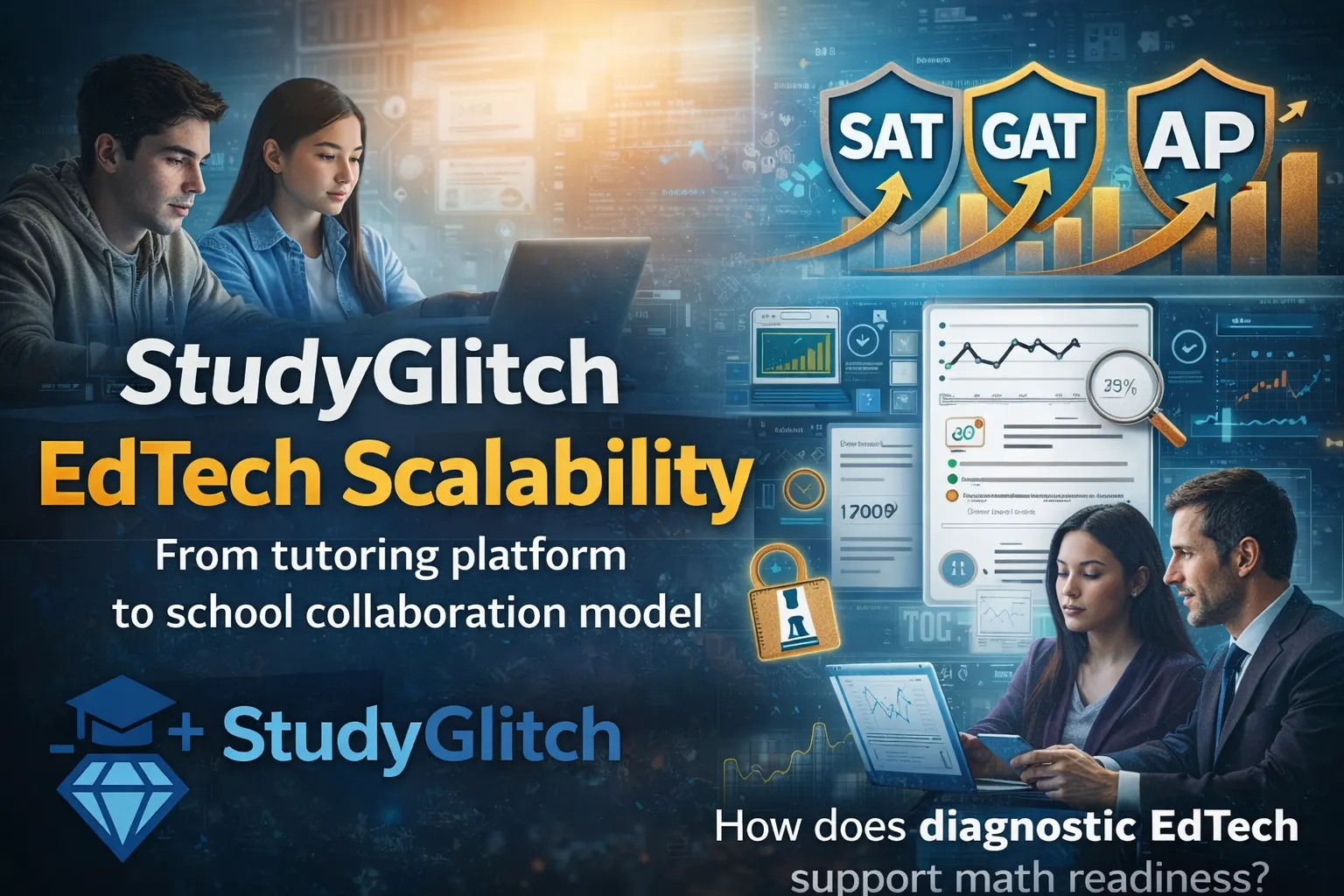
StudyGlitch was built to scale diagnostic-based SAT, GAT, and AP math preparation with more clarity for students, parents, and schools.
Do math preparation properly.
Do it with structure.
Do it with visibility.
Do it in a way that helps students preparing for SAT Math, GAT Qudurat quantitative, and AP Calculus AB move from confusion to measurable progress.
That is why the system was not built as a generic tutoring page.
It was built as a math-focused EdTech platform centered on diagnostic-based preparation, guided academic support, secure online practice, and a clearer path for students, families, schools, and educational centers.
Now the same system is being strengthened for broader academic deployment.
What StudyGlitch was built to solve
Many students preparing for standardized math tests do not fail because they lack effort.
- They struggle because their preparation is scattered.
- They solve randomly.
- They repeat familiar questions.
- They do not know which weakness matters most.
- They use tutoring without enough visibility.
- They consume content without a proper progression model.
StudyGlitch was designed to make that process more structured.
It begins with identifying the student’s current level, then moves into guided improvement through tutoring, materials, and exam-style training. The goal is not only to prepare students for one test date. The goal is to create a preparation system that can be tracked, improved, and expanded over time. Start with the diagnostic
A math-focused EdTech platform with clearer specialization
One strength of StudyGlitch is focus.
The platform is not trying to be everything for every subject.
It is built specifically around math preparation pathways that matter strongly to students and families in the region.
That includes:
- Digital SAT Math preparation
- GAT Qudurat quantitative preparation
- AP Calculus AB preparation
- online tutoring support
- guided materials and structured practice
- exam-like digital assessment flow
- diagnostic-based academic visibility
This specialization matters because students preparing for these exams need more than generic homework help. They need academic systems that understand standardized math pressure, topic-level weakness patterns, timing issues, calculator decisions, reasoning control, and performance development over time.
StudyGlitch supports that through dedicated program paths for SAT Math, GAT Qudurat quantitative, and AP Calculus AB, along with Arabic landing pages for broader accessibility. SAT Math Arabic Qudurat Arabic AP Calculus AB Arabic
Why diagnostic-based scale matters
Scale in education should not mean losing academic quality.
It should mean delivering structure to more students without turning the learning process into guesswork.
StudyGlitch starts from a strong foundation because the platform is built around diagnosis first.
That matters for individual students.
It also matters for institutions.
When students start with a diagnostic assessment, schools and educational centers gain a much clearer view of readiness before they decide what kind of support is needed next.
This makes the system more useful in real educational settings.
Instead of asking teachers or parents to assume a student’s level, StudyGlitch can help create a documented starting point. From there, support can become more targeted, more efficient, and easier to explain.
This is especially valuable for institutions that want both academic seriousness and operational clarity. See the free diagnostic system
How the system can grow with schools and educational centers
StudyGlitch is a math-focused EdTech SaaS platform for schools and educational centers, built to support structured academic programs with ongoing refinement in reporting, visibility, and delivery.
The platform is positioned to support more than individual tutoring journeys.
It can also support school collaboration models and center-based assessment workflows.
For example, a school that prepares students for SAT, AP, or GAT pathways may need:
- an organized diagnostic assessment for students entering prep
- secure online links for class-based or group-based testing
- an easier way to monitor readiness across multiple students
- a more professional third-party academic system without building everything internally
- flexible support that can combine diagnostics, materials, practice, and reporting
This is where scale in EdTech becomes practically meaningful.
A school does not always need a heavy custom platform of its own.
In many cases, it needs a trusted external system that is easier to deploy, easier to maintain, and academically aligned with student performance goals.
That is the kind of role StudyGlitch is built to grow into.
Secure online assessment matters
Modern schools and educational centers increasingly need digital systems that are usable, practical, and controlled.
StudyGlitch can support that vision through secure online links and digital math assessment environments that feel closer to real standardized test conditions.
For SAT-like practice in particular, this matters a lot.
Students benefit when the assessment environment trains not only content, but also rhythm, decision-making, and digital familiarity. That is where PowerCenter becomes important as part of a broader preparation flow.
Instead of treating assessment as a one-time event, institutions can think of it as part of a measurable training cycle:
- diagnostic
- guided improvement
- exam-like practice
- progress review
- reporting
This type of academic loop is much stronger than isolated testing.
From diagnostic to reportable progress
One of the most important parts of institutional growth is reporting.
Institutions and families do not only want activity.
They want visibility.
They want to know where the student started.
They want to know how the student trained.
They want to know whether progress is actually happening.
StudyGlitch is well positioned for this because its structure naturally connects the key stages of preparation:
- diagnostic assessment
- guided materials and explanations
- training through exam-style environments
- tutoring support when needed
- performance review across the journey
That means the platform is not limited to delivering practice only.
It can also support performance interpretation.
A school administration or parent may want a report that reflects the student’s academic journey from the beginning diagnostic through training and follow-up. That kind of visibility is far more valuable than a single isolated score because it explains direction, not just outcome.
How institutional reporting strengthens the model
An EdTech platform becomes stronger at scale when it can convert learning activity into understandable academic reporting.
For schools, that can mean a clearer view of student performance patterns.
For parents, that can mean stronger trust in the educational process.
For students, that can mean seeing progress in a more motivating and evidence-based way.
StudyGlitch can support institutional reporting in a way that matches real academic needs:
- starting level visibility
- topic-level weakness identification
- progress through training and practice
- performance patterns over time
- reports prepared for administration or parents upon request
This type of reporting helps institutions deliver better student support while keeping the service operationally practical. It also reinforces the value of diagnostic-based tutoring and prep because the work becomes measurable instead of vague.
A third-party model that is easier to adopt
Many schools want to improve standardized test readiness without adding unnecessary complexity to their internal systems.
That is why a well-designed external EdTech model can be attractive.
StudyGlitch can be delivered as a third-party academic service with a simpler maintenance burden and a more focused educational role.
That creates several practical advantages:
- schools can offer stronger prep support without building a full internal assessment platform
- students gain access to structured diagnostics, materials, and practice
- administrations can request clearer performance visibility
- parents can receive better direction when needed
- the institution pays for a service that is focused, maintainable, and designed for real student outcomes
This is where scale meets practicality.
Growth is not only about adding more users.
It is about making the system useful at multiple levels without losing its academic identity.
Why this supports brand authority
Brand authority in education does not come only from saying the right things.
It comes from having a system that makes educational sense.
StudyGlitch strengthens its authority when it shows that tutoring, diagnostics, materials, digital practice, and reporting are not disconnected pieces. They are parts of one preparation architecture.
That architecture matters for students preparing independently.
It also matters for schools evaluating external academic partners.
A platform that can support materials, tutoring bundles, diagnostic assessment, and exam-style practice from one focused math ecosystem is easier to position as a serious EdTech partner.
This also supports SEO authority because the brand is not only publishing isolated exam articles. It is publishing from a real framework of diagnostic-based prep, online tutoring, and measurable academic development across SAT, GAT, and AP preparation.
Who this model is for
This model is especially relevant for:
- schools supporting students entering SAT, AP, or GAT pathways
- educational centers that want stronger digital assessment flow
- parents looking for a more structured third-party prep environment
- students who need more than random question solving
- institutions that want academic visibility without building a custom platform from zero
This makes the brand conversation larger than tutoring alone.
It becomes a conversation about educational infrastructure, digital assessment support, and better preparation architecture.
The long-term value of a focused EdTech system
The future of effective test preparation is not random content volume.
It is organized visibility.
It is measured progress.
It is systems that help students understand where they are, what they need, and how to move forward with less confusion.
StudyGlitch supports structured growth because it was not built as a content pile.
It was built as a structured math preparation system.
That distinction matters.
It allows the platform to grow from student-level support into school-level collaboration without abandoning its original academic purpose.
Frequently Asked Questions
What makes StudyGlitch able to scale as an EdTech platform? StudyGlitch is built to scale because it combines diagnostic-based assessment, guided materials, online tutoring, exam-like practice, and reporting visibility in one math-focused system that can support both individual students and institutions.
Can StudyGlitch work with schools and educational centers? Yes. The platform is well suited for collaboration models where schools or centers want diagnostic assessment, secure online practice links, structured student support, and clearer academic reporting without building a full internal system.
Why is diagnostic-based prep important for institutions? A diagnostic creates a clearer starting point. It helps schools, families, and students understand readiness before time and budget are spent on unfocused preparation.
Can StudyGlitch provide progress visibility for parents and school administration? Yes. The strength of the model is that it can connect student starting level, training activity, and performance development into a more understandable progress picture.
Is StudyGlitch only for SAT students? No. StudyGlitch is built as a math-focused preparation ecosystem supporting SAT Math, GAT Qudurat quantitative, and AP Calculus AB through diagnostics, materials, tutoring, and digital practice.
Final direction
StudyGlitch stands as a focused tutoring and prep platform with a structure designed for broader academic use.
A structured EdTech system.
A math-focused academic environment.
A diagnostic-based preparation model that can support students, families, schools, and educational centers with more clarity.
For institutions that want a more maintainable and well-designed third-party academic partner, that direction matters.
For students, it means better structure.
For parents, it means better visibility.
For schools, it means a practical path toward digital math assessment and measurable preparation support.
Explore the full platform through StudyGlitch, review the policy, contact the team through contact, or browse more brand and academic articles in the blog.