Online Group Math Tutoring
العربية

Expert-led online math tutoring that adapts to the student.

StudyGlitch brings experienced high-school mathematics teachers, diagnostic evidence, targeted practice and performance review into one connected tutoring system for SAT Math, GAT/Qudurat and AP Calculus AB.

Ongoing tutoring is delivered in online groups. The private 1-on-1 option is a separate one-time 60-minute Assessment.

The live lesson is only one part of the preparation.

Strong tutoring should know where the student is starting, what changes during the lesson, and whether the improvement survives later practice and testing. That is why StudyGlitch connects teaching to diagnostic evidence, student solving, targeted practice and performance review.

The goal is not to keep a student busy. It is to make each session more specific, then use new evidence to decide what deserves attention next.

Teach what needs teaching. Keep what is already secure. Test whether the change holds.
Before
Establish the starting point.

Use the free diagnostic when the baseline is unclear, prior work when it already gives useful evidence, or a deeper Assessment when the student’s reasoning needs human inspection.

During
Observe the reasoning.

Watch method choice, setup, recognition, timing and the points where understanding becomes unstable.

After
Return the work to practice and testing.

Use targeted practice, PowerCenter, SolvePrint or live checks to see whether the lesson changed performance — from full-test execution to deeper pattern evidence.

Next decision Change the lesson, pace or practice focus from the newest evidence.
Different starting points

Tutoring should not make every student restart.

A foundation student and an already-preparing student can use the same StudyGlitch system at different depth, pace and emphasis.

Foundation start

Build the mathematics before demanding exam speed.

Start with the concepts, formulas and solving structures the student actually needs, then add exam patterns and timed control as the foundation becomes stable.

  • Foundations and formulas
  • Guided solving and method control
  • Practice before heavier testing pressure

Already preparing

Protect secure knowledge and move faster through it.

Use diagnostic and testing evidence to narrow the tutoring focus instead of repeating an entire course the student already knows.

  • Target real gaps rather than restart
  • Increase pace where control is already strong
  • Use testing to expose the next bottleneck
Shared tutoring standard Professional teaching, exam-specific methods and visible progress evidence.
Meet the teachers

Know who will teach, and what the work will show.

StudyGlitch connects experienced mathematics teachers with exam-specific practice and progress evidence. Tutor availability and the assigned teacher for a group are confirmed in the live booking catalogue.

Abdullah Tarabain, StudyGlitch mathematics teacher
SAT Math · GAT / Qudurat

Abdullah Tarabain

High school mathematics teacher with 12+ years of SAT preparation experience, 7+ years of GAT/Qudurat preparation experience, and nine years of school teaching. Teaches in Arabic and English.

Shehab Ammar, StudyGlitch AP Calculus teacher
AP Calculus AB

Shehab Ammar

High school mathematics teacher with 10+ years of standardized test experience, eight years of AP Calculus teaching, and nine years of school teaching. Teaches in Arabic and English.

Teaching and follow-up in practice

See what happens inside a StudyGlitch classroom.

Real SAT Math examples show how an explanation connects to live checks, assigned practice and progress review. On-screen names and participant pictures are hidden.

01 · Explain and apply

From a geometric idea to an equation you can check.

In this example, the teacher connects an isosceles right triangle to its perimeter equation, then uses Desmos to check the hypotenuse. The method starts with identifying what the question asks for.

Original teaching audio. Optional on-screen solution guide.
Read the solution steps shown in the clip

Let each equal leg be a. The hypotenuse is a√2.

Perimeter equation: 2a + a√2 = 52 + 52√2.

Solving gives a = 26√2. The requested hypotenuse is therefore a√2 = 52 inches.

02 · Check and inspect

Inspect the answers behind the result.

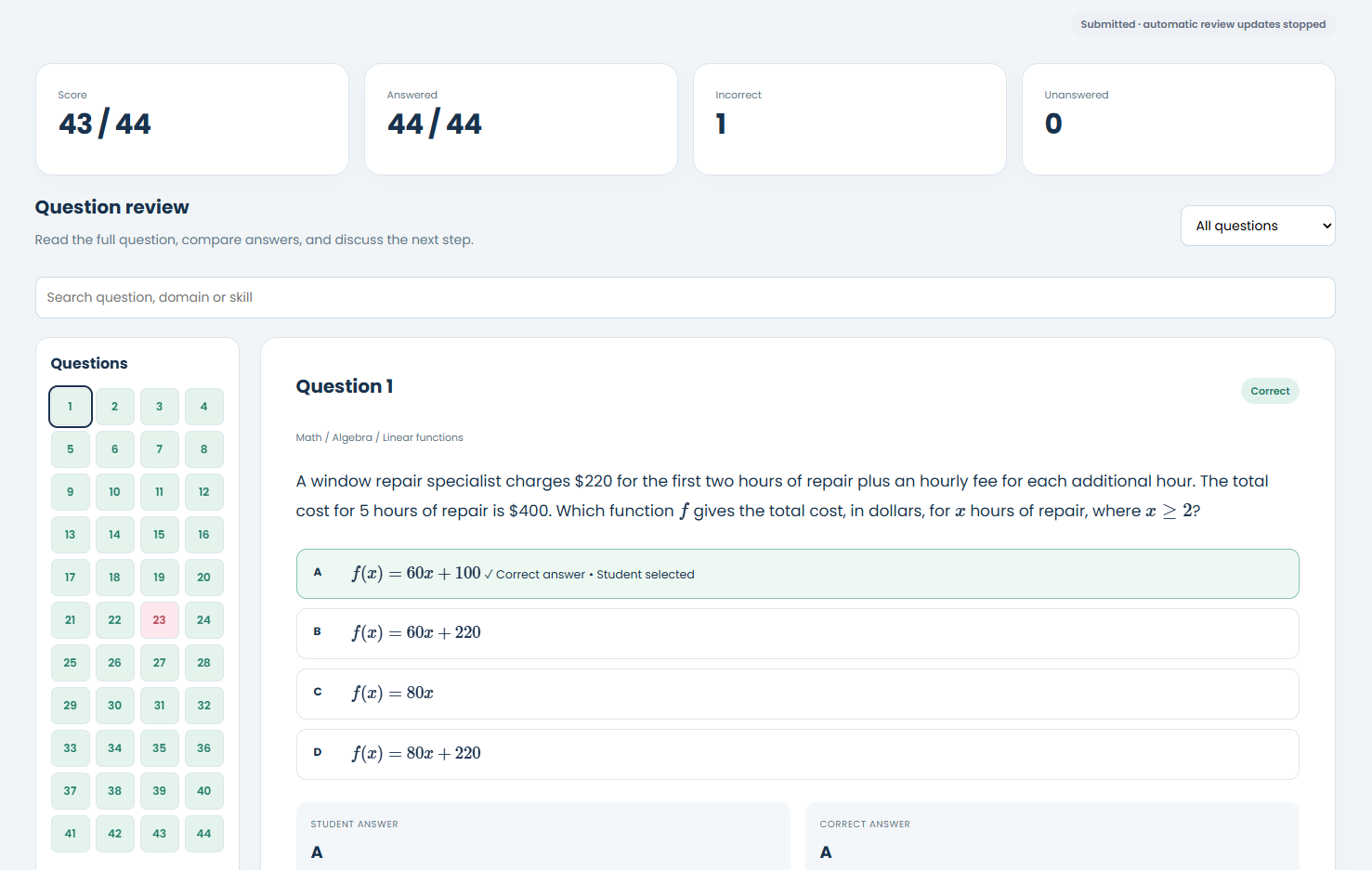
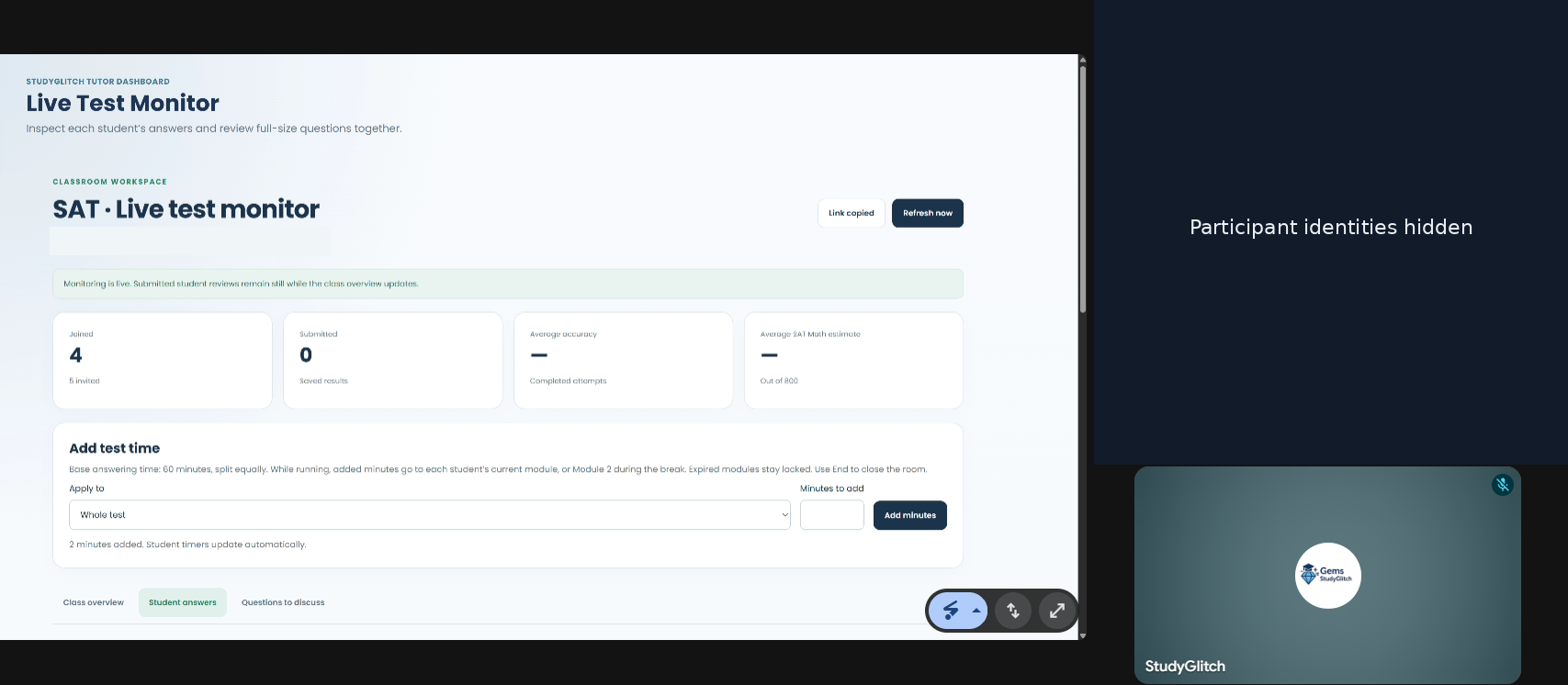
During a live check, the tutor can inspect student responses and move between questions. The review brings the full question, selected answer and response status together to identify what needs further discussion.

Silent screen recording of a live-test review.
SAT Math answer review showing the full question, selected answer and response states.
A linear-function question beside the selected answer and question-status grid.
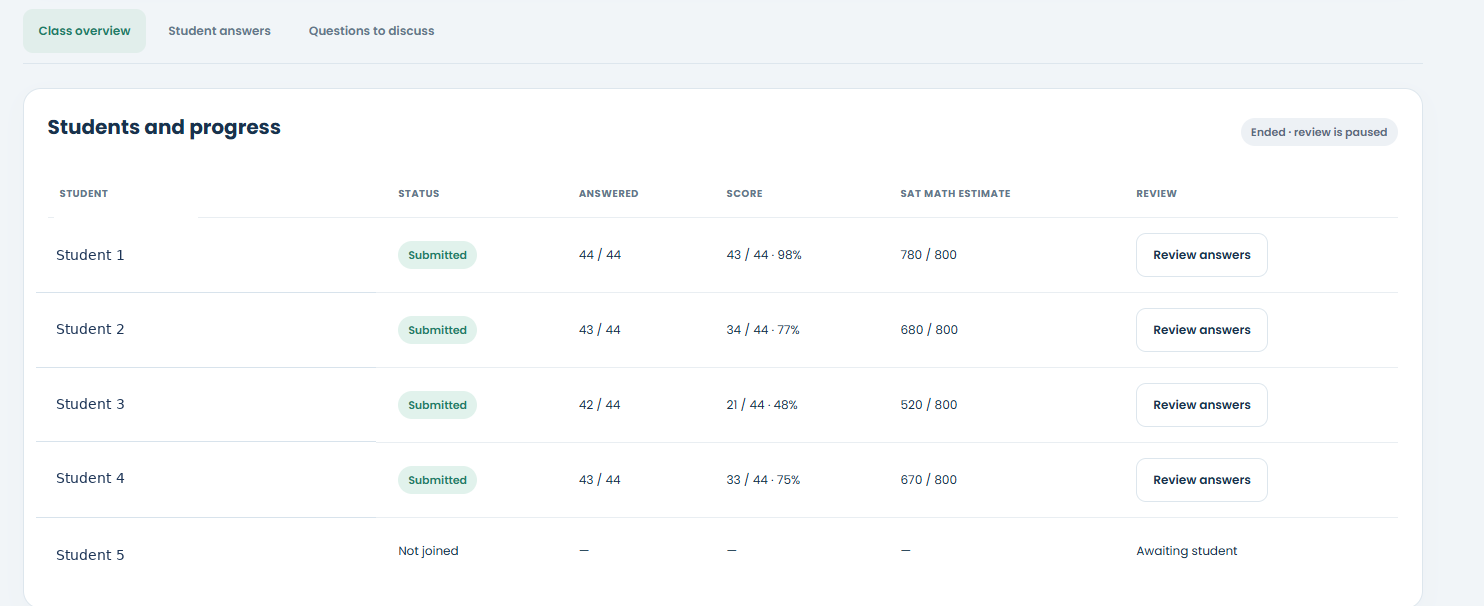
See the shared classroom view and class results
03 · Practise between lessons

Correctness and time tell different parts of the story.

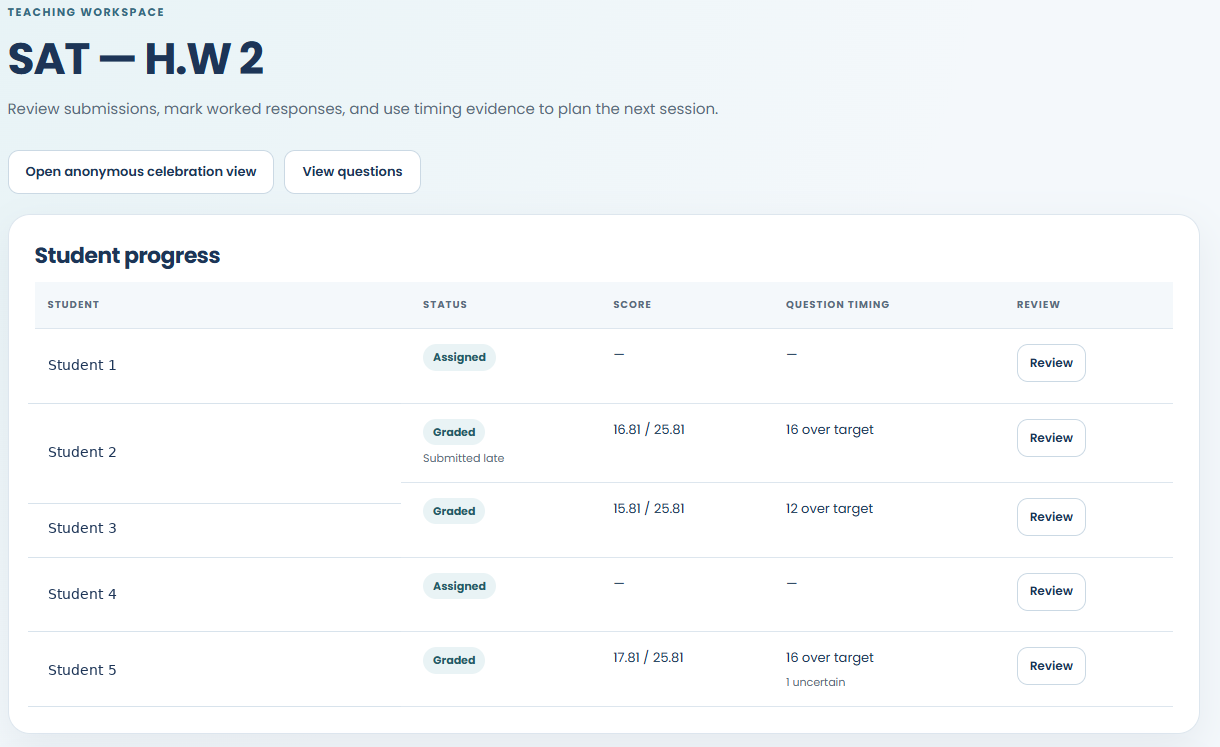
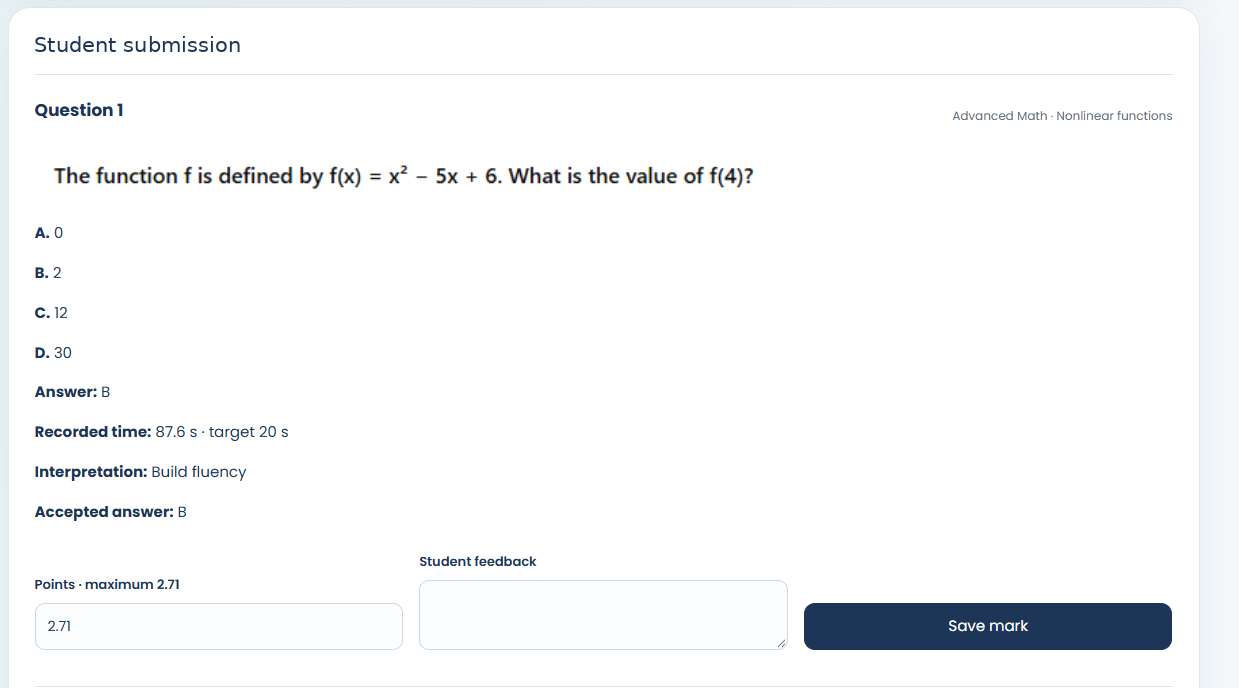
The homework overview shows submission status, marks and recorded timing signals. Opening an individual response lets the tutor compare the answer with its recorded time and decide what to practise next.

These examples show the process. The report brings a student’s results, skill evidence and available activity records together for review.

Inspect the report sample

These are separate SAT Math examples from different activities and students. The results shown are examples, not promised outcomes. Numbered student labels apply within each image.

04 · A fuller learning record

Inspect the report before choosing a plan.

This SAT Math academic report includes starting and latest results, domain and skill evidence, materials practice, homework learning signals and recorded study time.

The student name and identifying dates have been removed. Scores and percentages are preserved. This is one student’s example, not a typical or promised result. Sections depend on the activities completed.

Choose your exam below

SAT Math domain evidence in the report: Algebra, Advanced Math, Problem-Solving and Data Analysis, and Geometry and Trigonometry.
An excerpt from page 7 of the updated sample. Open the report to inspect the evidence and calculation notes.
Exam-specific tutoring

One teaching standard. Three different exam demands.

The tutoring system stays connected while the methods, examples, timing and performance signals change for the exam in front of the student.

Digital exam reasoning

SAT Math

Strengthen current domain control, recognition, efficient solution routes, timing and Desmos judgment for Digital SAT Math.

DomainsDesmosTimingAdaptive pressure
Explore SAT Math preparation →
Quantitative speed and control

GAT / Qudurat

Build arithmetic and algebraic control, quantitative pattern recognition, faster route selection and accuracy under no-calculator pressure.

SpeedPatternsRecognitionQuantitative control
Explore Qudurat preparation →
Calculus reasoning

AP Calculus AB

Develop conceptual transfer across equations, graphs, tables and written contexts while improving MCQ and free-response reasoning.

Graphs & tablesMCQFRQConcept transfer
Explore AP Calculus AB preparation →

Delivered online for learners from Lebanon to Saudi Arabia, across the Gulf and the wider Middle East.

Tutoring stays connected to the rest of the preparation.

A live session should create the next useful action. StudyGlitch connects tutoring with diagnostics, SolvePrint, materials, practice tests and performance evidence so learning does not reset when the call ends.

Baseline Diagnostic + Assessment Establish level, weakness patterns and deeper reasoning where needed.
Build GEMS + Materials Reinforce concepts, methods and targeted exam-specific practice between sessions.
Measure PowerCenter + SolvePrint Use full practice tests to rehearse execution; use SolvePrint when you need a deeper read of difficulty, timing, skill control and response patterns.
Review Progress evidence Use performance signals to decide what should change next.
One connected preparation system: lesson → practice → test or SolvePrint → evidence → next lesson.
Know what you are booking

Assessment and tutoring solve different problems.

StudyGlitch keeps the private one-time Assessment separate from ongoing tutoring. Use Assessment when the student needs a deeper human read; use group tutoring when continued teaching and repeated follow-up are useful.

One-time private session

1-on-1 Assessment

A focused 60-minute session for closer inspection of reasoning, setup, timing and the next preparation decision.

Explore the Assessment →
Ongoing teaching

Online Group Tutoring

Structured live teaching with continued practice, testing and progress review across a tutoring plan.

View live tutoring availability →
Online tutoring FAQ

What students and parents usually want to know.

Is ongoing StudyGlitch tutoring private or group-based?

Ongoing tutoring is delivered through online group tutoring. The private 1-on-1 option is the separate one-time 60-minute Assessment, not ongoing private tutoring.

Who teaches StudyGlitch tutoring sessions?

StudyGlitch tutoring is delivered by professional high-school mathematics teachers with 10+ years of standardized-test and high-school mathematics teaching experience.

Do I have to take a diagnostic before tutoring?

A diagnostic is useful when the starting level or weakness pattern is unclear, but the purpose is evidence rather than a rigid prerequisite. Prior work or a deeper 1-on-1 Assessment can also help establish the starting point.

How does tutoring change as the student improves?

Teaching, pace and practice focus can change as diagnostic results, student solving, PowerCenter attempts and live testing show that foundations are stronger or a different bottleneck has appeared.

Where is StudyGlitch online tutoring available?

StudyGlitch tutoring is delivered online for learners from Lebanon to Saudi Arabia, across the Gulf and the wider Middle East.

Where can I check schedules, seats and current pricing?

Use the Booking page when you are ready to book directly and want to see current tutoring schedules, tutors, seat availability and booking options. Or visit the Pricing page to compare SolvePrint advanced diagnostics, GEMS independent study, the one-time Assessment, and ongoing group tutoring.

Choose the level of support that fits the student now.

Start with the free diagnostic when the baseline is unclear. Use SolvePrint when preparation already exists and you need a deeper measurement of what it is producing. Use the one-time 1-on-1 Assessment for a human read, or group tutoring when ongoing teaching and follow-up are the right next step.