
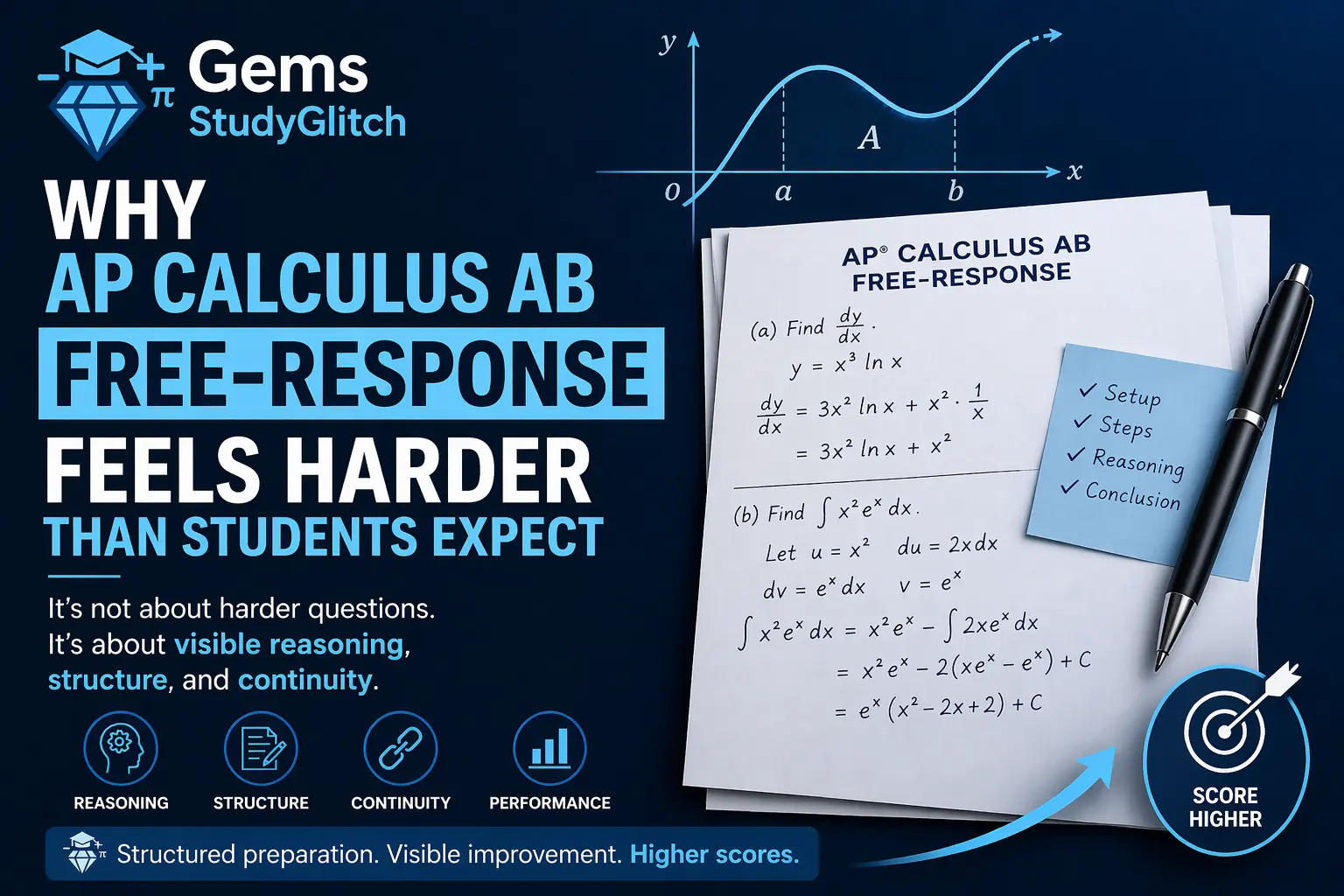
A student can finish an AP Calculus AB free-response question thinking, “I basically got it right,” and still leave several points on the table.
That is one of the biggest reasons FRQ feels harder than students expect.
The free-response section is not scored as one large judgment of whether your final answer is correct.
It is scored through specific pieces of mathematical evidence.
Depending on the question, points may be attached to the setup, a calculation, a conclusion, an interpretation, or a required justification.
That changes the way students need to think about FRQ.
The question is no longer only:
Can I solve this?
It becomes:
Can I show enough correct mathematics for the scorer to award the points?
AP Calculus AB FRQ is half of the exam
On the current AP Calculus AB exam, the free-response section contains 6 questions in 90 minutes and contributes 50% of the total exam score.
The structure is split into two parts:
| FRQ section | Questions | Time | Calculator |
|---|---|---|---|
| Part A | 2 | 30 minutes | Graphing calculator required |
| Part B | 4 | 60 minutes | Calculator not permitted |
The current exam is hybrid digital.
Students view the free-response questions through Bluebook but handwrite their actual solutions in the free-response booklet.
That matters.
You are not only thinking through calculus. You are organizing a handwritten solution under time pressure while deciding what work must be shown.
The StudyGlitch AP Calculus AB page gives the broader structure of the course and preparation path.
An FRQ is really a map of smaller scoring opportunities
Students often look at an FRQ as one large problem.
Scorers do not necessarily see it that way.
A single part can contain several separate opportunities to earn credit.
For example, a response might need some combination of:
- the correct mathematical setup
- a correct derivative or integral
- appropriate use of a theorem
- verification that the theorem's conditions apply
- a correct numerical or algebraic result
- an interpretation in the context of the problem
- correct units
- a mathematically valid justification
Not every FRQ uses the same scoring structure.
Some points can be earned from a correct answer alone.
Other points require supporting work.
A justification point may require something very different from a calculation point.
That is why “I got the final answer” and “I earned full credit” are not the same statement.
Correct mathematics can still be incomplete mathematics
Consider a typical calculus situation.
A student correctly finds that a function has a critical point at a particular value.
That may be mathematically correct.
But imagine the question asks:
At what value does the function attain its absolute maximum? Justify your answer.
Finding the critical point is only part of the job.
The student may also need to compare relevant candidates or explain why that value produces the maximum.
The calculation answers:
Where should I look?
The justification answers:
Why is this the correct conclusion?
FRQ regularly separates those two layers.
That is precisely where students who are strong at calculation can unexpectedly lose points.
“Justify” is an instruction, not decoration
One of the most important words on an AP Calculus AB FRQ is:
justify
Students sometimes treat it as though College Board simply wants one more sentence after the mathematics.
That is not what it means.
A justification should provide the mathematical reason the conclusion follows.
Depending on the problem, that may mean
- identifying the relevant theorem
- verifying the theorem's required conditions
- explaining a sign change
- comparing function values
- connecting the derivative to increasing or decreasing behavior
- connecting the second derivative to concavity
- interpreting an integral in context
Writing:
“Therefore, the answer is 4.”
is a conclusion.
It is not automatically a justification.
Likewise:
“Because the derivative is zero.”
may not be enough if the problem asks why the point is a maximum.
Students need to train themselves to notice exactly what the command word is demanding.
Setup points matter more than students realize
FRQ scoring is one reason students should stop thinking only about final answers.
A correct setup can be valuable even when the arithmetic or algebra later goes wrong.
Suppose a question asks for an average value.
The student may correctly write the average-value expression but then make a calculator mistake.
Depending on that question's scoring guideline, the correct setup may still earn credit even if the final number is wrong.
The opposite can also happen.
A student may enter something into the calculator, produce the correct number, and show too little evidence of where the number came from.
Whether that earns the available points depends on what that particular scoring criterion requires.
This creates an important FRQ habit:
Write the mathematical structure before chasing the decimal.
The setup tells the scorer what you understood.
Calculator output is not mathematical communication
The calculator section creates another trap.
A graphing calculator can evaluate an integral, solve an equation, find an intersection, or produce a numerical value.
But calculator output is not automatically a complete written solution.
Current AP instructions require work to be expressed using standard mathematical notation rather than calculator syntax.
So a student's thinking should look like mathematics on the page.
Not merely:
I typed this into the calculator and got 3.427.
The expression, equation, or mathematical object being evaluated should be visible when the scoring point requires it.
The calculator should support the mathematics.
It should not replace the mathematics.
Interpretation points are different from calculation points
AP Calculus AB frequently places calculus inside a context.
A derivative may represent a rate.
An integral may represent accumulated change.
A numerical answer may need units.
A value may need to be interpreted as increasing, decreasing, maximum, minimum, amount accumulated, or rate of change.
A student can perform the calculus correctly and still mishandle the meaning.
Consider the difference between these two responses:
5.2
and
The quantity is increasing at a rate of 5.2 liters per minute at t = 4.
The second response communicates what the number represents.
When a question asks for interpretation, that distinction matters.
This is why FRQ is not merely a longer version of multiple-choice.
It tests whether the student can move between calculation and meaning.
One wrong step does not always destroy the entire question
Another misunderstanding makes FRQ feel more frightening than necessary.
Students sometimes assume that once they make one mistake, the whole question is lost.
That is not always true.
Because FRQs are scored through individual points, later work may still contain credit-worthy mathematics.
A student who makes an early arithmetic mistake should therefore avoid mentally abandoning the question.
Continue logically.
Show the method.
Answer later parts as carefully as possible.
The scoring system is one reason partial credit is real and worth fighting for.
This is also why a blank response is so costly.
A partially correct method gives the scorer something to evaluate.
An empty page does not.
The hidden skill is knowing what evidence belongs on the page
Students often ask:
How much work do I need to show?
The useful answer is not “write everything.”
Writing every tiny algebra step wastes time and can make the solution harder to read.
The better rule is:
Show the work that establishes the mathematical claim you are making.
That usually means making the important objects visible:
- the equation being solved
- the derivative being analyzed
- the integral being evaluated
- the theorem being used
- the values being compared
- the sign or behavior supporting the conclusion
- the units or interpretation when requested
FRQ writing should be concise but complete.
The goal is not a beautiful essay.
The goal is scorable mathematical evidence.
How to review FRQ differently
This is where many students waste good practice.
They solve an FRQ, look at the final answer, decide whether they were right or wrong, and move on.
That misses most of the value.
After completing an FRQ, review it point by point.
Ask
- Did I earn the setup point?
- Did I show the required mathematical process?
- Did I answer the exact question being asked?
- Was a justification required?
- Did I actually justify it?
- Did I interpret the answer when the context required interpretation?
- Were units needed?
- Did I communicate using standard mathematical notation?
- If my final answer was wrong, which earlier parts were still correct?
This changes FRQ practice from answer checking into scoring analysis.
That is much closer to how the real exam evaluates the response.
Students can use AP Calculus AB practice tests to strengthen timed exam work and use StudyGlitch Materials when a weakness exposed by practice needs deeper review.
What strong FRQ preparation actually looks like
The best FRQ preparation is not simply solving more free-response questions.
It is learning to recognize what each question is asking you to demonstrate.
A stronger training cycle looks like this:
- solve the question under realistic timing
- write the solution as if it will be scored
- compare the work with the scoring criteria
- identify exactly which point was lost
- classify why it was lost
- repair that specific weakness
- attempt another question requiring the same skill
The reason for losing a point matters.
A student who loses a point because of weak integration needs a different correction from a student who integrated correctly but failed to justify a conclusion.
The final score may look the same.
The underlying problem is not.
Why FRQ eventually starts to feel easier
AP Calculus AB free-response does not become easier because the mathematics suddenly becomes simpler.
It becomes easier when the student stops seeing each FRQ as one intimidating block.
Instead, the student begins seeing:
setup
method
calculation
justification
interpretation
communication
Those are separate jobs.
And each one can be trained.
The strongest FRQ students are not necessarily writing the longest solutions.
They are learning to put the right mathematical evidence in the right place.
That is what turns a solution that merely feels correct into one that can actually earn the available points.
Explore the full StudyGlitch AP Calculus AB program, practice with AP Calculus AB tests, or use StudyGlitch Materials to strengthen the concepts that FRQ exposes.