
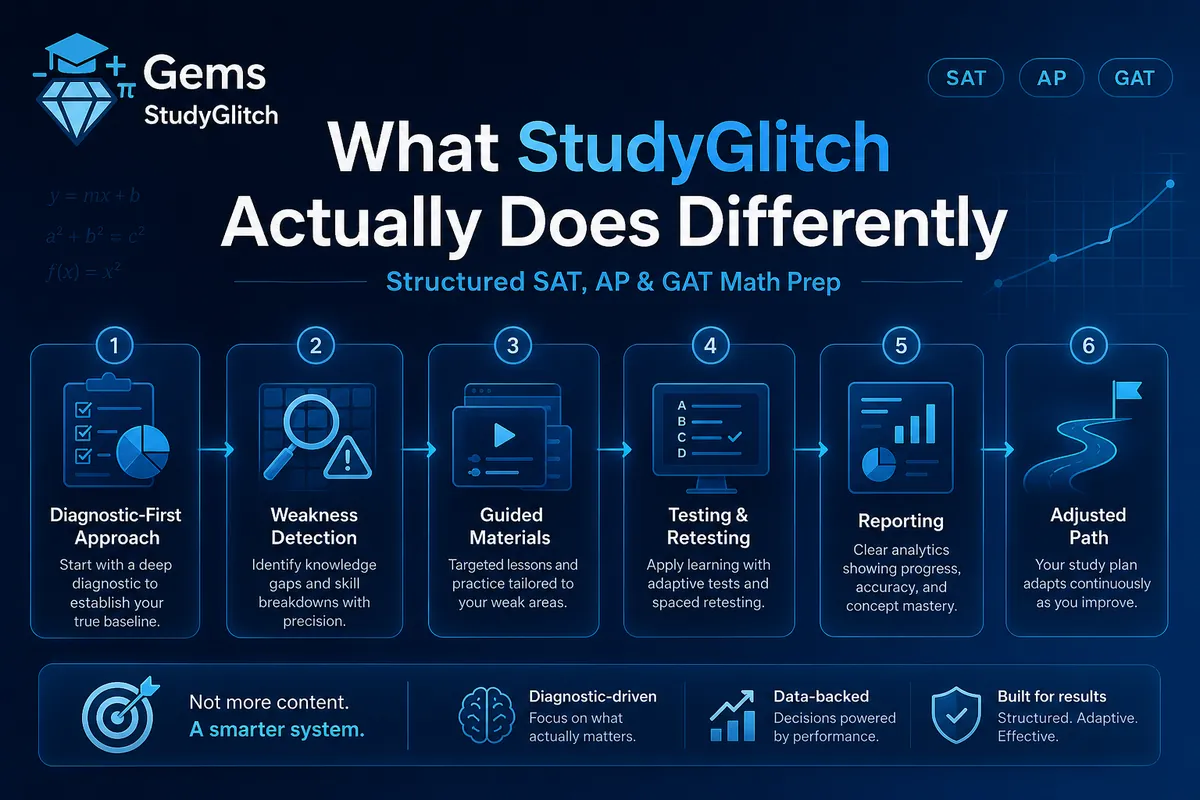
Most math prep looks busy before it looks useful.
A student solves more questions, watches more explanations, takes more notes, or joins tutoring sessions. Sometimes that helps. But often, the student still does not know what is actually blocking progress.
That is the problem StudyGlitch is built around.
StudyGlitch is not simply a tutoring page, a question bank, or a diagnostic test. It is a structured math preparation system for SAT Math, AP Calculus AB, and GAT Quantitative students. The goal is not to make students do more random work. The goal is to help them understand where they stand, what is holding them back, and what should happen next.
The difference starts with diagnosis
Many students begin prep by asking the wrong question.
They ask, “What should I study?” before they know what their current performance is showing. They ask, “How many questions should I solve?” before they know whether their mistakes come from content gaps, timing pressure, careless execution, or weak recognition.
StudyGlitch starts differently.
The first step is often the free diagnostic, because a diagnostic gives the student a clearer starting point. It does not only show a score. It helps reveal patterns.
A useful diagnostic should help answer questions like:
- Which areas are currently weak?
- Is the student losing marks because of knowledge, timing, or decision-making?
- Are mistakes concentrated in certain topics or spread across the test?
- Does the student need review, practice, strategy, or a more guided plan?
That matters because two students can receive the same score for very different reasons. One student may know the content but lose control under time pressure. Another may work carefully but lack topic coverage. Another may understand lessons but fail to transfer them into exam-style questions.
A fixed plan treats those students as if they are the same. StudyGlitch does not.
Weakness detection is more useful than general motivation
Students are often told to “practice more” when the real issue is not effort.
A student may already be practicing. The problem is that the practice is not connected to a clear diagnosis. Without weakness detection, practice can become repetitive. The student keeps touching familiar topics, avoids uncomfortable ones, and mistakes start to feel random.
StudyGlitch is designed around targeted weakness detection.
The point is not just to say that a student is weak in math. That is too broad to be useful. The point is to narrow the weakness into something more actionable: a topic, a skill, a type of decision, or a pattern of performance.
For SAT Math, that may mean identifying whether the problem is algebraic setup, function interpretation, geometry reasoning, or timing stability.
For AP Calculus AB, that may mean noticing whether the student struggles more with representation transfer, derivative and integral meaning, accumulation, graph interpretation, or multi-step reasoning.
For GAT Quantitative, that may mean seeing whether the student’s issue is speed, recognition, route selection, number sense, or hesitation under pressure.
This is why structured prep is different from generic prep. It does not simply add more content. It makes the student’s next step more precise.
Guided materials give practice a direction
A common problem in online learning is that students have access to too much material but not enough direction.
More resources do not automatically create better preparation. If a student does not know what to use, when to use it, or why it matters, a large resource library can become confusing.
StudyGlitch uses guided materials to support a more structured learning path. The idea is simple: materials should connect to what the student needs to repair, not just exist as a random collection.
This matters because effective math prep is not only about exposure. It is about sequence.
A student often needs to move through a cycle:
- Detect the weak area
- Review the correct concept or method
- Practice the skill in a focused way
- Test whether the weakness improved
- Adjust the plan if it did not
Without that cycle, students may feel productive while still repeating the same mistakes.
Testing and retesting keep the plan honest
A plan is only useful if it responds to evidence.
That is why StudyGlitch does not treat preparation as a one-time diagnosis. Students need chances to test, retest, and compare performance over time. Improvement should not be based only on feeling more confident after a lesson. It should show up in performance.
The PowerCenter supports that idea by giving students a place to continue structured exam practice and track performance signals.
This is important because math confidence can be misleading.
A student may feel stronger after reviewing a topic, but still miss exam-style questions when the wording changes. A student may solve correctly with unlimited time, but lose accuracy when pace matters. A student may improve one topic while another weakness becomes more visible.
Retesting helps separate real progress from temporary comfort.
Reporting makes progress visible
One of the strongest differences in StudyGlitch is that preparation is not treated as invisible.
In many tutoring or self-study setups, students finish a session and leave with a general feeling: “That went well” or “I still feel weak.” But feelings are not enough. Students and parents need clearer signals.
Reporting helps make performance more visible.
A structured report can show where a student is improving, where weaknesses remain, and how performance changes across attempts. That is especially important for students preparing across serious exams like SAT Math, AP Calculus AB, and GAT Quantitative.
Reporting also changes the conversation.
Instead of saying, “You need to study more,” the conversation can become:
- This topic is improving
- This skill is still unstable
- Timing is affecting accuracy
- This area needs another review cycle
- The next step should be adjusted
That is a more serious way to prepare.
StudyGlitch is not a fixed generic plan
Many prep programs start with a fixed path.
Week one: topic A. Week two: topic B. Week three: topic C. The structure may look organized, but it does not always respond to the student’s actual performance.
StudyGlitch is built around an adjusted path instead.
The student’s path should depend on what the data shows. If the diagnostic shows a weak area, that area should influence the plan. If later testing shows improvement, the student can move forward. If the weakness remains, the plan should not pretend everything is fine.
That is the difference between a schedule and a system.
A schedule tells the student what comes next. A system checks whether the student is actually ready for what comes next.
Tutoring fits inside the system
StudyGlitch also offers booking for tutoring, but tutoring is not treated as a separate random service.
The stronger model is diagnostic-based tutoring. That means tutoring should be connected to the student’s actual needs, not just a generic lesson list.
This makes tutoring more focused.
A tutor can use diagnostic signals, performance patterns, and student history to focus on what needs repair. That does not mean every session is identical or automated. It means the session has a clearer reason behind it.
For a student, this can reduce wasted time. For a parent, it can make the learning process easier to understand. For the platform, it keeps tutoring connected to measurable academic movement.
Why this matters for SAT, AP, and GAT students
SAT Math, AP Calculus AB, and GAT Quantitative are different exams, but they share one problem: students often misread what their score means.
A low score does not always mean the student lacks ability. A plateau does not always mean the student has reached a limit. A strong untimed result does not always mean the student is exam-ready.
The real question is more specific.
What is the score actually telling us?
StudyGlitch is built to answer that question more clearly.
For SAT Math, structure matters because students need accuracy, timing, and flexible problem-solving across changing question styles.
For AP Calculus AB, structure matters because students must move between formulas, graphs, tables, worded contexts, and conceptual reasoning.
For GAT Quantitative, structure matters because speed, recognition, and decision-making can affect performance as much as raw math knowledge.
That is why StudyGlitch focuses on clarity before intensity.
A serious prep system should reduce confusion
Students do not only need more math.
They need a better way to understand their math performance.
That is the core StudyGlitch difference. It brings diagnosis, weakness detection, guided materials, testing, retesting, reporting, and tutoring into one structured learning flow.
It does not promise that preparation becomes effortless. It does not pretend that one diagnostic solves everything. It does not reduce improvement to motivation.
Instead, it gives students a clearer structure.
Start with evidence. Study the right areas. Practice with direction. Retest honestly. Adjust the path.
That is what StudyGlitch does differently.
To learn more about the platform, visit StudyGlitch or read more about the approach on the About page.
Frequently Asked Questions
What makes StudyGlitch different from normal math tutoring? StudyGlitch connects tutoring with diagnostics, weakness detection, guided materials, testing, retesting, and reporting. The goal is to make the learning path more structured instead of relying only on general lessons.
Is StudyGlitch only a diagnostic test? No. The diagnostic is an important starting point, but StudyGlitch also supports guided materials, exam practice, reporting, and tutoring for SAT Math, AP Calculus AB, and GAT Quantitative preparation.
How does StudyGlitch help students after the diagnostic? After the diagnostic, the student can use the results to understand weak areas, review guided materials, continue practice through PowerCenter, and consider tutoring if structured support is needed.
Does StudyGlitch support SAT Math, AP Calculus AB, and GAT Quantitative? Yes. StudyGlitch is focused on math preparation for SAT Math, AP Calculus AB, and GAT Quantitative students.
Why does StudyGlitch focus on structure instead of only more practice? More practice helps only when it is connected to the right feedback. Structure helps students identify what is weak, practice with purpose, retest progress, and adjust the next step.