
Many AP Calculus AB students experience the same frustrating situation:
They understand the lesson, follow the explanation, recognize the concept, and still lose points on the exam.
This can feel unfair at first. The student thinks, “I know what this question is about. Why did I still get it wrong?” But AP Calculus AB does not only test whether the idea exists somewhere in your head. It tests whether you can turn that idea into visible mathematical work under exam conditions.
That difference is important.
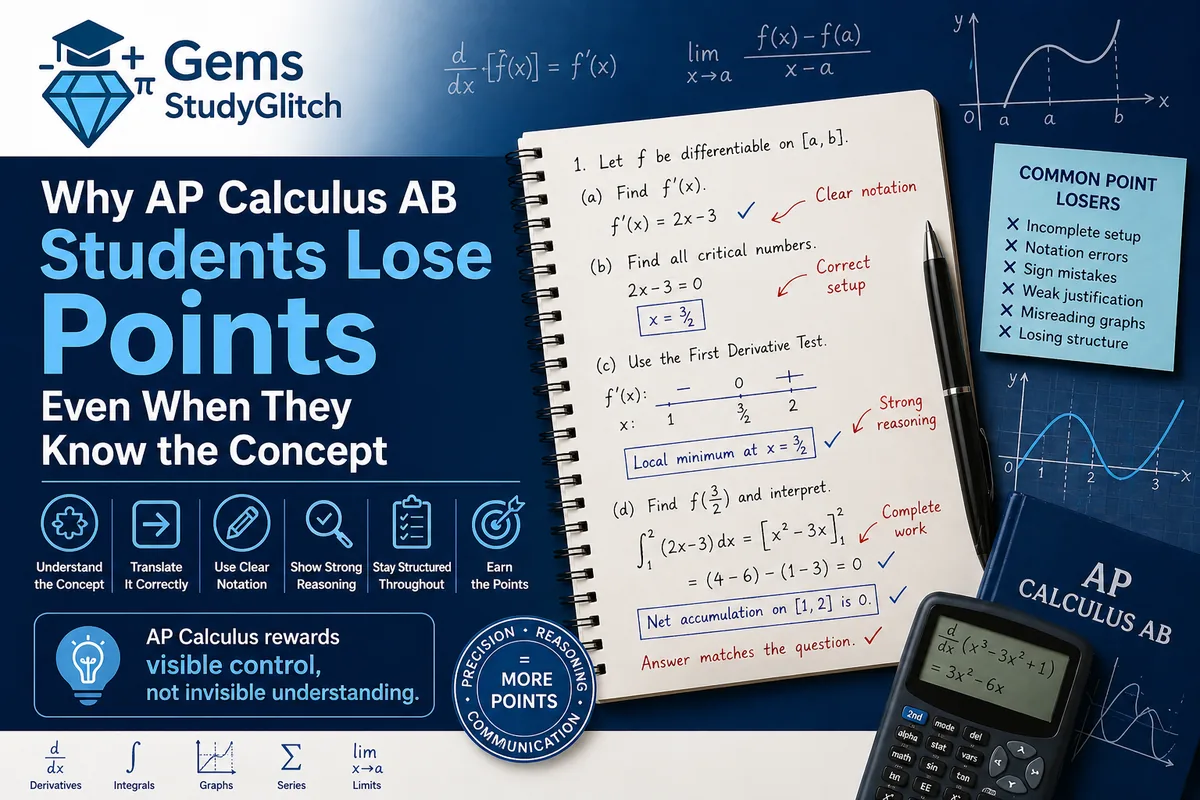
In AP Calculus AB, concept familiarity does not automatically become scoring accuracy. A student may know derivatives, integrals, limits, accumulation, tangent lines, or optimization, but still lose points because the setup is incomplete, the notation is unclear, the sign is wrong, the justification is weak, or the response loses structure halfway through.
The exam rewards control.
Not just private understanding. Not just “I knew what to do.” Not just recognizing the topic.
It rewards whether your understanding is shown clearly enough to earn the point.
The gap between understanding and earning points
There is a real gap between “I understand this” and “I earned the points”.
In normal studying, a student often checks whether they understand the concept. They watch a solution, follow the steps, and feel comfortable. That comfort matters, but it is not the full exam demand.
AP Calculus AB asks for more than recognition.
It asks students to translate a situation into calculus, choose the correct structure, use notation accurately, reason clearly, and maintain control across multi-step problems.
A student may understand that a derivative represents a rate of change but still lose points if they use the wrong variable, misread the graph, ignore units, or fail to explain the meaning of the derivative in context.
A student may understand that an integral represents accumulation but still lose points if they set the bounds incorrectly, forget the initial value, or write a final answer that does not match the question.
This is why AP Calculus can surprise strong students.
They know the concept, but the exam asks them to prove that knowledge through precise execution.
That is why AP Calculus AB preparation should not only focus on learning topics. It should also train students to express their reasoning clearly and consistently.
Incomplete setup costs points
One common reason AP Calculus AB students lose points is incomplete setup.
The student may know the correct concept but start the solution in a way that is too vague or unfinished.
For example, they may know that an integral is needed but not define what the integral represents. They may know that a derivative should be used but not identify the function or variable clearly. They may know an optimization problem requires a relationship between variables but skip the equation that connects them.
In a short multiple-choice question, the answer might still be found through quick work. But in longer AP-style questions, especially free-response style thinking, the setup matters because it shows the path of reasoning.
Incomplete setup often leads to later errors.
If the starting expression is unclear, the rest of the solution becomes harder to control. A small missing piece at the beginning can cause confusion in the middle and lost points at the end.
Students should train themselves to ask:
- What quantity am I finding?
- Which function or relationship is involved?
- What does the derivative or integral represent here?
- Are the bounds, variables, and units clear?
- Have I written enough structure for the solution to make sense?
This does not mean writing long explanations for everything. It means making the mathematical path visible.
Notation sloppiness is not a small issue
Notation matters in AP Calculus AB.
Many students treat notation as decoration. They think the idea is more important than how it is written. The idea is important, but AP Calculus is a language. If the language is unclear, the reasoning becomes unclear.
Notation mistakes can include:
- Writing derivative notation without showing the correct variable.
- Using equals signs between expressions that are not actually equal.
- Dropping function notation halfway through a solution.
- Mixing up f, f prime, and f double prime.
- Writing an integral without clear bounds.
- Forgetting dx in an integral setup.
- Using a calculator value without showing what it represents.
- Switching variables without explanation.
Some notation mistakes are minor. Others change the meaning of the work.
For example, confusing f(x) with f prime of x is not just a writing issue. It can mean confusing a position or value with a rate of change. In calculus, that difference is central.
This is why students who “know the concept” may still lose points. They may understand the idea privately, but their written work does not communicate the idea accurately.
AP Calculus rewards mathematical communication. Clean notation helps the scorer, and more importantly, it helps the student stay organized.
Sign mistakes change the meaning
Sign mistakes are another common source of lost points.
In AP Calculus AB, a positive or negative sign often carries meaning. It can represent increasing or decreasing behavior, motion direction, concavity, net accumulation, area orientation, or whether a rate is adding or removing quantity.
A sign error is not always a tiny arithmetic slip. Sometimes it changes the interpretation of the entire answer.
For example, if a rate is negative, that may mean a quantity is decreasing. If a second derivative is negative, that may suggest concavity down. If an integral gives net change, the sign tells whether the total effect increases or decreases the original amount.
Students often lose points when they perform the right general process but fail to track the sign carefully.
This can happen because they rush, copy values incorrectly, misread a graph, or forget whether the question asks for net change, total change, rate, position, velocity, or acceleration.
The solution is not simply “be careful.”
The better solution is to build sign checks into the work.
Students should ask:
- Should this value be positive or negative based on the context?
- Does the graph show the function above or below the axis?
- Is the quantity increasing or decreasing?
- Did the question ask for net change or total amount?
- Does my final answer make sense with the situation?
This kind of checking turns sign accuracy into a habit, not a last-second hope.
Weak justification loses points
Many AP Calculus AB questions require reasoning, not only calculation.
A student may get a correct number but lose points because the explanation does not justify the conclusion. This happens often in questions about increasing and decreasing behavior, concavity, extrema, the Mean Value Theorem, the Intermediate Value Theorem, or interpreting derivatives and integrals in context.
Students sometimes write conclusions like:
“It is increasing because the graph goes up.”
Or:
“There is a maximum because the derivative is zero.”
These statements may be incomplete.
The exam often expects a clearer reason. For example, if a student claims a function has a local maximum, they may need to connect it to a derivative changing from positive to negative. If they use a theorem, they may need to show that the conditions are satisfied. If they interpret an integral, they may need to explain what the accumulated quantity means in context.
The issue is not that the student does not understand the concept.
The issue is that the reasoning is not fully visible.
AP Calculus AB rewards conclusions that are supported by mathematical evidence. Students should practice writing short but complete justifications.
A good justification does not need to be long. It needs to connect the conclusion to the correct calculus reason.
Graph and table misreading causes hidden losses
AP Calculus AB often gives information through graphs and tables.
Many students lose points not because they cannot do calculus, but because they misread the given information.
A graph may show f, f prime, or f double prime. A table may give values of a function, values of a derivative, or values at selected points. If the student does not identify what the data represents, the entire solution can go in the wrong direction.
This is a very common AP Calculus problem.
A student sees a graph and starts thinking visually, but they forget to ask the most important question:
What function is this graph showing?
If the graph shows f prime, then increasing and decreasing behavior of f depends on whether f prime is positive or negative. If the graph shows f double prime, then concavity of f depends on the sign of f double prime. If a table gives rates, then an integral or accumulation idea may be needed to estimate change.
The same problem happens with tables.
Students may use values directly when they should be using differences, slopes, rates, or accumulated change. They may also assume behavior between table values without enough information.
This is why AP Calculus students should slow down at the beginning of graph and table questions.
Not slow down forever. Just slow down enough to identify what the information actually represents.
A few seconds of correct interpretation can save several points.
Longer questions require structure
AP Calculus AB becomes harder when questions have multiple parts or longer reasoning chains.
A student may understand each individual concept but lose structure across the full question. They start correctly, then forget what they are solving for, mix values from different parts, or carry an earlier mistake into a later step.
This is not just a knowledge problem. It is an organization problem.
Longer questions require students to manage information.
They need to track:
- What each variable represents.
- Which part of the question they are answering.
- Which values are given.
- Which values were already found.
- Whether a previous result should be reused.
- Whether the answer needs units or context.
- Whether the question asks for a value, a justification, or an interpretation.
When students do not structure their work, they often make mistakes that feel random.
But they are not random. They come from losing control of the solution.
This is why AP Calculus practice should include full exam-style questions, not only isolated skill drills. Isolated practice helps build concepts, but longer questions train students to hold the structure together.
The StudyGlitch AP Calculus AB practice tests is useful for this because students need repeated exam-style practice, not just topic familiarity.
Private understanding is not enough
One of the most important AP Calculus lessons is this:
The exam cannot see what you meant.
It can only evaluate what you showed.
This is why students sometimes feel they deserved more credit. They may have understood the idea internally, but the written work did not make that understanding clear enough.
This does not mean students need to write excessive explanations. It means their work should show visible control.
Visible control includes:
- A clear setup.
- Correct notation.
- Accurate signs.
- Logical steps.
- Short but valid justifications.
- Correct interpretation of graphs and tables.
- Final answers that match the question.
When students train only for understanding, they may feel prepared. When they train for visible control, they become more exam-ready.
That is the difference.
This connects directly to the idea in What AP Calculus AB Actually Demands From Students. AP Calculus does not only ask whether students recognize calculus ideas. It asks whether they can use them with precision.
Why more practice does not always fix the problem
Many students respond to lost points by doing more practice.
Practice matters, but more practice does not automatically fix AP Calculus mistakes.
If the student repeats the same habits, they may keep losing points in the same way: incomplete setup, weak notation, unclear reasoning, or poor graph interpretation.
This is why practice quality matters.
After each missed question, students should not only ask “What was the right answer?” They should ask:
- Did I lose the point because I did not know the concept?
- Did I know the concept but set it up poorly?
- Did notation make my work unclear?
- Did I make a sign error?
- Did I fail to justify the conclusion?
- Did I misread the graph or table?
- Did I lose structure in a longer question?
These categories create better review.
A student who knows the category of the mistake can repair it. A student who only marks the answer wrong may repeat it.
This is why Why More Practice Does Not Always Improve Your AP Calculus AB Score matters. AP improvement depends on how practice is reviewed, not only how much practice is completed.
How to train for scoring accuracy
To improve AP Calculus AB scoring accuracy, students should train the bridge between concept and response.
That means practicing in a way that makes reasoning visible.
A strong AP Calculus review routine can include:
- Rewrite incomplete setups clearly.
- Correct notation errors, not only final answers.
- Mark every sign error and explain what the sign meant.
- Practice one-sentence justifications for common conclusions.
- Identify whether each graph or table shows f, f prime, or f double prime.
- Review longer questions by structure, not only by result.
- Redo missed questions after a delay to test whether the repair lasted.
Students should also use diagnostic-style feedback. If the same type of mistake appears repeatedly, it should become a priority.
A AP Calculus AB diagnostic test can help students see whether their issue is topic knowledge, execution, timing, or consistency.
The goal is not to become perfect overnight.
The goal is to make lost points less mysterious.
Once students understand why points are being lost, AP Calculus becomes more trainable.
Study AP Calculus without memorizing everything
Some students try to fix AP Calculus by memorizing more steps.
Memorization can help with formulas and common structures, but it cannot replace understanding and reasoning. AP Calculus AB often changes the form of the question. If the student only memorized a pattern, they may struggle when the wording, graph, table, or context changes.
A better approach is to understand the role of each concept.
For example:
- A derivative describes rate of change.
- A second derivative helps describe concavity and rate changes.
- An integral can represent accumulation or net change.
- A tangent line uses local linear behavior.
- A critical point needs interpretation, not just calculation.
- A theorem requires conditions, not just a name.
When students understand the role of each idea, they can adapt more easily.
This is the mindset behind Study AP Calculus Without Memorizing Everything. The goal is not to memorize every possible question form. The goal is to recognize the mathematical role and communicate it clearly.
That is how concept knowledge becomes scoring accuracy.
Frequently Asked Questions
Why do I lose AP Calculus points even when I know the concept? You may understand the concept but lose points because your setup, notation, sign tracking, justification, or interpretation is incomplete. AP Calculus AB rewards visible mathematical control, not only private understanding.
Does notation matter in AP Calculus AB? Yes. Notation matters because it shows what function, variable, derivative, or integral you are using. Sloppy notation can make correct thinking look unclear or mathematically incorrect.
Why is AP Calculus harder to score well in than expected? AP Calculus AB can feel harder to score well in because it requires both understanding and precise execution. Students must translate concepts into clear work, interpret graphs and tables correctly, and justify conclusions under exam pressure.
Can I understand calculus and still perform badly on the exam? Yes. A student can understand calculus during lessons but struggle on the exam if they cannot apply the ideas quickly, organize longer solutions, write clear reasoning, or avoid repeated execution mistakes.
What kinds of mistakes cost points in AP Calculus AB? Common point-costing mistakes include incomplete setup, unclear notation, sign errors, weak justification, graph or table misreading, and losing structure in multi-step questions.
Final thought
AP Calculus AB does not only reward knowing the idea.
It rewards showing control of the idea.
A student may understand the concept privately, but the exam score depends on what appears in the work: the setup, notation, reasoning, structure, interpretation, and final answer.
That is the key shift.
AP Calculus rewards visible control, not invisible understanding.