
Many students assume that if they know the topic, they should be able to solve the question well.
But that is not always true.
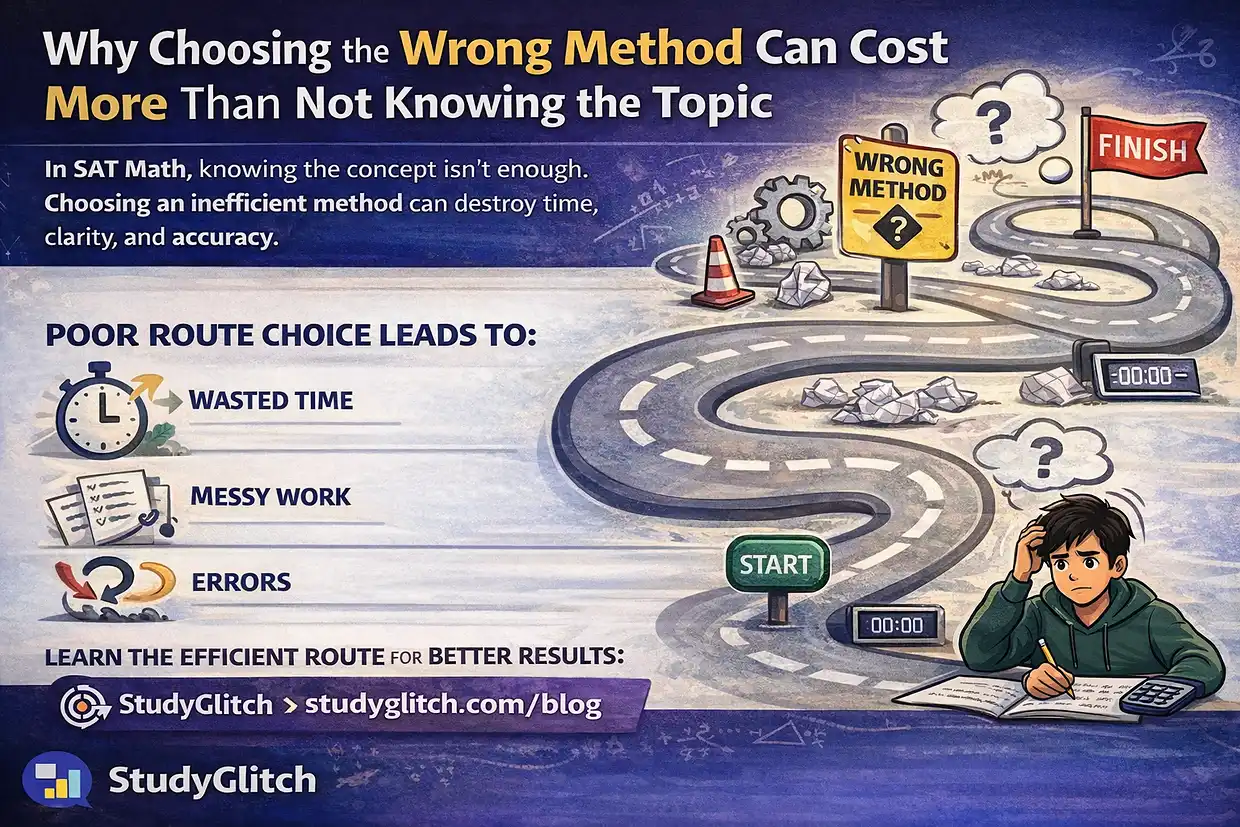
In math exams, especially SAT Math, knowing the topic is only part of the job. A student may recognize the concept, understand the lesson, and still lose points because the path they choose is too long, too messy, too risky, or simply wrong for the situation.
This is one of the most underappreciated parts of strong performance.
Students often blame weak results on not knowing enough math. But in many cases, the larger issue is not topic knowledge. It is method choice.
That is why choosing the wrong method can cost more than not knowing the topic.
If a student truly does not know a topic, the weakness is visible. It can be identified and studied. But when a student knows the topic and still chooses a poor route, the mistake is harder to notice. The work may look serious. The student may feel capable. Yet the result still collapses through wasted time, unnecessary steps, and rising error risk.
That is what makes route choice so important.
Why method choice matters so much in math exams
Not every correct method is equally good under exam conditions.
This is the key idea many students miss.
A method can be mathematically valid and still be a bad exam method. It may take too long. It may create too many steps. It may increase sign errors, algebra mistakes, or confusion halfway through. It may work in homework but fail under timed pressure.
That is why math exams do not only reward knowledge. They reward judgment.
Students need to know the topic, but they also need to choose a path that fits the question, the timing, and the level of control required.
This is especially important in SAT Math because the exam often rewards efficient thinking, flexible decision-making, and smart route selection more than brute-force effort.
A student who chooses well can look faster and stronger without actually knowing dramatically more math. A student who chooses badly can look weaker than they really are.
The wrong method creates hidden damage
Students often notice when they do not know a topic.
They do not always notice the damage caused by a poor method.
That damage usually appears in several forms at once:
- time loss
- messy work
- avoidable algebra errors
- broken focus in the middle of the solution
- confusion about whether the route is still correct
- extra pressure on later questions
This is why wrong solving method math exam problems are so costly. The issue is not only that the chosen route is inefficient. The issue is that inefficiency spreads.
One poor decision early in a question can create instability through the rest of the section.
A student may spend too long setting up something that could have been seen more directly. They may choose a heavy algebra route when structure, substitution, estimation, graph reading, or answer choice logic would have been cleaner. By the time they realize the route is ugly, they are already committed and the timing damage is done.
That is why method choice is not a small detail. It affects the whole performance system.
SAT Math rewards efficient route choice more than students think
SAT Math is one of the clearest places where route choice matters.
The exam often allows more than one possible path. But it does not reward all paths equally. Some routes are faster, safer, and more aligned with how the question is designed. Others are technically possible but strategically poor.
This is why SAT math strategy method choice matters so much.
A student might know how to solve a system, a function question, or a percent problem in a formal classroom way. But on the SAT, the best method may be simpler. It may rely on structure, answer choices, graph interpretation, or a more efficient setup.
That does not mean the SAT is testing tricks.
It means the SAT often rewards students who can choose intelligently instead of automatically.
This is one reason students can understand the topic and still underperform. They bring the wrong style of solving to the exam.
Knowing the math is not enough if the route is unstable.
A correct method can still be the wrong method
This is worth saying clearly.
A method does not have to be mathematically wrong to be the wrong exam choice.
Students often think method mistakes only count if they produce the wrong answer. But sometimes the problem is that the route made the question harder than it needed to be.
A route may be wrong for the exam because it is:
- too long for the time available
- too dependent on perfect algebra control
- too easy to derail halfway through
- too detailed for a question with a simpler structure
- too rigid for a problem that rewards flexibility
This is one of the biggest reasons students lose points they should have kept.
They are not always solving incorrectly.
They are solving expensively.
And in a timed exam, expensive solving is dangerous.
Why students choose bad routes even when they know better
Students usually choose poor methods for one of a few reasons.
Sometimes they panic and grab the first method they recognize.
Sometimes they are overly loyal to the way they learned the topic in class.
Sometimes they do not pause long enough to compare options.
Sometimes they confuse effort with strength and assume the longer route is the more serious one.
And sometimes they never trained themselves to think about route choice at all.
That last point matters a lot.
Many students are taught to solve, but not to choose how to solve. They learn procedures, but not decision-making. Then they enter an exam like the SAT and discover that topic knowledge alone does not create efficient performance.
That is why digital SAT math prep should include route comparison, not just question completion.
Students need practice asking:
- Is there a cleaner way to see this?
- Am I creating unnecessary algebra?
- Is this route safe under time pressure?
- Am I solving the question, or am I over-solving it?
Those questions build judgment.
And judgment is one of the real competitive edges in SAT Math.
The wrong route increases timing problems
Many timing problems in math exams are really route-choice problems.
A student may think they are simply too slow, when the deeper issue is that they keep entering questions through inefficient paths. They do more steps than necessary, create more opportunities for error, and use too much mental energy on work that the exam did not require.
That is why timing often collapses even when the student knows the content.
The route drained the section.
For a fuller explanation of that idea, read Why Math Exam Timing Problems Are Usually Not About Speed.
This is also why students should be careful with the phrase “I need to get faster.”
Sometimes the better answer is not getting faster.
It is choosing better.
Efficient route choice SAT math performance depends on this distinction. A student does not need to rush if they can remove unnecessary solving weight.
Messy work is often a method problem, not just a carelessness problem
When students create messy work, they often blame themselves for being careless.
Sometimes that is fair. But often the mess began earlier, when the chosen route created too much structure to manage cleanly.
A poor method usually produces more lines, more transformations, more places to lose track of signs, variables, and conditions. Under time pressure, that kind of work becomes fragile.
So the real issue may not be carelessness at all.
It may be that the route demanded too much control for that question under those conditions.
This is one reason strong students can look inconsistent. They understand the topic, but their method choices create unstable work. On one day they survive it. On another day they do not.
That is why cleaner solving is not only about being organized.
It is also about choosing routes that stay manageable.
How this applies beyond SAT
This article is SAT-heavy because route choice is especially visible there, but the idea matters across programs.
In AP Calculus AB, students can choose methods that are technically valid but too complicated, too weakly structured, or too hard to communicate clearly. The result is unstable written reasoning.
In GAT Quantitative, students can choose routes that are too heavy for a fast-paced exam. The result is time loss and broken fluency.
So the principle is broader than one test.
The wrong method can damage performance across SAT, AP, and GAT.
But in SAT Math, where judgment, adaptability, and efficiency matter so much, route choice becomes one of the clearest performance separators.
What better route choice looks like
Better route choice does not mean using shortcuts blindly.
It means choosing a method that is mathematically sound, strategically efficient, and stable under pressure.
That can include:
- seeing structure before expanding
- using substitution at the right moment
- leveraging answer choices when appropriate
- reading graphs and tables efficiently
- avoiding algebra that the question does not require
- choosing the path with fewer risky steps
- preferring control over unnecessary elegance
This is where many students misunderstand strategy.
Strategy is not about flashy tricks.
It is about choosing a route that protects accuracy, time, and clarity.
That is the kind of solving that actually scales in exams.
If you want a stronger SAT framework around this, read Digital SAT Math Prep in Saudi Arabia: A Smarter Way to Improve Your Score, Why SAT Math Shortcuts Keep Students Stuck, and Prepare for SAT Math in Saudi Arabia: A Structured Approach.
Why this is really a judgment problem
At its core, route choice is a judgment skill.
The student is not just solving.
They are evaluating.
They are noticing the form of the question, anticipating the cost of different methods, and choosing a route that fits both the math and the exam environment.
This is one reason StudyGlitch’s judgment angle is so valuable. Many students think performance comes only from more content and more repetition. But a large part of strong performance comes from knowing how to move through the content intelligently.
That is what separates surface familiarity from exam readiness.
A student can know the topic and still lose because their judgment under pressure is weak.
A student can know slightly less math and still outperform because their route choice is strong.
That is not luck.
That is method quality.
How students can improve method choice
The first step is to stop treating every completed solution as equally good.
After solving, students should ask:
- Was this route efficient?
- Was there a cleaner entry point?
- Did I create unnecessary work?
- Would this method still hold under stronger time pressure?
- Did the route increase my chance of errors?
Those questions help students review for decision quality, not just answer accuracy.
The second step is to compare methods deliberately. When possible, students should look at alternate paths and notice why one route is more stable than another.
The third step is to train in a structured way, where problem types, timing behavior, and review patterns make method quality visible.
That is why a strong SAT system matters.
If you want SAT-specific pathways, see SAT Math and SAT Math Arabic.
A diagnostic can also help if a student suspects their score is being limited by timing collapse, route instability, or inefficient solving habits rather than only by content gaps. In that case, the StudyGlitch SAT Math Diagnostic can be a useful starting point.
The real lesson
Students often fear not knowing the topic.
But in many SAT Math situations, the more dangerous problem is thinking you know it well enough while choosing a route that quietly destroys your performance.
That is why the wrong method can cost more than not knowing the topic.
Not knowing is visible.
Bad route choice is often hidden until the time is gone, the work is messy, and the points are already lost.
The students who improve most are usually not just learning more math.
They are learning how to choose better.
And in an exam that rewards judgment, that change matters more than many students realize.
FAQ
Why does choosing the wrong method matter so much in SAT Math? Because SAT Math rewards efficient and stable solving, not just correct topic knowledge. A poor method can waste time, create messy work, and increase errors even when the student understands the concept.
Can I know the topic and still lose points because of the method I choose? Yes. Many students understand the topic but choose a route that is too long, too risky, or poorly matched to the question. That can damage performance more than a simple content gap.
What is route choice in math exams? Route choice is the decision about how to approach and solve a question. It includes choosing the method, structure, and level of complexity used to reach the answer under exam conditions.
Are efficient methods the same as shortcuts? Not always. Efficient methods are routes that are mathematically sound and strategically stable. Some shortcuts are helpful, but others keep students stuck if they replace real judgment and understanding.
Why do timing problems often come from method choice? Because inefficient routes create unnecessary steps and drain time across the section. Students often think they need more speed when the real problem is that they are solving too expensively.
How can I improve my SAT Math method choice? Review your solutions for efficiency, compare alternate methods, and notice when a route created unnecessary work. Strong SAT preparation should train judgment, not only question completion.