
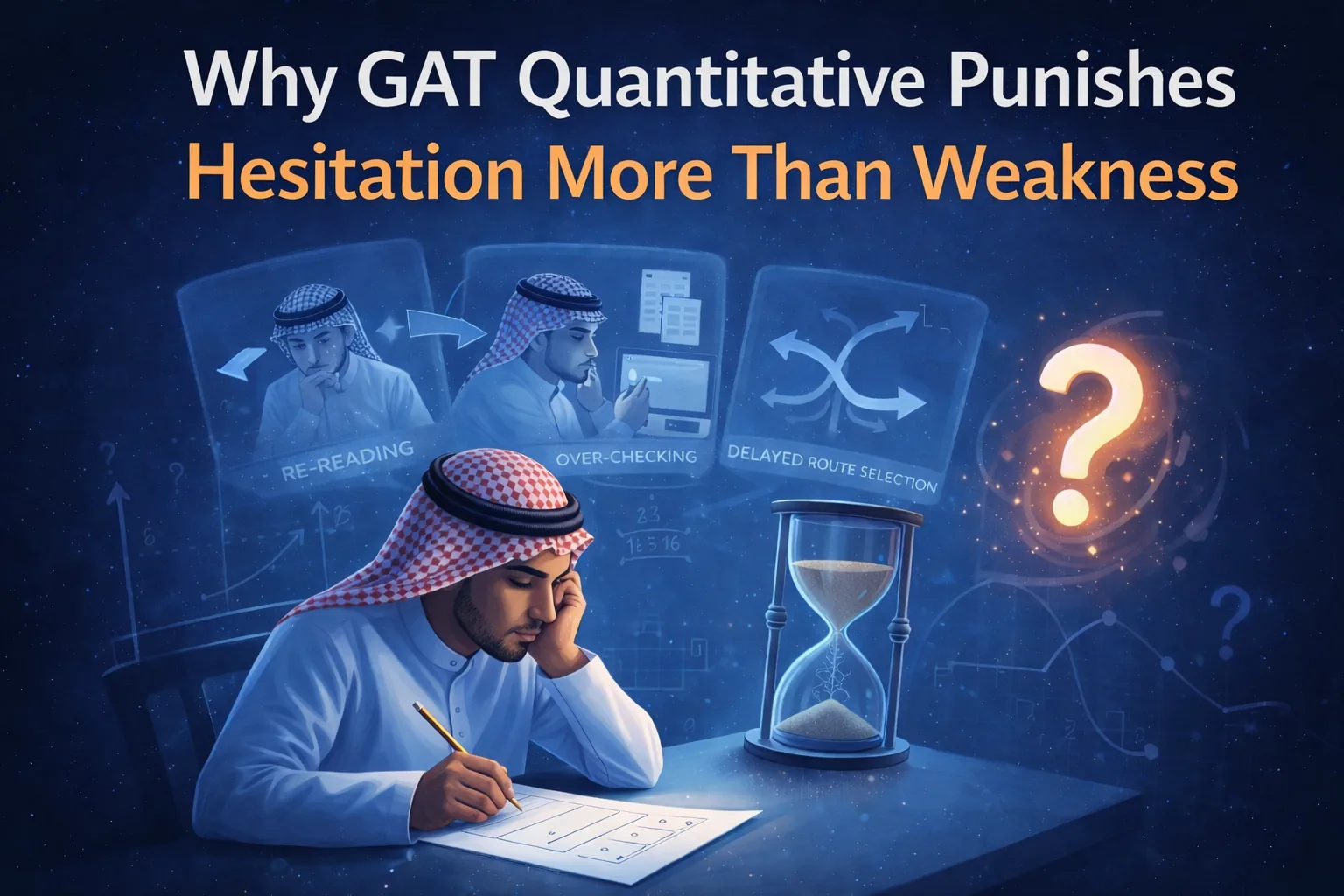
Many students walk out of GAT Quantitative feeling like the exam exposed a math weakness.
Sometimes that is true.
But often, the real problem is different.
The student knew more than the final result showed. The issue was not total confusion, and it was not complete mathematical weakness. The issue was hesitation.
That hesitation may look small in the moment. A second reading here. A pause before starting there. A little extra checking. A delayed choice between two methods. A brief moment of uncertainty before entering the question properly.
But on GAT Quantitative, those moments accumulate quickly.
That is why the section often feels harder than the student’s raw math level actually is.
The exam does not only reward knowledge. It rewards stable recognition, fast filtering, and the ability to move into a question with enough clarity to make a decision early. If you want to understand that structure better, the main GAT Math page gives a broader view of how StudyGlitch approaches Qudurat preparation in Saudi Arabia.
Why GAT Quantitative Feels Harder Than a Student Expects
A common GAT experience sounds like this:
“I studied the topic.” “I saw similar ideas before.” “I understood the explanation later.” “But inside the exam, everything felt slower.”
That is the important clue.
When students repeatedly understand a question after the fact but struggle to handle it on time during the exam, the issue is often not raw knowledge alone. It is unstable decision-making under exam conditions.
GAT Quantitative can punish that instability very quickly.
The student is not always failing because the question is advanced. Sometimes the question feels difficult because the student entered it slowly, filtered it slowly, or doubted the first clean path long enough to lose control of the timing.
That is why some students think they need more math content when what they really need is a more stable response pattern.
Hesitation Does Not Look Like One Thing
Students often imagine hesitation as obvious freezing.
But in GAT Quantitative, hesitation is usually quieter than that.
It can appear as:
- re-reading a question even after the basic structure is already clear
- delaying the first step because the route does not feel perfectly certain
- checking simple work too early
- comparing two methods for too long
- second-guessing an answer before the question has even been fully processed
- entering the question late because confidence arrives late
None of those behaviors look dramatic on their own.
That is exactly why they are dangerous.
They do not feel like a major mistake, so students do not always notice how much time they are losing to them. But over a full GAT Quantitative section, hesitation can damage performance more than one or two genuinely hard questions.
Why Hesitation Costs So Much on GAT Quantitative
GAT Quantitative is not only testing whether you can eventually solve a problem.
It is also testing whether you can recognize the type of problem, filter out what matters, and begin with enough control to keep moving.
That means hesitation hurts in multiple ways at once.
It Steals Time Before Real Solving Even Starts
Some students think they are slow because calculation takes them too long.
But in many cases, the bigger loss happens before the real solving stage even begins.
The student reads, pauses, re-reads, compares possibilities, questions their own recognition, and only then starts. By that point, the clock has already taken more than it should.
This is one reason math exam timing problems are usually not about speed. The issue is often not hand speed or mental speed. It is wasted time before commitment.
It Weakens Control
A student who enters a question late usually feels less control once the work begins.
That matters because uncertainty at the beginning often creates uncertainty in the middle. The student becomes easier to shake, more likely to over-check, and more vulnerable to switching methods halfway through.
What began as hesitation becomes instability.
And instability is expensive on GAT.
It Makes Medium Questions Feel Hard
This is one of the most important effects.
Many students assume hesitation only matters on difficult questions. But in reality, hesitation often turns medium questions into hard experiences.
A question that should have been handled with calm recognition now feels heavy because the student arrived late, doubted the route, and lost the clean entry point.
That creates a false impression about the student’s level.
The math may not have been beyond them. Their timing and control made it feel beyond them.
Where GAT Hesitation Usually Comes From
Hesitation is not random.
It usually comes from a small set of underlying causes. Once students understand those causes, the problem becomes more fixable and much less mysterious.
Unstable Recognition
Recognition is the ability to see what kind of question is in front of you before the work becomes messy.
If that recognition is unstable, the student takes longer to identify the structure, longer to choose a route, and longer to trust that route.
This is a major reason GAT students hesitate even when they technically know the topic.
They know the content in a broad sense, but they do not recognize the form quickly enough under pressure.
Weak Filtering
Some students look at too much of the question at once.
Instead of quickly separating what matters from what does not, they mentally carry every detail at the same level. That creates friction immediately.
Strong GAT performance depends a lot on filtering.
What is given? What is being asked? What matters first? What can be ignored for now?
When that filtering is weak, hesitation rises because the question feels more crowded than it really is.
Lack of Exam Familiarity
Some hesitation is not about math at all. It is about unfamiliarity with the feel of the exam.
GAT Quantitative has its own rhythm. Its own style of pressure. Its own patterns of recognition and timing.
Students who are not familiar with that rhythm often hesitate because nothing feels settled yet. Even if they understand the topic in school or tutoring, the exam environment changes how quickly they can identify and trust a route.
That is one reason structured GAT practice matters so much. Prepare for GAT (Qudurat) Math in Saudi Arabia explains that exam familiarity is not a side issue. It is part of performance.
Poor Confidence Calibration
This is another hidden cause.
Some students distrust themselves too early. Others trust themselves in the wrong places and then become extra cautious everywhere else. In both cases, confidence becomes unstable.
Healthy confidence does not mean blind certainty.
It means knowing when the question is simple enough to move, when the route is good enough to commit, and when checking is actually needed.
Without that calibration, hesitation grows because every question feels like it deserves full suspicion.
That is exhausting, and it slows everything down.
Why “Just Work Faster” Is Weak Advice
Students hear this advice all the time.
Work faster. Be quicker. Do not waste time.
But that advice is usually too shallow to help.
A student who hesitates is not always choosing to be slow. Often they are reacting to uncertainty that has not been properly understood.
That is why hesitation should not be reduced to speed alone.
The real improvement usually comes from:
- recognizing the question earlier
- filtering faster
- choosing a route sooner
- trusting the route more appropriately
- checking at the right moment instead of all moments
Those are not the same as simply moving faster.
If a student tries to solve hesitation with speed alone, they often become more rushed without becoming more stable. That creates new mistakes without fixing the real issue.
GAT Quantitative Rewards Early Control
One of the most useful ways to think about this section is that it rewards early control.
A student does not need to feel perfect. They do not need to know every shortcut. They do not need to attack every question aggressively.
But they do need to enter questions with enough clarity to make decisions early.
That means:
- recognizing the general type quickly
- filtering the information cleanly
- deciding on a first move without unnecessary delay
- avoiding repeated hesitation inside the same problem
When students improve that part of their process, the whole section starts to feel different.
The exam may not become easy, but it becomes less slippery.
That matters a lot.
Why Knowing the Topic Is Sometimes Not Enough
Many GAT students get frustrated because they know the topic but still struggle inside the exam.
That frustration is understandable.
But knowing a topic in isolation is not the same as handling it well under timing pressure. The exam asks for knowledge plus recognition, knowledge plus control, knowledge plus decision speed.
That is why the same student can do fine in practice review and then feel much weaker in the real section.
The missing piece is often not new information. It is more stable performance behavior.
This is also where GAT differs from other exams in meaningful ways. SAT vs GAT (Qudurat) Math: Key Differences Students in Saudi Arabia Should Know helps explain why GAT can punish hesitation differently from exams that reward longer setup or deeper sustained work.
What Better GAT Improvement Usually Looks Like
Improvement in GAT Quantitative is often misunderstood.
Students think they need to become dramatically faster or dramatically stronger in math all at once.
Usually, that is not what changes first.
More often, improvement begins when the student becomes less hesitant in the first thirty seconds of a question.
They start recognizing sooner. They filter sooner. They stop over-respecting questions that do not deserve that much hesitation. They stop delaying the first move while waiting for perfect certainty.
That creates a much healthier timing pattern.
If you want to test that kind of improvement properly, a StudyGlitch GAT/Qudurat diagnostic can reveal whether the real issue is topic weakness, hesitation, route choice, or overall timing behavior. And once that pattern becomes clearer, targeted timed practice through GAT/Qudurat practice tests becomes much more useful than repeating random questions without a framework.
If hesitation begins before the calculation, use GAT quantitative questions by skill to name the clue that identifies the method. Once that recognition becomes steadier, a full practice test can check whether it survives a mixed set.
StudyGlitch’s Position on GAT Hesitation
At StudyGlitch, the goal is not to tell students to rush.
The goal is to reduce the hesitation that comes from unstable recognition.
That is a very different kind of improvement.
When students start recognizing question types more cleanly, filtering information more calmly, and trusting the first workable route more often, their GAT Quantitative performance usually rises even before their underlying math knowledge changes dramatically.
Many students improve in Qudurat not when they “learn more math,” but when they stop losing control to hesitation that came from unstable recognition.
FAQ
Why do I hesitate so much in GAT Quantitative? Hesitation usually comes from unstable recognition, weak filtering, lack of exam familiarity, or poor confidence calibration. It is often not random, and it is not always a sign that you do not know the math.
Is GAT math more about speed or knowledge? It is about both, but not in a shallow way. GAT Quantitative rewards knowledge that can be recognized and used quickly. Students often struggle because decision speed and recognition are unstable, not because they know nothing.
How do I stop wasting time in Qudurat math? The best fix is not simply “go faster.” It is improving how quickly you recognize the question type, filter what matters, choose a route, and avoid unnecessary re-checking.
Why do I know the topic but still struggle in GAT? Because knowing a topic in review is different from handling it under timing pressure. GAT often exposes hesitation, unstable recognition, and weak early decision-making more than students expect.
Does hesitation affect GAT score more than difficulty? Very often, yes. A few truly difficult questions matter less than a repeated pattern of hesitation across many medium questions. That is why hesitation can reduce a score more than students realize.