
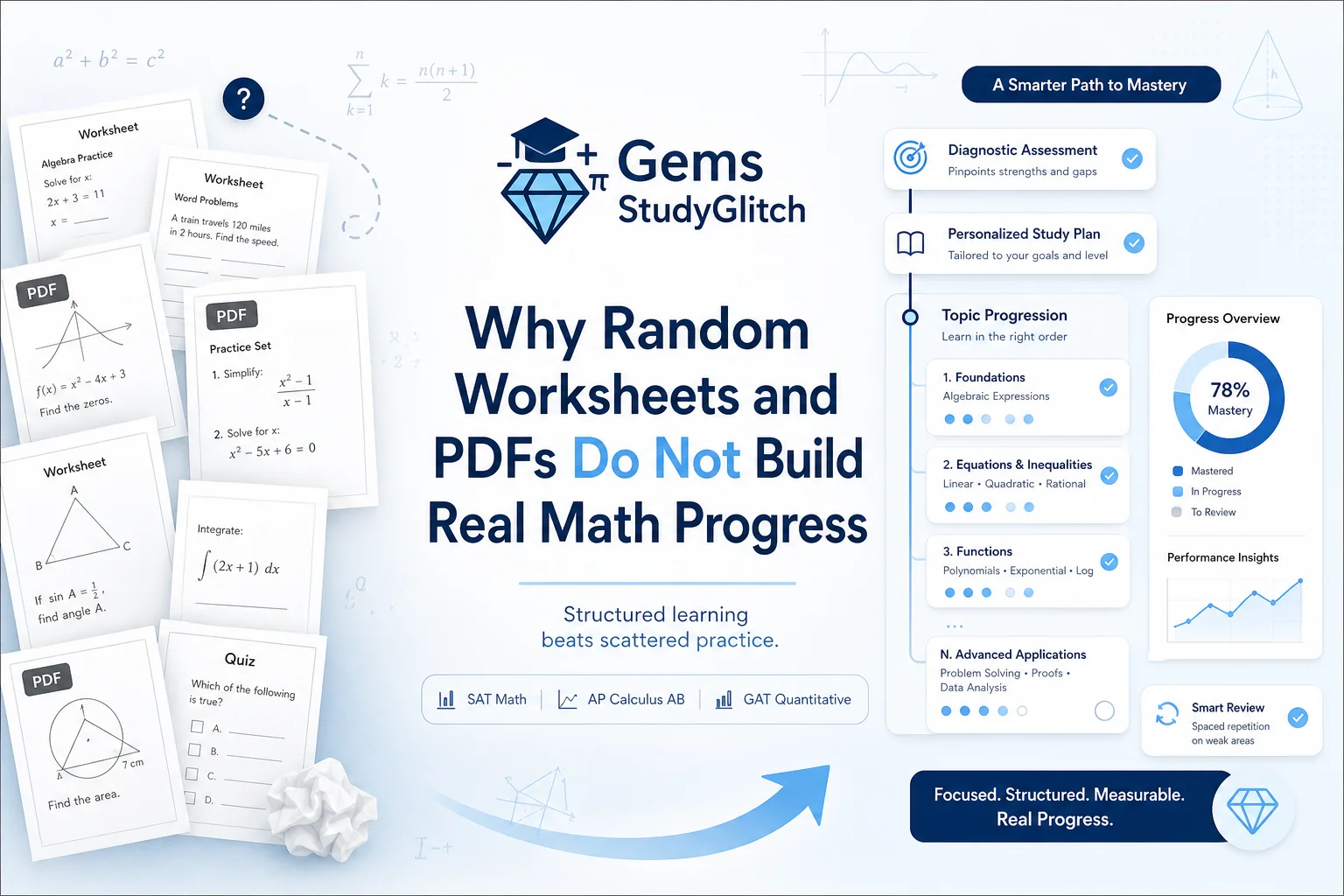
Worksheets and PDFs can be useful. The problem starts when they become the whole study plan.
Many students preparing for SAT Math, AP Calculus AB, or GAT Quantitative collect worksheets, download PDFs, save question sets, and jump from one resource to another. At first, this feels productive because the student is doing more math. But more practice does not always mean better preparation.
A worksheet can help a student practice a topic. A PDF can explain a concept. A question set can expose a weakness. But if these resources are disconnected, random, and not connected to a clear learning order, they often fail to build steady math progress.
The issue is not the resource itself. The issue is the structure around the resource.
Why random practice feels productive
Random practice feels useful because it creates activity.
A student opens a worksheet, solves questions, checks answers, and feels like something was completed. Parents may also see the student spending time on math and assume the preparation is moving forward.
But math improvement is not only about time spent. It depends on whether practice is fixing the right weakness in the right order.
A student can spend hours solving questions and still repeat the same mistakes if the questions are not connected to diagnosis, sequencing, review, and performance tracking.
This is common in Digital SAT Math preparation, AP Calculus AB review, and GAT Quantitative practice. Students may complete many pages but still struggle when the exam changes the wording, combines skills, or adds time pressure.
No diagnosis before practice
The first weakness of random worksheets is that they usually start without diagnosis.
A student may choose a PDF because it looks helpful, because someone recommended it, or because it covers a familiar topic. But the student may not know whether that topic is actually the most important weakness.
For SAT Math, the student may keep practicing geometry while algebra is the real score blocker. For AP Calculus AB, the student may review derivative rules while the bigger weakness is interpreting graphs, tables, or accumulation. For GAT Quantitative, the student may solve mixed questions without realizing that percentages, ratios, or basic algebra are repeatedly causing mistakes.
Without a diagnostic test, practice can become guesswork.
A better preparation process starts by asking:
- Which topics are weak?
- Which mistakes repeat?
- Which question types take too long?
- Which skills are strong enough to maintain?
- Which topic should be repaired first?
That is why a Diagnostic Test matters. It helps turn practice from random activity into targeted study.
No sequencing
Math topics are connected.
Some skills need to come before others. If a student skips the foundation and jumps into harder mixed practice, the practice may feel challenging but not productive.
For SAT Math, equation solving supports functions, systems, word problems, and advanced algebra. For AP Calculus AB, limits, derivative meaning, derivative rules, applications of differentiation, integrals, and accumulation are connected. For GAT Quantitative, arithmetic fluency supports ratios, percentages, geometry, and quantitative reasoning.
Random PDFs often ignore this order.
They may group questions by page, by source, or by difficulty, but not by the student’s learning sequence. That creates a problem: the student may practice questions before the required foundation is stable.
A good math resource system should help the student move from:
- Foundation
- Topic practice
- Mixed application
- Timed practice
- Full test performance
That sequence matters because it helps build confidence and accuracy step by step.
No guided order
Even when the resources are good, students often do not know what to open next.
This is one of the biggest problems with scattered math resources. The student may have twenty PDFs, many worksheets, saved videos, old practice tests, and topic notes. But when it is time to study, the question becomes: where should I start?
Without a guided order, students often choose what feels easiest, newest, or most familiar.
That can create uneven preparation. Strong topics get repeated because they feel comfortable, while weak topics are delayed because they feel frustrating. Over time, the student may build more activity, but not enough score movement.
Guided learning resources should make the next step clearer.
A useful materials system should help answer:
- What should I study first?
- What should I practice after diagnosis?
- Which resource matches my weak topic?
- When should I move from explanation to practice?
- When should I take a timed test?
This is why the structure of a resource library matters. The StudyGlitch Materials page is built around guided preparation, not just a pile of files.
No measurement loop
A worksheet usually ends when the student checks the answers.
But real progress needs a loop.
The student should know what changed after practice. Did accuracy improve? Did timing improve? Did the same mistakes disappear? Did the weak topic become stable in a mixed test?
Random worksheets rarely answer those questions.
A strong preparation system should connect practice to measurement. That means the student studies a topic, practices it, checks performance, and then uses the result to decide the next step.
The loop should look like this:
- Diagnose the weakness
- Study the topic
- Practice targeted questions
- Review mistakes
- Test again
- Adjust the plan
Without this loop, practice can become disconnected. The student may finish many worksheets but still not know whether the preparation is working.
No progression logic
Progression logic means the study path becomes harder, broader, or more exam-like at the right time.
This matters because students should not stay forever in easy topic practice. They also should not jump too early into full exams before the basics are stable.
For SAT Math, a student may need to move from basic linear equations to worded algebra, then to mixed module-style practice. For AP Calculus AB, a student may need to move from derivative rules to application questions, then to graph and table interpretation, then to AP Calculus FRQ-style reasoning. For GAT Quantitative, a student may need to move from arithmetic accuracy to faster quantitative reasoning under time pressure.
Random PDFs usually do not manage this progression.
They may provide questions, but they do not always tell the student when to move on, when to repeat, or when to increase difficulty.
A better system should make progression visible.
The student should be able to see whether they are still repairing foundations, building topic accuracy, practicing mixed questions, or preparing for timed exam performance.
Why resource quality is not only about the file
A high-quality PDF can still be used badly.
A simple worksheet can be useful if it is used at the right time, for the right topic, and followed by review. The difference is not only the resource. It is the role of the resource inside the learning plan.
This is why students should not ask only, “Is this worksheet good?”
They should also ask:
- Why am I using this worksheet now?
- Which weakness does it target?
- What should I do after finishing it?
- How will I know if it worked?
- Does it connect to my next practice test?
These questions turn a resource from random material into part of a study system.
The problem with collecting too many resources
Many students collect more resources than they can actually use.
They save SAT Math PDFs, AP Calculus AB notes, GAT Quantitative worksheets, YouTube videos, answer keys, practice sets, and online explanations. But more resources can create more confusion if there is no order.
The student may start one file, switch to another, then try a different topic the next day. This creates scattered preparation.
The result is often:
- Too many unfinished resources
- No clear study direction
- Weak topics left unresolved
- Repeated mistakes across tests
- Low confidence before exams
A smaller set of structured resources is usually better than a large collection of disconnected material.
Why guided materials support better study habits
Guided materials help students study with purpose.
Instead of opening random PDFs, the student can connect resources to a topic, skill, or weakness. This makes the preparation easier to manage.
For example, after a diagnostic result, a student may know that algebra is weak in SAT Math, accumulation is weak in AP Calculus AB, or ratios are weak in GAT Quantitative. The next resource should match that weakness.
Guided materials help the student avoid three common problems:
- Practicing topics that are already strong
- Skipping weak foundations
- Moving to full tests too early
This does not mean every resource needs to be complicated. It means each resource should have a clear purpose inside the preparation path.
How students should use worksheets and PDFs correctly
Worksheets and PDFs are not bad. They become weak when they are used without structure.
A good way to use them is to connect each resource to a specific goal.
Before using a worksheet, the student should know:
- The topic being practiced
- The reason this topic matters
- The level of difficulty
- The time target, if timing matters
- How mistakes will be reviewed
- What comes after the worksheet
After finishing the worksheet, the student should not only count correct answers. They should look for patterns.
Did the mistakes come from misunderstanding, careless calculation, timing pressure, or question interpretation? That answer matters more than simply finishing the page.
When students need more than resources
Sometimes the student has enough materials but still does not improve.
This usually means the issue is not access to resources. The issue may be diagnosis, sequence, feedback, consistency, or accountability.
A student may need more structured support if:
- Scores are not improving after repeated practice
- The same topic mistakes keep appearing
- The student avoids difficult topics
- Timing does not improve
- Mistake review is shallow
- The student does not know what to study next
In that case, more PDFs may not solve the problem. The student may need a clearer plan, better reporting, or guided tutoring support.
Related reading:
- Why Practicing More Math Questions Doesn’t Improve Your SAT, AP, or GAT Score
- Why Most Students Review Math Mistakes the Wrong Way
Frequently Asked Questions
Are worksheets and PDFs bad for math preparation? No. Worksheets and PDFs can be useful when they are connected to diagnosis, topic goals, mistake review, and a clear study sequence. The problem is random use without structure.
Why do students finish many worksheets without improving? Students may finish many worksheets without improving because the practice is not targeting the right weakness, not following a sequence, or not connected to performance tracking and review.
What is better than random math practice? Targeted math practice is better than random practice. Students should diagnose weak topics, practice the right skills, review mistakes carefully, and test again to measure improvement.
How should students choose SAT Math, AP Calculus AB, or GAT Quantitative resources? Students should choose resources based on their weak topics, exam goals, difficulty level, and next step in the study plan. A resource should support the preparation path, not distract from it.
How can StudyGlitch Materials help with structured study? StudyGlitch Materials help students use learning resources with more direction by connecting preparation to topics, practice needs, and structured study rather than relying only on scattered worksheets or random PDFs.