
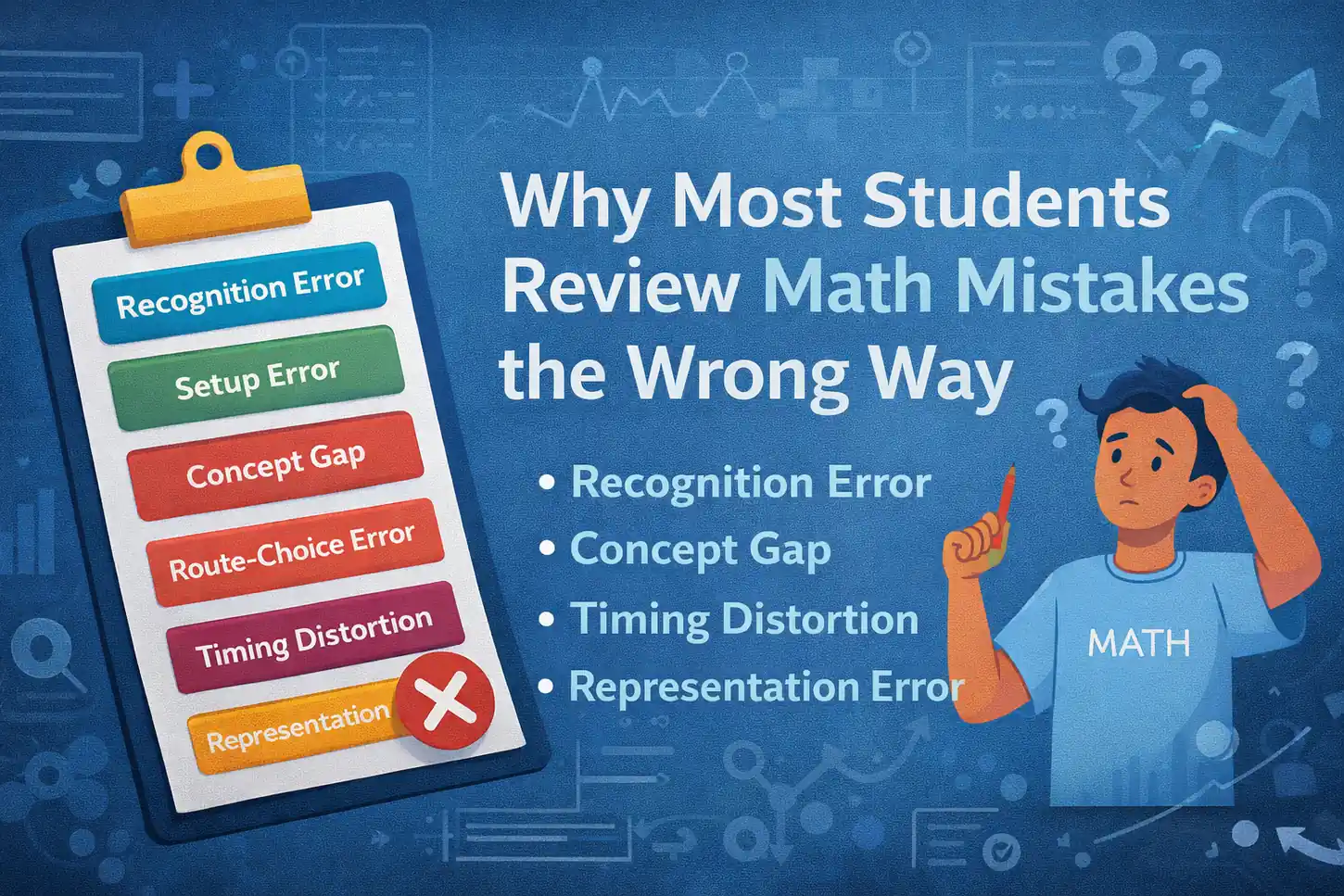
Most students do review their math mistakes.
They just do it too weakly to create real change.
A student finishes a practice set, sees what went wrong, tells themselves it was a careless mistake, and moves on. Sometimes they re-solve the question. Sometimes they circle it. Sometimes they promise to be more careful next time.
Then the same type of mistake happens again.
This is one of the biggest problems in SAT, AP, and GAT math preparation. Students think they are reviewing, but what they are really doing is checking answers without analyzing error behavior. That kind of review feels responsible, but it usually does not fix the system that produced the mistake.
Good review is not just about whether the answer was wrong.
It is about why the answer became wrong.
If a student does not classify the real cause of a mistake, improvement becomes unstable. They may solve more questions, spend more time, and work harder, but their score pattern does not move the way it should. The same errors return in different forms because the underlying weakness was never identified clearly.
That is why math mistake analysis matters so much.
The real purpose of reviewing math mistakes
The purpose of review is not to admire the correct solution after the fact.
The purpose is to locate the breakdown point.
A wrong answer is only the visible result. The useful question is what failed before that result appeared.
Was the student unable to recognize the structure of the question?
Did they build the setup incorrectly?
Was there a concept gap hiding underneath the attempt?
Did they choose a bad route even though they understood the math?
Did timing pressure distort judgment?
Did the student lose control of notation, representation, signs, or step structure?
These are not small differences. They lead to very different next steps.
When students treat all mistakes as the same kind of problem, they usually use the wrong fix. They review too broadly, too emotionally, or too quickly. The outcome is predictable: repeated mistakes with slightly different surfaces.
That is why strong math review needs classification, not just correction.
Why “careless mistake” is often a weak label
The phrase careless mistake sounds useful, but most of the time it is too vague to help.
Sometimes a mistake is truly careless in the narrow sense. A student may copy a number incorrectly or click the wrong choice while understanding the question correctly.
But in many cases, “careless” is only a convenient label placed on top of a deeper issue.
A student may call something careless when the real issue was:
- weak recognition of the question type
- incomplete setup
- shaky understanding of a concept
- poor route choice
- timing pressure
- messy mathematical control
This matters because vague labels produce vague fixes.
If a student says, “I need to be more careful,” that sounds reasonable. But careful about what exactly?
Should they slow down?
Should they improve recognition?
Should they strengthen fundamentals?
Should they stop choosing long routes?
Should they learn how to represent the information more cleanly?
Without that precision, review becomes motivational rather than diagnostic.
And motivational review does not reliably raise performance.
The six mistake types students should actually use
A stronger review system classifies mistakes by cause.
That does not mean every wrong answer fits perfectly into one box, but most mistakes can be understood through a dominant cause. Once that dominant cause is identified, the correction becomes much more useful.
Here are six highly practical error types that create better math mistake analysis.
Recognition error
A recognition error happens when the student does not correctly identify what kind of structure the question is testing.
This can happen even before the actual solving begins.
The student may know the topic in theory, but fail to notice the key pattern, relationship, or form that should guide the approach. They start solving in the wrong frame because they misread what the problem is really asking them to recognize.
Examples include:
- treating a structure question like a computation question
- missing the role of a graph or table
- not noticing a standard quantitative pattern
- failing to see which idea is central in the problem
Recognition errors are common in timed exams because students often read too quickly or too mechanically. They think they have started solving, but they are already off track.
The right fix is not just more practice. It is pattern recognition training, question interpretation, and review that asks, “What should I have noticed earlier?”
Setup error
A setup error happens when the student sees the problem direction but builds the mathematical framework incorrectly.
This means the issue is not always the concept itself. The issue is translating the question into the right equation, expression, condition, relationship, or model.
Examples include:
- defining variables incorrectly
- writing the wrong equation from a word problem
- setting the wrong interval or boundary
- building an incomplete representation from the prompt
- misplacing what is given versus what is being asked
Students often miss setup errors because the work can still look serious and mathematically active. But activity is not the same as alignment.
A strong review question here is, “At what exact line did the structure of the solution stop matching the logic of the prompt?”
Concept gap
A concept gap means the student does not sufficiently understand the underlying mathematical idea needed to solve the problem correctly.
This is deeper than a surface mistake. The student may get close, imitate a method, or remember a partial rule, but the actual conceptual command is incomplete.
Examples include:
- weak understanding of function behavior
- confusion around rates, units, or proportional reasoning
- incomplete grasp of derivative meaning
- shaky algebraic manipulation principles
- memorizing a rule without knowing when it applies
This is where many students waste time. They misclassify concept gaps as careless mistakes and move on without rebuilding the actual math foundation.
If a concept gap is present, the fix is not to simply re-solve the question once. The fix usually requires targeted concept review, additional examples, and structured practice around that exact idea.
Route-choice error
A route-choice error happens when the student understands the math well enough to solve the question, but chooses an inefficient, unstable, or unnecessary method.
This matters more than students think.
In exams like SAT Math especially, route choice can be the difference between control and confusion. Even on AP or GAT, a poor route can increase time pressure and error risk.
Examples include:
- choosing a long algebraic method when a simpler route exists
- using brute force when structure would be cleaner
- solving with too many steps under time pressure
- using a method that increases sign or notation risk
- insisting on a familiar method even when it is the wrong fit
These mistakes are important because the student may still believe the issue was execution. In reality, the route itself created fragility.
A strong review question is, “Was my approach mathematically valid but strategically poor?”
Timing distortion
Timing distortion is not just being slow.
It is when time pressure changes the quality of thinking.
This is a major distinction. Students often assume timing problems are always speed problems, but many timing issues are actually decision-quality problems created by pressure. Under time stress, students read worse, choose worse routes, rush structure, and abandon control.
That means a wrong answer late in a timed set is not always evidence of weak math skill. It may be evidence that time pressure distorted recognition, setup, or execution.
Examples include:
- rushing into a solution before understanding the question
- panicking and abandoning a cleaner method
- skipping a key condition because of perceived urgency
- making unusual errors only when timed
- becoming less selective and more reactive under pressure
This is why timing review must go deeper than “I need to be faster”.
For a fuller breakdown of that idea, read Why Math Exam Timing Problems Are Usually Not About Speed.
Representation or control error
A representation or control error happens when the student loses stability in the written or symbolic handling of the mathematics.
This includes notation, sign control, expression structure, organization, variable tracking, and clean management of mathematical information.
This type is especially important because students often underestimate how much messy representation can damage performance. They know more than their work is showing.
Examples include:
- sign errors caused by weak step control
- losing track of variables or substitutions
- poor notation in calculus work
- collapsing multi-step work into unclear lines
- writing something mathematically ambiguous
- misreading one’s own structure during solving
These errors are not always pure concept problems. Sometimes the student understands the idea but cannot maintain control while expressing it.
That means the solution is not always more theory. Sometimes it is more disciplined mathematical writing, cleaner setup, better line structure, and more stable representation habits.
Why students repeat the same math mistakes
Students repeat the same math mistakes because they often review outcomes instead of causes.
That is the core issue.
They ask:
- What was the right answer?
- What should I have done?
- Can I understand the solution now?
Those questions are not useless, but they are incomplete.
Better review also asks:
- What type of mistake was this?
- Where did the breakdown actually begin?
- Was the issue recognition, setup, concept, route, timing, or control?
- Is this a repeated pattern?
- What change would prevent this class of error from happening again?
Without those questions, students keep solving new questions with old weaknesses.
This is also why practicing more does not automatically solve the problem. More volume can increase familiarity, but it does not guarantee better diagnosis.
For a related explanation, read Why Practicing More Math Questions Doesn’t Improve Your SAT, AP, or GAT Score and Why Students Study Hard but Still Don’t Improve Their Scores.
How to review math mistakes the right way
A good review process should be deliberate enough to create pattern awareness, but simple enough to use consistently.
A strong post-practice review method can look like this.
Step 1: Reconstruct the moment of failure
Do not jump immediately to the official solution.
First ask where your thinking went off track. The useful point is not where the final answer became visibly wrong. The useful point is where the logic first drifted.
Step 2: Classify the dominant error type
Choose the main category:
- recognition error
- setup error
- concept gap
- route-choice error
- timing distortion
- representation or control error
This matters because the fix depends on the category.
Step 3: Write the real reason in one sentence
Force precision.
Not “careless".
Not “I rushed".
Write something like:
- I did not recognize that the graph was giving the key relationship.
- I set up the equation from the word problem incorrectly.
- I remembered the rule but did not understand when it applied.
- I chose a longer route that increased error risk.
- I only made this mistake because timing pressure changed my reading.
- My notation became unstable and I lost control of the structure.
That one sentence is often more useful than re-reading the full solution.
Step 4: Decide the correction type
Different mistakes need different corrections.
For example:
- recognition error needs pattern training
- setup error needs translation practice
- concept gap needs concept rebuilding
- route-choice error needs strategy comparison
- timing distortion needs timed review analysis
- representation or control error needs cleaner written habits
This is what turns review into a system instead of a ritual.
Step 5: Track repeated patterns across questions
Single mistakes matter less than repeated categories.
If the same dominant error appears again and again, that is a signal about the actual weakness controlling your score.
That pattern is far more valuable than isolated frustration.
Why this matters across SAT, AP, and GAT math
This review method matters across all three programs, but the error patterns often show up differently.
In SAT Math, route-choice errors, recognition errors, and timing distortion often become especially important because students need judgment, adaptability, and efficient decision-making.
In AP Calculus AB, concept gaps and representation or control errors become especially visible because notation, written reasoning, and formal structure matter more.
In GAT Quantitative, recognition errors, setup errors, and timing distortion often dominate because fundamentals, fluency, and fast clean execution matter so much.
So the same review framework works, but the most common dominant error types may differ by exam.
That is one reason diagnostic-based preparation is stronger than generic advice. It helps identify not only that a student is losing points, but how those points are being lost.
For a better picture of what a diagnostic should reveal, read What a Good Math Diagnostic Should Actually Tell a Student and SAT, GAT, AP Math Preparation in Saudi Arabia: Diagnostic-Based Strategy.
What strong students do differently in review
Strong students do not just notice that they got something wrong.
They study the mechanism of the mistake.
They understand that wrong answers are data. They do not protect their ego with vague labels. They do not rush to finish review just to feel productive. They do not assume repeated mistakes will disappear on their own with more effort.
Instead, they look for categories, patterns, and causes.
That is why their review becomes cumulative. Over time, they are not just solving more questions. They are removing recurring forms of failure.
This is what makes their improvement more stable.
The real goal of error review
The goal of error review is not perfection.
The goal is to make your mistakes more informative.
A student who learns how to analyze mistakes properly gains something powerful: they stop reacting randomly to wrong answers. They begin building a map of how their own math performance breaks down under real conditions.
That map creates better decisions.
It tells them what to fix first, what type of practice they need, and why previous effort may not have transferred into better results.
This is one of the clearest differences between surface prep and intelligent prep.
Surface prep counts questions.
Intelligent prep studies failure patterns.
That is why most students review math mistakes the wrong way.
And that is why changing how you review can change how you improve.
FAQ
What is the best way to review math mistakes? The best way is to identify the real cause of the error, not just the correct answer. Strong review classifies whether the mistake came from recognition, setup, concept understanding, route choice, timing distortion, or representation and control.
Why do students repeat the same math mistakes? They usually review too loosely. Many students check answers, label mistakes as careless, and move on without identifying the actual breakdown point. That allows the same error pattern to return later in a different form.
What does a careless mistake usually mean in math? Sometimes it means a true attention slip, but often it hides a deeper issue. It may actually reflect weak recognition, poor setup, unstable notation, bad route choice, or timing pressure rather than simple carelessness.
How do I know whether my mistake was conceptual or strategic? Ask whether you understood the math idea but chose a bad approach, or whether the idea itself was weak. If the concept was missing or unclear, it is likely a concept gap. If the concept was fine but the method was poor, it is more likely a route-choice or setup problem.
Does reviewing the solution once fix the mistake? Usually not. Reading the correct solution may help you understand that question, but it does not always fix the underlying weakness. Real improvement comes from identifying the mistake type and applying the right correction.
Why is math mistake analysis important for SAT, AP, and GAT? Because these exams punish repeated error patterns in different ways. SAT often exposes route and judgment errors, AP exposes concept and representation weaknesses, and GAT exposes recognition, setup, and timing issues. Better error analysis leads to more precise preparation.