
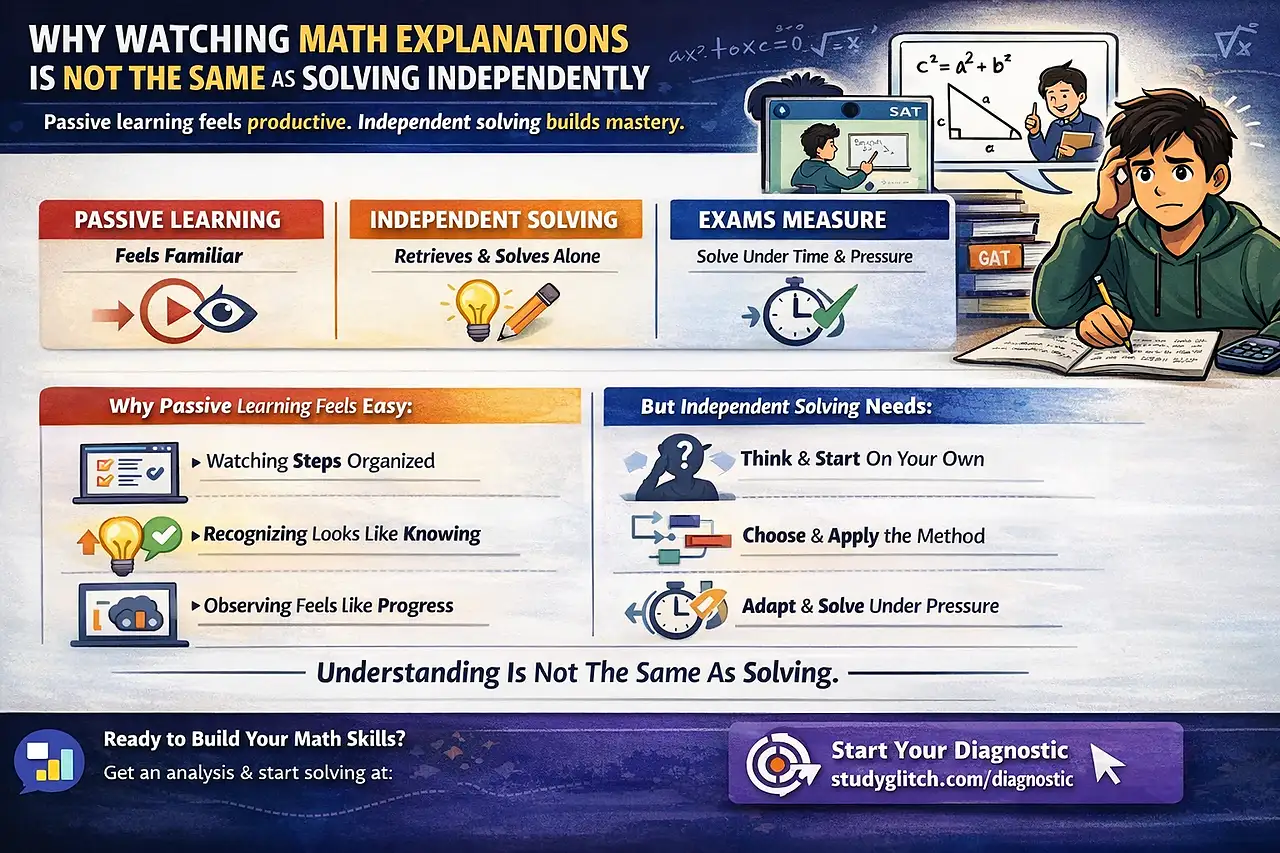
Many students spend hours watching math explanations and feel that they are making real progress.
Sometimes they are focused. Sometimes they understand the teacher. Sometimes the solution looks clear and logical from beginning to end. By the time the lesson is over, they feel more confident than before.
Then they try a similar question alone and freeze.
This is one of the biggest gaps in math preparation. Watching can create familiarity, but familiarity is not the same as independent performance. A student may follow a solution while it is being shown and still be unable to produce that same solution without support.
That is why watching math explanations is not the same as solving independently.
And that difference matters because exams do not measure how well a student follows someone else’s reasoning. They measure whether the student can think, choose, set up, and solve on their own.
Why watching math can feel productive even when mastery is weak
Watching a good explanation often feels productive for a simple reason: it reduces confusion in the moment.
A strong teacher organizes the steps, removes unnecessary noise, highlights the important idea, and moves through the logic in a clean sequence. That makes the math feel understandable. Students often mistake that feeling for mastery.
But understanding something while it is being explained is a lower level of performance than generating it independently.
That is the key distinction.
When students watch solutions, they are usually receiving structure, not creating it. The route is being chosen for them. The setup is being built for them. The key recognition point is often being highlighted for them. Even the pacing is being controlled for them.
That support changes the difficulty of the task.
So a student may leave the lesson saying, “I got it,” when what really happened was, “I could follow it.”
Those are not the same thing.
Passive learning in math creates a misleading sense of progress
This is why passive learning in math can be so deceptive.
Passive learning is not always useless. Watching can help introduce concepts, clarify confusion, or model a cleaner way of thinking. But when students rely on passive exposure too heavily, they begin confusing recognition with recall and observation with execution.
They feel closer to mastery than they actually are.
This creates several common illusions:
- I understood the explanation, so I must know how to solve it
- I have seen this kind of question before, so I should be able to do it
- I followed the steps easily, so I am ready for the exam
- I watched a lot today, so I studied effectively
Those thoughts are understandable, but they are often misleading.
Math exams do not reward passive familiarity. They reward active retrieval, independent setup, and correct execution without someone guiding the path.
That is why students can spend a lot of time studying and still feel shocked by their real test performance.
For a related issue, read Why Students Study Hard but Still Don’t Improve Their Scores.
What independent problem solving actually requires
Independent problem solving begins when support is removed.
That is where the real test starts.
A student solving independently has to do all of the following without outside help:
- recognize what the question is really testing
- decide how to start
- choose an efficient route
- build the setup correctly
- manage the steps with control
- recover when the first idea does not work
- finish under realistic timing conditions
This is very different from watching someone else do those things.
When students are watching, the difficult choices are often hidden because the teacher has already made them. The lesson looks smooth partly because uncertainty has been removed from the presentation.
But uncertainty is exactly what students face on exams.
That is why independent problem solving math is such a critical skill. It is the difference between observed understanding and usable performance.
Why watching math videos is not enough for exam prep
Math videos can absolutely be useful.
They can explain a concept, model a method, or help students correct misunderstandings. But videos alone are not enough because they do not automatically train independent execution.
A student can watch ten excellent lessons and still underperform if they have not developed the ability to solve under silence, timing, and uncertainty.
This is especially true in SAT, AP, and GAT math, where students are expected to do more than recognize content.
They must perform.
SAT Math often requires judgment, route selection, and adaptation.
AP Calculus AB often requires formal reasoning, notation control, and structured written thinking.
GAT Quantitative often requires clean fundamentals, fluency, and quick recognition under time pressure.
In all three cases, passive learning has limits. Watching may help a student feel more prepared, but exam readiness depends on whether the student can produce the work independently.
That is why strong math preparation needs a transition from guided exposure to active solving.
Following is easier than producing
One reason students overvalue watching is that following a solution feels mentally active.
And to be fair, it often is active in a limited way.
The student may be paying attention, anticipating the next step, or understanding the logic as it unfolds. But even then, following is still easier than producing.
Producing requires retrieval.
It requires the brain to recall the idea, select the method, and organize the steps without being fed the structure in real time. That is a much higher demand.
This is why students sometimes say, “I knew it when I saw it, but I could not do it alone.”
That statement reveals the exact gap.
The issue is not total ignorance. The issue is dependence on support.
And support dependence is dangerous in exam preparation because the exam removes support completely.
Why students get stuck after watching lessons
Students usually get stuck for one of three reasons after watching a lesson.
First, they never tested whether they could do the problem without guidance.
Second, they moved too quickly from watching to confidence without forcing independent recall.
Third, they used content consumption as a substitute for skill building.
This can happen even with good intentions. A student may honestly believe they are studying seriously because the time investment is real. But if most of that time is spent observing instead of producing, the improvement will usually be weaker than expected.
The pattern often looks like this:
- watch explanation
- feel clearer
- assume improvement happened
- face independent question
- struggle to start
- return to another explanation
- repeat the cycle
That cycle creates dependency.
The student keeps touching math, but not owning it.
Why this matters for SAT, AP, and GAT students
This matters in every program, but the weakness shows up differently depending on the exam.
In SAT Math, students who rely too much on watched explanations may struggle when they need to choose a path quickly without being told what idea matters most.
In AP Calculus AB, they may understand a teacher’s reasoning when they see it, but fail to write clear mathematical logic independently.
In GAT Quantitative, they may recognize familiar examples from lessons, but freeze when pattern recognition and speed must happen without support.
So the problem is not just that passive learning is weaker.
It is that each exam punishes support dependence in its own way.
That is why independent problem solving is not an optional extra. It is one of the central skills that students must build.
How to turn explanations into real math mastery
The solution is not to stop watching completely.
The solution is to change the role that watching plays.
Explanations should support learning, not replace solving.
A better system looks like this:
- watch to clarify a concept or model a strategy
- close the explanation
- solve a related problem alone
- explain your own route without help
- identify what you still could not produce independently
- repeat until the support is no longer needed
This is how watching becomes useful instead of addictive.
The goal is not to become dependent on clear explanations. The goal is to use them temporarily, then remove them as soon as possible.
That shift is what moves a student from passive learning toward real mastery.
What students should ask after every math explanation
A very useful habit is to stop asking, Did that make sense?.
And start asking, Can I do this alone now?.
That one question changes everything.
If the answer is no, the learning is not finished yet.
It may still be progressing, but it is not yet independent.
Students can make this even more precise by asking:
- Could I start this without the teacher?
- Could I choose the method on my own?
- Could I reproduce the setup from memory?
- Could I solve a variation without copying the pattern?
- Could I do this under timed pressure?
Those questions reveal whether the understanding is portable.
That is what matters in exams.
Why feeling prepared after watching can be misleading
This topic connects closely to a major prep mistake: students often confuse comfort with readiness.
A lesson can make math feel cleaner, more organized, and less scary. That is useful emotionally, but it does not automatically mean the student is test-ready.
A student can feel prepared right after watching because the logic is still fresh and the route was just demonstrated. But if they cannot recreate that route later, the confidence was premature.
For that reason, this article fits directly with Why Feeling Prepared in Math Is Not the Same as Being Test-Ready.
The hidden risk of too much guided learning
Guided learning is helpful at the right stage.
The risk appears when students stay in that stage too long.
Too much guided learning can delay independence because students become used to seeing math in its cleaned-up form. They expect the structure to appear quickly. They expect the right idea to feel visible. They expect the path to reveal itself the way it does in a polished explanation.
But on a real exam, math does not arrive with those supports.
The student has to create structure from the raw question.
That is why tutoring, lessons, and videos should be judged partly by one important standard: do they help the student become more independent, or do they mainly keep the student comfortable while the teacher does the heavy thinking?
That is also why strong tutoring matters. Good tutoring should move students toward independent performance, not create long-term dependence on explanation.
For that reason, see Online Math Tutoring for SAT, AP, and GAT: What Students Should Actually Look For.
What real progress looks like in math
Real progress in math is not only that the student understands more while watching.
Real progress is that they can do more without being shown.
That may include:
- starting more problems independently
- choosing better methods on their own
- making fewer support-based mistakes
- solving variations without copying
- holding structure under time pressure
- needing less explanation to produce correct work
This is a much better measure of growth than hours spent consuming content.
Because in the end, exams do not ask whether the student watched enough.
They ask whether the student can solve.
Independent solving is the standard that matters
Math explanations have value.
They can guide, clarify, and accelerate learning when used correctly. But students need to be honest about what explanations do and do not prove.
Watching is not the same as doing.
Following is not the same as generating.
Understanding with support is not the same as solving independently.
That is why students who want real improvement in SAT, AP, or GAT math must build active mastery, not just passive familiarity.
Independent solving is what turns math from something that looks understandable into something that becomes usable under exam conditions.
And that is the standard that actually matters.
FAQ
Why is watching math videos not enough? Watching math videos can improve familiarity and understanding, but exams measure whether you can solve independently. If you cannot recognize, set up, and solve the problem alone, the learning is still incomplete.
What is passive learning in math? Passive learning in math happens when students mainly observe explanations instead of actively retrieving and producing solutions themselves. It can help with exposure, but it does not guarantee independent mastery.
Why do I understand math when watching but struggle alone? Because following a solution is easier than generating one. When you watch, the structure, method, and pacing are often provided for you. Solving alone requires independent recognition, recall, and execution.
How do I move from watching lessons to solving independently? Use explanations to clarify, then quickly switch into active practice. Close the lesson, solve a related problem alone, and test whether you can reproduce the method without support.
Does tutoring count as passive learning? It can if the student only listens and follows. Strong tutoring should gradually build independence, not dependence. The goal is for the student to solve more on their own over time.
What matters more for math exams, watching or solving? Solving matters more. Watching can support learning, but independent problem solving is what exams actually measure in SAT, AP, and GAT math.