
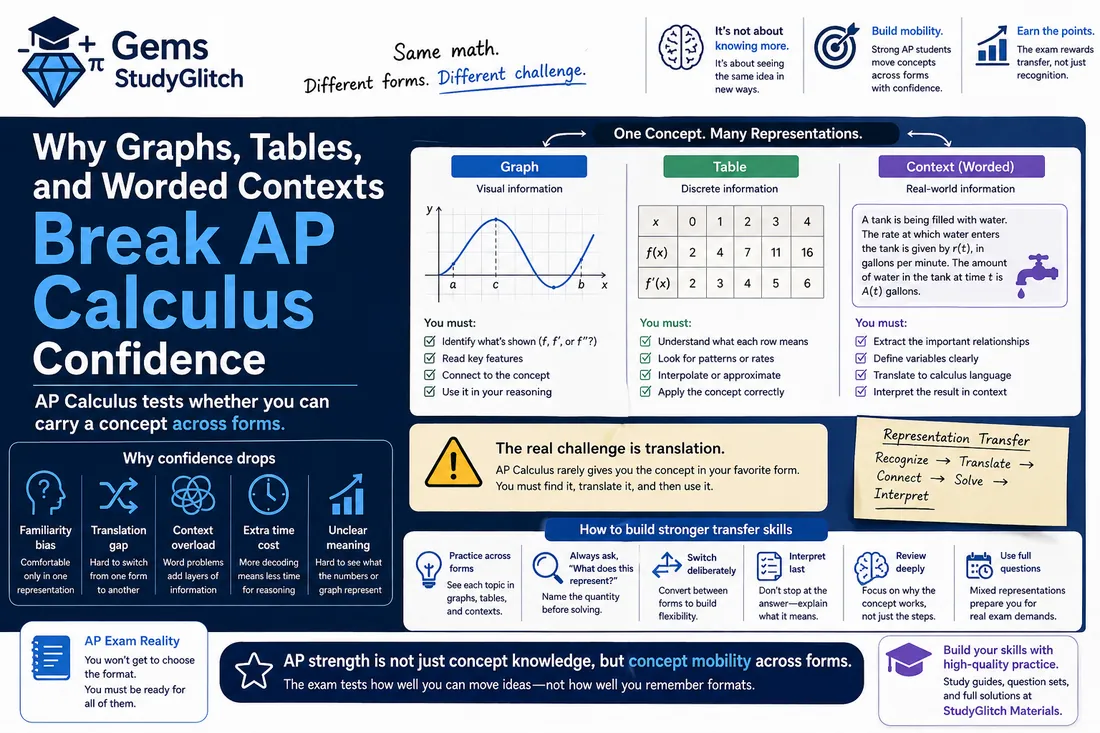
AP Calculus AB students feel confident when a question looks direct.
Give them a function, ask for a derivative, and they know what to do. Give them an integral in a familiar form, and they can begin. Ask a standard limit question, and the method feels recognizable.
Then the same concept appears through a graph, a table, or a real-world context, and confidence drops.
This is one of the most common AP Calculus problems.
The student may not be missing the concept completely. They may know derivatives. They may know accumulation. They may know increasing and decreasing behavior. But they only feel comfortable when the concept appears in one preferred style.
AP Calculus AB does not only test whether a student recognizes a concept in algebraic form. It tests whether the student can carry the concept across different representations.
That skill is called representation transfer.
And for many students, it is the hidden reason AP Calculus feels harder than expected.
What representation transfer means in AP Calculus
Representation transfer means moving a calculus idea from one form to another.
A concept might appear as:
- An equation.
- A graph.
- A table.
- A verbal description.
- A real-world rate.
- A contextual situation.
- A multi-part question that combines several forms.
The calculus idea may be the same, but the surface form changes.
For example, a derivative can appear as a formula to calculate, a slope on a graph, a rate in a worded context, or values listed in a table. Accumulation can appear as an integral, an area under a graph, a total change from a rate, or a quantity increasing over time.
Students often think they know a concept because they can solve it in one form. But AP Calculus asks a harder question:
Can you recognize the same idea when it looks different?
That is where confidence often breaks.
This is why AP Calculus AB preparation should train students across representations, not only through direct algebraic practice.
Why familiar algebra feels easier
Algebraic questions often feel safer because the student knows where to begin.
If the question gives a formula, the student can look for a rule. Product rule, chain rule, quotient rule, substitution, derivative, integral, limit behavior — the action may feel more obvious.
This creates a sense of control.
The student sees symbols, remembers a procedure, and begins applying steps.
But AP Calculus AB is not only about applying procedures. It is about understanding what the procedure means and when the idea should be used.
That is why graphs, tables, and worded contexts feel different.
They remove some of the obvious signals.
A graph may not say “differentiate this.” A table may not announce “use average rate of change.” A worded context may not clearly label the function, the rate, the accumulated quantity, or the variable relationship.
The student has to extract the calculus idea before solving.
That extra translation step is what causes many students to lose confidence.
Why graphs can feel difficult
Graph questions can feel difficult because they ask students to read meaning visually.
A graph is not just a picture. In AP Calculus AB, a graph may represent a function, a derivative, a second derivative, a rate, or a quantity changing over time. The student must first identify what the graph is showing before deciding what the graph means.
This is where many mistakes begin.
A student may look at a graph of f prime and accidentally reason as if it were a graph of f. Another student may use the shape of the graph but forget whether the question asks about increasing, decreasing, concavity, extrema, or accumulation.
The problem is not always that the student does not know calculus.
The problem is that the student has not trained enough with visual translation.
Graph questions require students to ask:
- What does this graph represent?
- Is it showing a function, a derivative, or a rate?
- What does positive or negative mean here?
- What does increasing or decreasing mean here?
- What quantity is the question actually asking about?
- How does the graph connect to the calculus concept?
These questions are not a full lesson. They are a control system.
They help the student avoid treating every graph the same way.
Why tables create confusion
Tables create a different kind of challenge.
A table gives discrete information. Instead of seeing a full function or a full graph, the student sees selected values. That means they must reason from limited data.
This can feel uncomfortable.
Students may wonder whether they should subtract values, estimate a rate, use an average rate of change, approximate an integral, compare intervals, or interpret a value in context.
The table does not always tell them directly.
That is why table questions often expose whether the student understands the role of the numbers.
A table value is not automatically the answer. It may be the function value, the derivative value, a rate, a measurement, or a piece of information needed for a larger conclusion.
Students lose points when they treat tables mechanically.
They may grab numbers too quickly without asking what those numbers represent.
A better habit is to pause and label the table mentally:
What is in the first column? What is in the second column? Are these values of the function, the derivative, or a rate? Is the question asking for a value, a change, a rate, an estimate, or an interpretation?
Once students learn to read tables this way, they become less intimidating.
The table is not the enemy. The unclear meaning of the table is the problem.
Why worded contexts feel harder
Worded AP Calculus questions feel harder because they add a translation layer.
The calculus may be familiar, but it is hidden inside a situation.
A student may need to identify what is changing, what the rate represents, what the initial value means, what the bounds describe, and what the final answer should mean in context.
This is why a student can know accumulation but still struggle when the question describes water entering a tank, a particle moving, a population changing, or a quantity increasing and decreasing over time.
The math idea is not necessarily new.
The form is new.
Worded contexts require students to translate language into calculus structure. They must connect phrases like “rate of change,” “total amount,” “at time t,” “from t equals a to t equals b,” or “how much has changed” to the correct calculus action.
This is not about memorizing every possible story.
It is about recognizing the role of the quantities.
Students should ask:
- What quantity is being measured?
- What quantity is changing?
- Is this value a rate or an amount?
- Is the question asking for a value, a change, or an interpretation?
- Does the final answer need context or units?
This helps turn worded questions from stories into structured math.
The same concept can feel like three different topics
One reason AP Calculus confidence drops is that students experience the same concept as if it were multiple unrelated topics.
For example, they may feel that derivatives from formulas, slopes on graphs, and rates in word problems are three separate skills.
But they are connected.
The derivative idea is still about rate of change. The representation changes, but the concept remains linked.
The same thing happens with accumulation.
Students may treat integrals, area under a curve, total change from a rate, and context-based accumulation as separate tasks. But AP Calculus often expects students to see the connection across all of them.
This is why concept mobility matters.
A student does not fully own a calculus concept until they can recognize it across forms.
Knowing a derivative rule is useful. But AP strength grows when the student can also identify derivative meaning in a graph, a table, and a real-world situation.
That is the difference between procedural comfort and conceptual control.
Representation shifts expose shallow understanding
Representation shifts are powerful because they reveal whether understanding is flexible.
A student who only memorized a procedure may perform well when the question looks familiar. But when the representation changes, the procedure may not be obvious anymore.
This does not mean memorization is useless. Students still need rules, formulas, and common structures.
But memorization alone is fragile.
If the student only knows what to do when the question looks a certain way, the confidence will collapse when AP changes the form.
This is why Study AP Calculus Without Memorizing Everything is an important idea. AP Calculus does not reward memorization alone. It rewards understanding that can move.
A flexible student can say:
This graph is showing a rate, so the area connects to total change.
This table gives derivative values, so I need to think about rate behavior.
This context describes accumulation, so the integral has meaning beyond calculation.
That is the kind of thinking AP Calculus wants.
Why students say “I knew this” after missing the question
After reviewing a missed graph, table, or context question, students often say:
“I knew that.”
And they may be right.
They knew the concept after the form was explained.
But the exam challenge was not only knowing the concept. The challenge was recognizing it before the explanation.
That distinction matters.
Knowing after review is not the same as recognizing during the exam.
A student may understand the solution once the teacher labels the idea. But on the exam, there is no label. The student must identify the concept alone.
This is why AP Calculus preparation must train recognition before explanation.
Students should not only ask:
Do I understand the solution?
They should ask:
Would I have known what concept this question was testing before someone explained it?
That is a stronger test of readiness.
This also connects to Why AP Calculus AB Students Lose Points Even When They Know the Concept. Sometimes students understand the idea privately, but the exam requires visible control and correct translation.
Confidence drops when the first step is unclear
Many AP Calculus students lose confidence because they do not know how to start.
The first step feels unclear when the representation is unfamiliar.
With an equation, the student may immediately apply a rule. With a graph, they must interpret. With a table, they must decide what the values mean. With a context, they must translate the situation.
That delay creates doubt.
Doubt then creates pressure.
Pressure then makes the student rush, freeze, or overthink.
This is how confidence breaks.
The solution is not to tell students to “be more confident.” Confidence grows when students have a repeatable approach for unfamiliar forms.
A strong approach might be:
Identify what is given. Name what it represents. Connect it to the calculus concept. Choose the action. Interpret the result.
This simple sequence helps students stay calm because they are no longer waiting for instant recognition. They have a process for reaching recognition.
AP Calculus tests whether concepts transfer
The strongest AP Calculus students are not always the ones who memorized the most question types.
They are often the ones who can transfer concepts across forms.
They understand that a derivative may appear visually, numerically, verbally, or symbolically. They understand that accumulation may appear as area, total change, a rate context, or an integral expression. They understand that a graph or table is not a separate universe. It is another way of showing the same mathematical relationship.
This is one of the biggest differences between classroom comfort and AP exam readiness.
In class, students may practice one representation at a time. On the exam, representations may shift quickly.
That is why AP Calculus confidence must be built across forms.
The question is not only:
Can I solve this when it is written as an equation?
The better question is:
Can I still recognize the concept when the exam changes how it is shown?
That is the real AP demand.
How to build stronger representation transfer
Students can improve representation transfer with the right practice habits.
The goal is not to do endless random problems. The goal is to deliberately practice the same concept in different forms.
For example, after studying a concept, students can ask:
- What does this idea look like as an equation?
- What does it look like on a graph?
- What does it look like in a table?
- What does it mean in a worded context?
- What phrases or features usually reveal it?
- What mistakes happen when the representation changes?
This creates mobility.
Students should also review mistakes by representation type.
Instead of writing only “derivatives” as the weak topic, write more specifically:
Derivative meaning from graph. Derivative values from table. Derivative interpretation in context. Derivative calculation from equation.
This is much more useful.
It shows whether the student has a concept problem or a representation problem.
A AP Calculus AB diagnostic test can help reveal these gaps because students often do not know whether they are missing content or struggling with transfer.
Why materials should train more than formulas
Good AP Calculus materials should not only explain formulas.
They should help students see concepts from multiple angles.
A student who only studies algebraic examples may feel prepared until the exam changes the representation. Then confidence drops because the practice did not match the real demand.
This is why StudyGlitch materials should be used with a transfer mindset.
Students should not only ask:
Did I finish the lesson?
They should ask:
Can I recognize this same idea if it appears in a graph, table, or context?
That is a better measure of AP readiness.
Materials should build understanding, but students must also test whether that understanding moves.
What AP Calculus AB actually demands
AP Calculus AB demands more than topic coverage.
It demands interpretation, reasoning, communication, and transfer.
A student may cover all major units and still struggle if the concepts remain trapped in one format. The exam can take a familiar idea and present it in a less familiar way.
That is why students should avoid judging readiness only by whether they “know the lesson.”
They should ask whether they can use the lesson in different forms.
This is part of what What AP Calculus AB Actually Demands From Students explains. AP Calculus is not only about remembering content. It is about applying that content under exam conditions.
Graphs, tables, and contexts make that demand visible.
They show whether the student can move from recognition to reasoning.
Frequently Asked Questions
Why are graph and table questions harder in AP Calculus AB? Graph and table questions feel harder because they require interpretation before calculation. Students must first identify what the graph or table represents, then connect it to the correct calculus concept.
Why do worded AP Calculus questions feel harder than direct ones? Worded questions feel harder because the calculus is hidden inside a situation. Students must translate the context into variables, rates, quantities, bounds, or accumulated change before solving.
Does AP Calculus test the same concept in different forms? Yes. AP Calculus AB often tests the same concept through equations, graphs, tables, and verbal contexts. Students need to recognize the idea even when the representation changes.
How can I get better at AP Calculus representation shifts? Practice the same concept across different forms. After learning a topic, study how it appears as an equation, graph, table, and context. Review mistakes by representation type, not only by topic name.
Why do I understand the topic but struggle when the question looks different? You may understand the concept in one form but have not yet built concept transfer. AP Calculus confidence grows when you can carry the same idea across unfamiliar representations.
Final thought
Graphs, tables, and worded contexts do not break confidence because they are impossible.
They break confidence because they test whether the concept can move.
That is the real AP Calculus challenge.
A student is not fully prepared only because they know the rule in one format. They become stronger when they can recognize the same idea in a graph, extract it from a table, and interpret it inside a real context.
AP strength is not just concept knowledge.
It is concept mobility across forms.