
One of the most common problems in math prep is not lack of effort.
It is lack of resource control.
Students often collect too much material too quickly. A few PDFs become ten. One practice source turns into five different platforms. A useful video turns into a long chain of unrelated videos. Soon the student is juggling books, worksheets, downloaded files, random question banks, screenshots, and conflicting advice without any clear standard for what actually deserves trust.
This is where preparation starts to break down.
Many students assume that having more material means having better preparation. In reality, too much uncontrolled material often creates confusion, weak calibration, and unstable confidence. Students begin mixing questions that do not reflect the real exam, methods that do not match the test well, and explanations that pull them away from how the exam actually behaves.
This is why resource judgment matters.
The strongest prep systems are not built on collecting everything. They are built on choosing what should anchor the process, what should support it, and what should stay out.
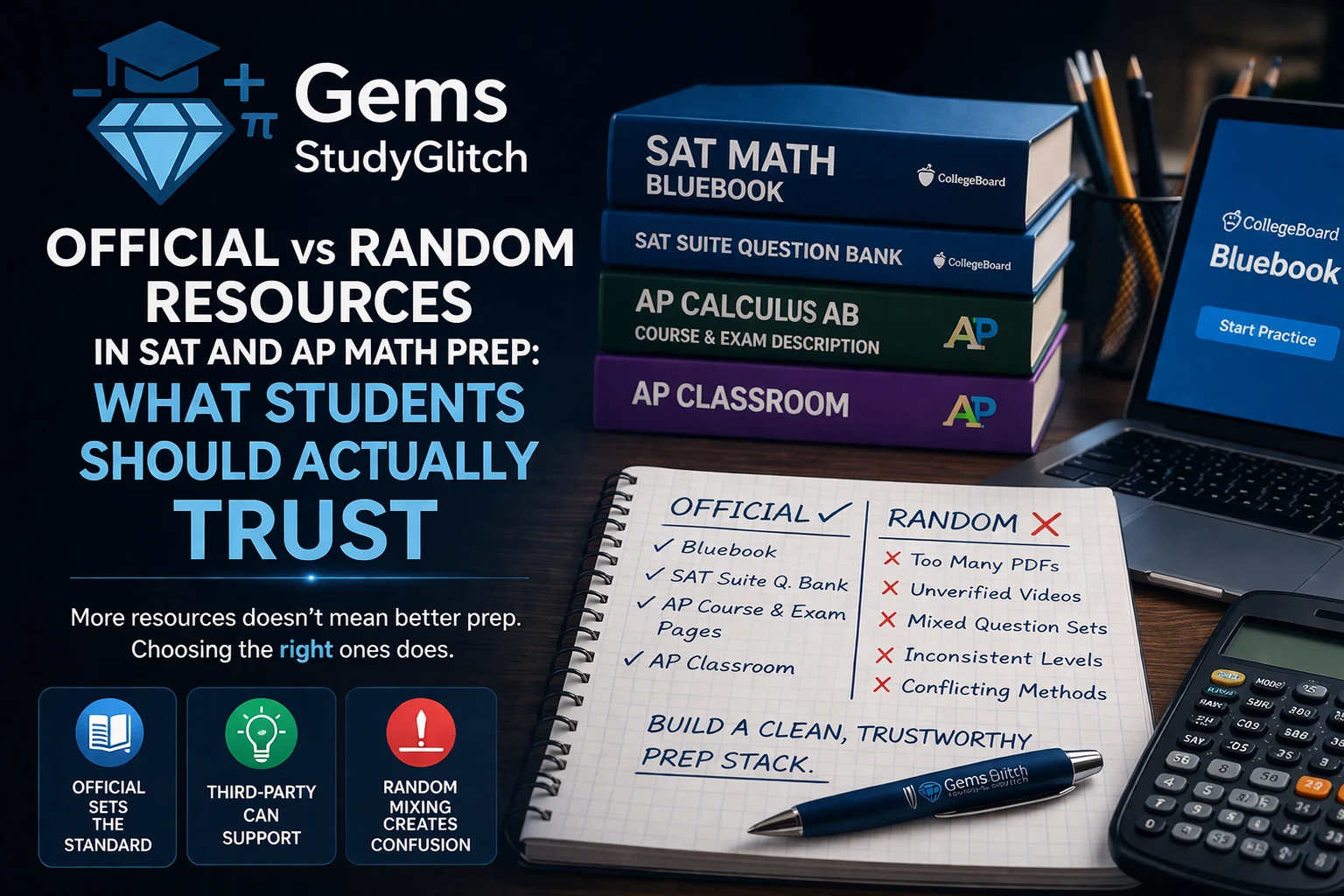
For SAT Math and AP Calculus AB, the smartest starting point is usually the same: official resources should define the standard. Third-party resources can support, but they should not replace the exam’s own signals. And random uncontrolled mixing is where many students lose clarity.
Why Students Get Lost in Resource Overload
Resource overload usually begins with good intentions.
A student wants to improve, so they search for the best SAT Math resources, the best AP Calculus AB resources, the best question banks, the best video explanations, the best books, the best worksheets, and the best shortcuts. But instead of building clarity, that search often creates a pile.
The pile becomes the problem.
Once a student is working from too many disconnected sources, several things start happening at once. The level of difficulty becomes inconsistent. The style of questions becomes inconsistent. The logic behind the solutions becomes inconsistent. The student stops knowing whether weak performance is coming from the real exam demands or from badly selected materials.
That confusion affects both accuracy and confidence.
A student may feel productive because they are doing a lot, but the prep itself becomes scattered. One source emphasizes tricks. Another emphasizes long traditional methods. Another uses question styles that do not resemble the real exam closely enough. Another is simply too easy or too strange to be useful.
The result is often false confidence in some areas and unnecessary panic in others.
This is why resource selection is not a side issue. It shapes the quality of preparation itself.
Why Official Resources Should Set the Standard
Official resources matter because they come from the exam ecosystem itself.
That does not mean official material is the only material a student should ever use. It means official material should define the reference point. If a student wants to know what the exam actually values, what the wording feels like, how the structure behaves, and how questions are framed, official sources should carry the most weight.
This matters because exams are not just collections of math topics.
They are specific assessment systems.
Each exam has its own style, structure, pacing, language, priorities, and expectations. Students often underestimate how much this affects performance. A student may know the content but still prepare inefficiently if the resources being used do not reflect the real assessment well enough.
Official resources help prevent that mismatch.
They give students a more reliable picture of what the exam is actually asking them to do. They set the standard for difficulty, style, and decision-making. They help students calibrate correctly instead of guessing their way through prep using random internet material.
That is why official resources should anchor the stack, not sit somewhere in the middle of it.
The Official SAT Anchor
For SAT Math, official resources should be the foundation.
The clearest anchors are Bluebook and the SAT Suite Question Bank.
Bluebook matters because it reflects the actual digital testing environment students are preparing for. It is not just a source of questions. It helps students experience the structure, pacing, and feel of the exam in a way that random worksheets cannot reproduce properly.
The SAT Suite Question Bank matters because it gives students access to official question material tied much more closely to the actual exam logic than most uncontrolled third-party sets.
Together, these resources do something very important: they define the standard.
They help students understand how SAT Math actually behaves. They show what kinds of reasoning are rewarded, what kinds of shortcuts are reliable, what kinds of setups are efficient, and how the exam presents its demands. That is essential because SAT Math is not just about content coverage. It is also about decision-making, route choice, and solving under the structure the exam actually uses.
Students who ignore official SAT material and build their prep mostly around random sources often distort their calibration. They may end up training on material that is too mechanical, too tricky in the wrong way, too traditional, or simply too detached from the actual exam style.
That is why SAT prep should be built outward from official material, not inward toward it.
Related SAT Articles: SAT article 1, SAT article 2.
The Official AP Anchor
For AP Calculus AB, official resources should also set the standard.
The strongest anchors are the official AP course and exam pages along with AP Classroom direction.
These resources matter because AP Calculus AB is not only about knowing calculus content. It is about understanding how the course framework, exam expectations, representations, and scoring logic fit together. Students who prepare without reference to official AP signals often misunderstand what the course is really demanding from them.
Official AP resources help solve that problem.
They clarify the course structure. They help students understand what kinds of questions, representations, and reasoning the exam is built around. They provide better alignment with what the exam expects students to do, not just what a random resource happens to emphasize.
This is especially important in AP Calculus AB because students can easily waste time on materials that are mathematically related but not well aligned to the actual exam. Some resources overcomplicate. Some simplify too much. Some train students in ways that do not support the precision, notation, and process control the exam actually rewards.
Official AP direction gives students a more stable frame.
It does not solve everything on its own, but it prevents prep from floating away from the exam’s true center.
Related AP Calculus AB articles: AP article 1, AP article 2
When Third-Party Resources Help
A balanced prep system should not reject third-party resources completely.
Third-party material can be very useful when it plays the right role.
It can help with explanation. It can help with targeted drilling. It can help students revisit weak concepts from a different angle. It can help create more repetition once official material has already defined the standard. It can also help when students need structure, pacing support, or guided sequencing that official platforms alone do not always provide.
That is where good support material becomes valuable.
The key is that third-party resources should support official calibration, not replace it.
A strong third-party resource usually helps students understand the exam better, organize their work better, or strengthen specific weak areas without pulling them away from the real exam logic. It adds clarity instead of distortion.
This is also where guided systems can help students avoid overload. A student does not always need more material. Often they need better selection, cleaner sequencing, and clearer judgment about what deserves attention.
Students who want a more guided starting point can begin with a diagnostic.
From there , you can visit Materials Page and target diagnostic test's exposed weakness in topics & skills, using guided materials.
When Third-Party Resources Start Hurting Prep
Third-party material becomes a problem when it stops supporting the exam and starts replacing it.
This usually happens in a few familiar ways.
Some students use resources that are far too disconnected from official style. Others collect multiple overlapping resources and keep switching between them before any real structure forms. Others rely too heavily on content that makes the exam look easier, harder, or stranger than it really is.
This is where score instability begins.
A student may feel well-prepared because they have done many questions, but if those questions are poorly chosen, the preparation can still be weak. Random resource stacks often create one of two distortions. Either the student becomes overconfident because the material is not representative enough, or the student becomes discouraged because the material is distorted in the opposite direction.
Both outcomes are harmful.
Poor resource control also damages confidence. When students work from too many mixed sources, they stop trusting their own performance signals. A bad result on one random set feels more important than it should. A good result on an unrepresentative set feels more reassuring than it should. The student loses calibration.
That is why random uncontrolled mixing causes so much confusion. It does not just waste time. It makes performance harder to interpret.
How to Build a Clean Prep Stack Without Overload
A better prep stack is usually simpler than students expect.
Start with the official anchor.
For SAT Math, that means centering the prep around Bluebook and the SAT Suite Question Bank.
For AP Calculus AB, that means grounding the prep around official AP course and exam guidance along with AP Classroom direction.
Then add support selectively.
That support may include concept review, targeted practice, or guided structure from a good third-party source. But every added layer should answer a clear question. Why is this here? What weakness is it helping solve? Does it support the official standard or pull me away from it?
If the answer is unclear, the resource probably does not belong in the stack.
This kind of clean prep structure matters because students rarely struggle from having too little information anymore. More often, they struggle because they are carrying too much low-control input at once.
A stronger system is usually built from fewer, better-chosen sources.
Why Resource Quality Affects Score Stability and Confidence
Students often focus on quantity because quantity feels measurable.
- More questions.
- More videos.
- More hours.
- More pages.
But score stability comes more from alignment than volume.
When resources are well chosen, students build a more accurate sense of the exam. Their timing improves more meaningfully. Their interpretation of weak areas becomes more reliable. Their confidence becomes steadier because it is based on cleaner signals.
When resources are badly chosen, the opposite happens.
Prep feels noisy. Students misread their level. Weaknesses become harder to diagnose. Confidence swings too much because the preparation itself is unstable.
This is why resource quality matters so much. It shapes not only what students study, but how accurately they understand their own readiness.
A student using a clean, well-anchored prep stack usually develops better score stability than a student using a much larger but more chaotic pile of material.
What Students Should Actually Trust
Students preparing for SAT Math or AP Calculus AB do not need to distrust every third-party source.
They need to place trust in the right order.
Official resources should define the exam.
Third-party resources can support the process.
Random uncontrolled mixing is what usually creates the damage.
That order matters.
It creates a prep system that is clearer, more balanced, and more trustworthy. It reduces confusion. It improves calibration. It gives students a better chance of building real exam readiness instead of just collecting material.
Students who need a cleaner plan can start with a diagnostic.
Students who want more direct support building a curated study path can explore targeted tutoring support.
Frequently Asked Questions
Should students only use official SAT and AP resources? Not necessarily. Official resources should define the standard, but strong third-party resources can still help with explanation, targeted practice, and structure when they support rather than replace official calibration.
What are the most important official SAT Math resources? Bluebook and the SAT Suite Question Bank are the main official anchors because they reflect the digital SAT environment and official question logic more closely than random outside material.
What are the most important official AP Calculus AB resources? The official AP course and exam pages along with AP Classroom direction are key anchors because they help students align their preparation with the real course framework and exam expectations.
Why do random resource stacks hurt preparation? Random uncontrolled mixing often creates confusion, weak calibration, and unstable confidence because students end up practicing on materials that do not reflect the actual exam consistently enough.
How can students build a better prep stack? A better prep stack starts with official resources, then adds carefully selected support material only when it has a clear role and improves structure, explanation, or targeted correction.